![MaritimeJournal[Seawork]](https://www.maritimejournal.com/wp-content/uploads/2026/09/MaritimeJournalSeawork.svg)



Green ship breaking comes to Europe
With some 1,400 ships predicted to be consigned to the breakers each year, shipbreaking is an expanding business sector.
More than 90% of the world’s shipbreaking takes place in India and Bangladesh, where labour costs are almost a tenth of those in the developed world, but there are some smaller facilities in Europe, including Turkey and the UK.
However, there are only two shipbreaking yards on the European mainland acccredited to the International Ship Recycling Association (ISRA). The association, based in The Netherlands, was founded in 2007 to promote environmentally friendly ship recycling. Its membership includes five yards in China, three in Turkey, one in the Netherlands and the Galloo shipbreaking yard on the banks of the Ternuezen-Ghent channel in Belgium.
The Galloo Ghent facility, which covers 10hectares of land, was previously known as Van Heyghen Recycling. The yard has been breaking up ships since 1928 and it is reported to dismantle about 45 vessels a year.
It is most economical to break up smaller vessels as close to home as possible and several small ships which had been familiar sights in UK coastal waters have recently arrived at their final berth at the Galloo yard which has an 800m quay and a 38m wide slipway.
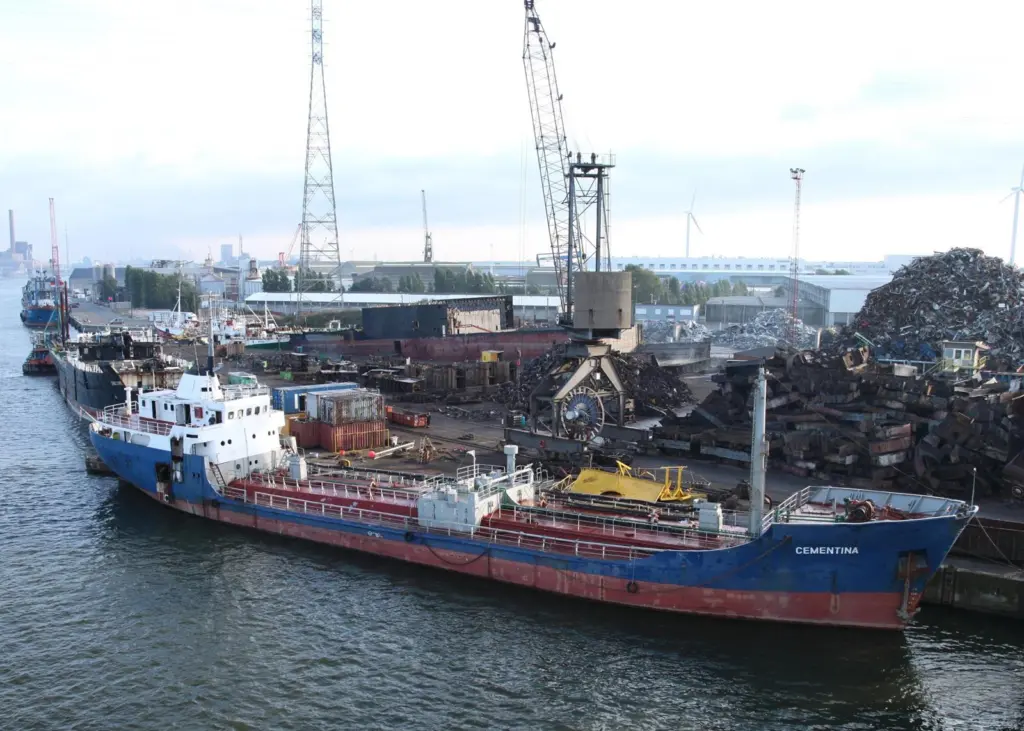
Two vessels from Torbulk’s troubled fleet ending their days here are the dredger Thames (1974/2,929gt/4,357 dwt) and the 1960 built cement carrier Cementina (1,096gt/1,205dwt), which arrived in Belgium under their own steam earlier this year. These followed Torbulk’s general cargo vessel Swan Diana, which was recently recycled at the yard.
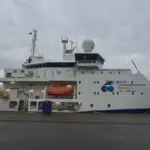
Another UK operated ship being cut up by hand on the quayside is the obsolete Royal Research Ship Discovery, operated by the ERC, which has recently been replaced by a new vessel with the same name (see MJ October 2013). The demolition of the 1962 built 3,008gt/1,520dwt ship was well under way in early October when the superstructure had been stripped down to below the main deck level.
On the slipway behind, the remaining stern section of a much larger ship, the 200m, 11,000 ton natural gas tanker Tellier, is slowly being picked to pieces, while several trawlers, a couple of Van Oord dredgers and smaller vessels await their fate.
By Graeme Ewens