![MaritimeJournal[Seawork]](https://www.maritimejournal.com/wp-content/uploads/2026/09/MaritimeJournalSeawork.svg)



Habbeke delivers a Rotterdam pilots taxi
Based at Volendam in the Netherlands, Habbeke Shipyard has been building aluminium vessels since 1966, winning the Dutch Aluminium Prize for innovation, quality and service in 1994. The yard has established excellent long term relationships with a number of clients, including the Royal Dutch Lifeboat Association (KNRM).
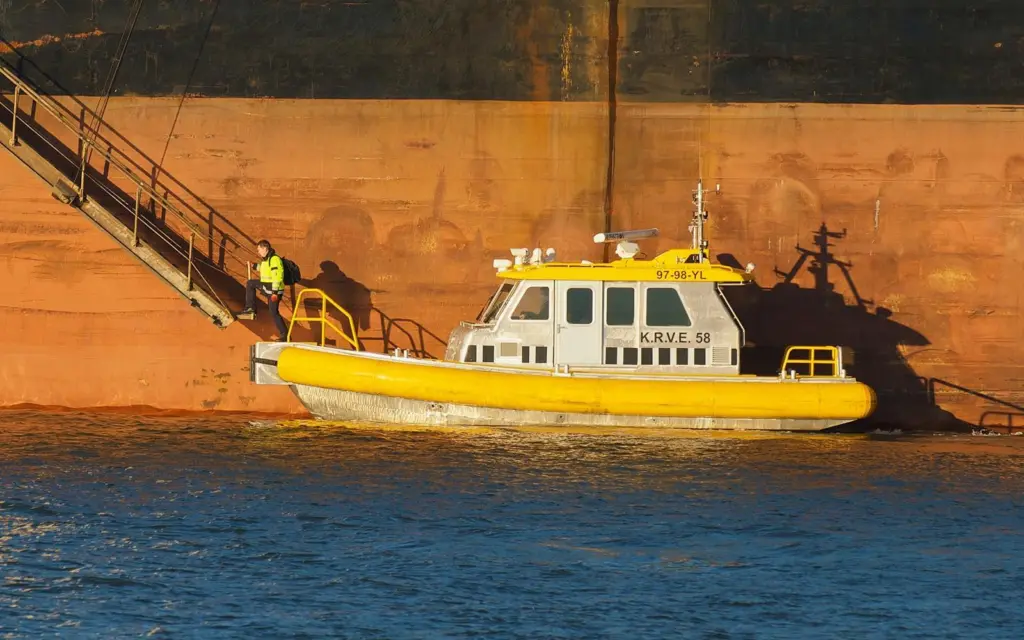
Habbeke Shipyard has recently delivered a new crew tender to the KRVE in Rotterdam, which that organisation will use as an alternative to driving pilots through Rotterdam road congestion in taxis. The tender, named the
KRVE58
, will operate as a very rapid tender taking pilots and crew members to vessels in the Rotterdam harbour complex and the North Sea.
The aluminium built vessel can carry four passengers in addition to the captain. All are accommodated in a luxurious cabin with heated floors and walls, with air conditioning for warmer temperatures and dry air. The passengers sit on suspension mounted NorSap/Shockwave seats.
KRVE58 is powered by a single John Deere 2175SFM75 main engine rated at 610hp and driving a Rolls-Royce Kamewa FF410 waterjet through a ZF Marine 3050 gearbox, delivering a speed of 33 knots. The engine also drives a number of hydraulic pumps, the air conditioning, water pumps, bow thrusters and a 10KVA generator.
This RIB has been specifically designed for the rough and tumble of Rotterdam harbours and is, according to Orm de Waart of the Habbeke Shipyard, ‘streetwise’.
When plans for this new vessel were first discussed, the emphasis was for a rapid and reliable tender. However, as discussions continued, it became clear to Orm de Waart and his team that this would be one of the most advanced boats in the Rotterdam or anywhere else.
One of the challenges which Habbeke Shipyard looked to overcome was the apparent fragility of the tubes traditionally built for this sort of vessel. Gerrit van de Burg of the KRVE points out that each tender makes something in the region of 100 controlled collisions per day as it delivers or collects pilots and other crew members. The tube therefore has to act as a shock absorber/fender, and resist collisions with sharp objects such as broken ladders, or steel bolts or pieces of reinforced concrete, as well as acting as a buoyancy aid to ensure that the vessel remains afloat even if completely full of water.
Poly-Marine in Maassluis, a company specialising in solving these sorts of problems, developed a special tube for the boat. Drawing upon their offshore experience, Poly-Marine has produced a tube with a hard exterior but filled with foam. This formula appears to work, as tests have included driving a fork lift truck hard into the tube without affecting its functionality in any way. Any boat using these tubes can thus be pushed bow first or alongside against another surface without serious damage.
In order to maximise the safe transfer of passengers, the boat has a warmed and fenced platform in the bow. With the nose of the boat pressed against the receiving vessel, crew members can step safely from one vessel the other, or from the tender onto dry land.
The vessel has been designed by the Willem de Vries-Lentsch marine architects office, which also designed the family of aluminium RIB lifeboats for the KNRM (the Valentijn, Arie Visser and Johannes Frederic classes).
Gerrit van der Burg is hopeful that if this first vessel lives up to the KRVE’s expectations, then others will follow. They presently use nine Mercedes Benz taxis, each driving 180,000 km per year, to transport pilots around the Rotterdam harbour complex. With the continuing increase in road congestion this is becoming ever more difficult to carry out effectively. Using Rotterdam’s complex of waterways is an obvious alternative solution.
After an exhaustive testing period, with vessels running 2,000 hours over the past five months, Orm de Waart is start working on the next boat in the series.