![MaritimeJournal[Seawork]](https://www.maritimejournal.com/wp-content/uploads/2026/09/MaritimeJournalSeawork.svg)

Macduff designs dynamic workboat duo
Two Macduff Ship Design tug/workboats have entered service recently, further increasing the extensive range of vessels now offered by the company.
Completed in October 2010 by Manor Marine in Portland, Dorset the 12.95m
Maid Marion was designed to the order of British Waterways.
With an ageing fleet of single screw river/canal tugs, British Waterways contracted Macduff to design a modern, efficient, twin screw tug. Macduff was responsible for handling the entire tender exercise which ultimately led to the build contract being awarded to Manor Marine.
Manor Marine was supplied with a complete technical and drawing package (including cutting information) from Macduff, which also carried out supervision of construction and attendance at trials on behalf of British Waterways.
The vessel’s primary roles are the pushing of 150/180T barges, occasional towage with an aft tow hook, plough dredging and general canal/lock maintenance using its own hydraulic deck crane. The area of operation is the river and canal system in the Midlands and the vessel is certified to the MCA Code of Practice for Small Commercial Vessels up to 24m load line length, Category 2. All certification and approvals were carried out by The Society of Consulting Marine Engineers and Ship Surveyors.
Of all welded steel construction, the vessel is heavily built to withstand the rigours of barge pushing and operating in confined and shallow areas. With a length overall of 12.95m, beam moulded of 4m and moulded depth of 2.25m, the vessel has an operating draft aft of 1.48m in pushing mode. Tank capacities allow for 4,048 litres of oil fuel, 496 litres of fresh water, and 700 litres of black/grey water. The vessel can also carry a deck cargo of about three tons that can be handled by the deck crane.
Fitted with twin keel cooled Perkins Sabre M185C main engines rated 190 hp at 2,100 rpm driving four bladed fixed and open propellers through PRM 1000D 4:1 gearboxes, the vessel surpassed contractual requirements. It achieved a free running speed at 100% MCR of 9.36 knots and about 8 knots at 80% MCR, with a static bollard pull of 3.45 tons. The twin aerofoil rudders and Wills Ridley electric hydraulic steering gear provide exceptional manoeuvrability and the centre skeg aft ensures the vessel has positive directional stability.
The hydraulic deck equipment was installed by Hercules Hydraulics and comprises a Fassi M20A.13 hydraulic deck crane with a capacity of 410 kg at 5m, an aft plough dredge winch of type Titan TH3, 41 kn, 44m/min, and two forward barge tensioning winches of type Titan TH1, 10kn, 38m/min. In addition, a Hercules capstan with foot operation is mounted on the aft deck. The hydraulic pumps are driven by one of the main engines and also the auxiliary engine, supplied by Beta Marine. The auxiliary engine also provides single phase power through a 5.5kw alternator.
Bilge pumping is handled by submersible electric pumps in each compartment and the fresh water domestic systems are provided with Cleghorn Waring pressure sets and calorifier (calorifier heated by either an electric immersion heater or main engine cooling system).
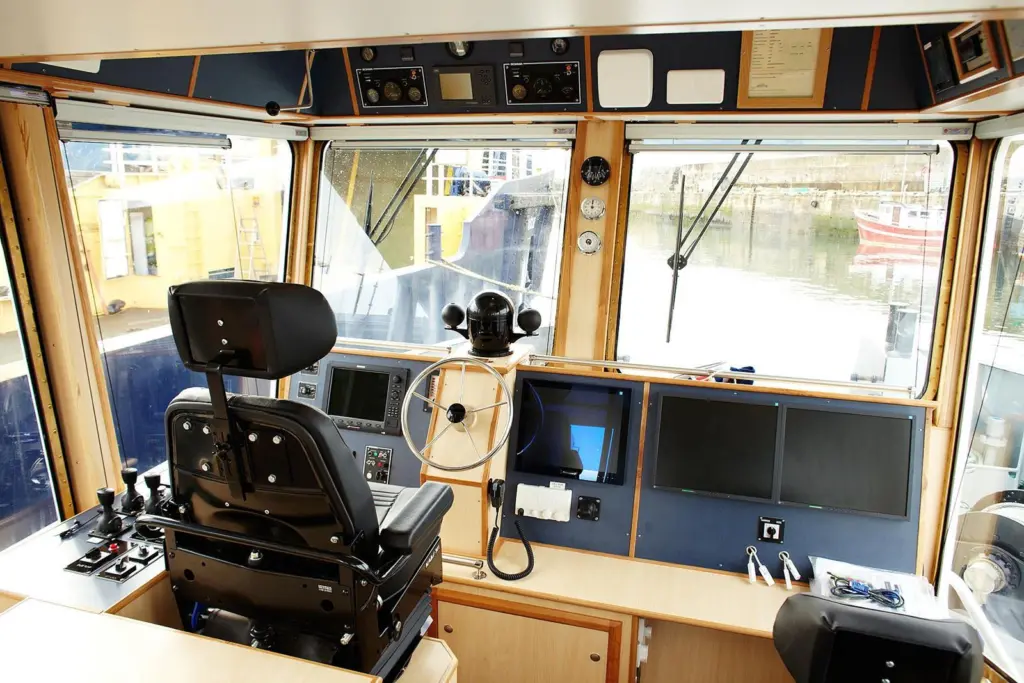
Designed for easy operation with a two man crew, the vessel features a wheelhouse with 360o vision and low forward windows giving the helmsman a full view of pushing operations.
Electronics within the wheelhouse include an Icom BC166 portable VHF, Icom IC M505 fixed VHF, FLS bronze echosounder, FM200 fire extinguishing panel, Electronic Devices fire alarm, engine panels, hydraulic pump panels and various switchboards.
Stepped down from the wheelhouse is a comfortable mess area and small galley fitted out with a sink, microwave oven and fridge. Below the wheelhouse there is a drying locker area and fully fibre glassed toilet compartment.
The vessel has been finished to a high standard both externally and internally and fitted out for heavy duty commercial tasks. The heavily fendered pusher bow features six vertical pusher knees with rubber fendering.
The second vessel to enter service is the 14m Sea Herald, built by Macduff Shipyards for Aberdeen Harbour Board and completed in February 2011.
Aberdeen Harbour Board contracted Macduff Ship Design to design a new multi-purpose workboat able to carry out plough dredging, debris collection, surveying, dive support, lifting, harbour repairs and occasional pilotage.
Macduff acted throughout the contract as owner’s naval architects, handling all aspects from the issuing of a PQQ, ITT and tender evaluation through to the provision of all necessary drawings, including cutting information, supervision of construction and attendance at trials.
Designed specifically to meet the requirements of Aberdeen Harbour, the vessel is a first of class and is certified to the MCA Code of Practice for Small Commercial Vessels up to 24m load line length, Category 3. All certification for this vessel was also carried out by the SCMSS.
With the deck space of a Multi Mac, the vessel features an underwater hull form similar to the 13m tug Fair Maid, designed for Perth Harbour in 2007. This single chine hull form, featuring tunnels in way of the nozzles and a relatively fine bow entry, has ensured optimum performance has been met. With an overall length of 14m, beam moulded of 5.7m and moulded depth of 2.7m, the vessel has a typical operating draft aft of about 1.95m. Tank capacities are 4,270 litres of oil fuel, 215 litres of fresh water, 215 litres of grey water, and 9,000 litres of ballast water.
The vessel is of all welded steel construction, including the wheelhouse. The large deck area is laid out with soft wood sacrificial decking to withstand miscellaneous deck cargos and the vessel can carry about six tons of cargo on deck.
Amongst the vessel’s many roles, debris collection from the surface of the harbour is carried out by a hydraulically hinged collection basket mounted into the bow. It empties into skips sitting on the foredeck forward of the wheelhouse, which are handled by the deck crane.
Main propulsion is provided by two Scania DI12 59M engines rated 350 hp at 1,800 rpm and driving four bladed Kort Propulsion fixed pitch 1,300mm diameter propellers in Kort nozzles through Twin Disc QuickShift gearboxes of type MGX 5114 DC, 4.59:1 ratio. Each gearbox is fitted with a PTO to operate the main hydraulic pumps.
The main engines and gearboxes are flexibly mounted on Southern Cross polyflex mounts to reduce noise and vibration. This set up gave an impressive bollard pull of 9.5 tons and a maximum free running speed of 9.6 knots, both above contractual requirements.
For manoeuvrability, twin Aerofoil rudders are operated by a Southern Cross Hydrive electric/hydraulic steering system which is further enhanced with a Kort Propulsion KT 30DD hydraulic bow thruster with a thrust of 320kg. Even without the bow thrusters, the vessel can turn within its own length.
The auxiliary engine is an Onan 19 MDKBV unit delivering 19 kW single phase and housed within an acoustic box. All engines are keel cooled via Fernstrum grid coolers supplied by Kort Propulsion. They are positioned and protected to avoid damage when working in extremely shallow water or if the vessel dries out.
Macduff Shipyards installed the comprehensive hydraulic deck machinery package which includes a Guerra M110.90A2 deck crane with winch and hydraulic grab. With a capacity of 1.5 tons at 7.9m, the crane is provided with a local control in addition to a remote electric control and covers the complete working deck. For plough dredging duties, the vessel is fitted with twin seven ton SR60 hydraulic winches forward and one identical winch just aft of the wheelhouse. These three winches are controlled from the wheelhouse. The final item of deck equipment is a Maxwell Hydraulic anchor windlass.
The layout of the vessel allows the plough dredge to be either carried on the main deck aft (the bulwark is stopped clear of the stern) or brought in through a gap in the aft bulwark and carried fore and aft on the main deck.
To allow the vessel to stand in for the Harbour’s conventional pilot boats in emergencies, the wheelhouse is offset to port, leaving a clear side deck for boarding. This area is fitted with a Hadrian rail system.
Azcue CA50 bilge/general service pumps are fitted into a spacious engine room that provides full access to all items of equipment for maintenance.
In addition to the main and auxiliary engine being flexibly mounted and the exhaust systems flexibly hung, extensive noise insulation is fitted in the engine room. This has given rise to low noise levels in the wheelhouse and on deck.
The offset wheelhouse has excellent all round visibility, especially over the complete working deck, due to the deep windows all round. KAB seating is provided for the helmsman, surveyor and a crewman while a bench seat is also fitted aft for additional crew.
The vessel is fitted out to a very high standard with a comprehensive kit of electronics, mostly provided and installed by Echomaster Marine Ltd and comprising a Sailor RT 6215 DSC VHF, Icom IC M71 hand held VHF, NSE 12 Network Navigation system with 4kw radome, Furuno FCV 620 echosounder, Furuno NX300 Navtex, Transas Class B AIS, Furuno GP32 GPS, and a JRC – JLR – 20 GPS compass.
For detailed survey work, a Reson Applanix POS MV is installed to work in conjunction with a Reson Navi Sound 620 single beam echosounder.
Below the wheelhouse a full height mess and galley area is arranged together with a WC compartment and plenty of storage lockers. Comfortable seating and messing is arranged for the crew of two, with ample room for supernumeraries.
These two vessels reflect the diversity of designs produced by Macduff and also the level of personalisation that goes into every design by the company.