![MaritimeJournal[Seawork]](https://www.maritimejournal.com/wp-content/uploads/2026/09/MaritimeJournalSeawork.svg)


Monitoring work for old customs boat
A former customs boat, converted by Lower Saxony authorities in north Germany into a water measurement, laboratory and monitoring vessel, is now performing well on the River Elbe.
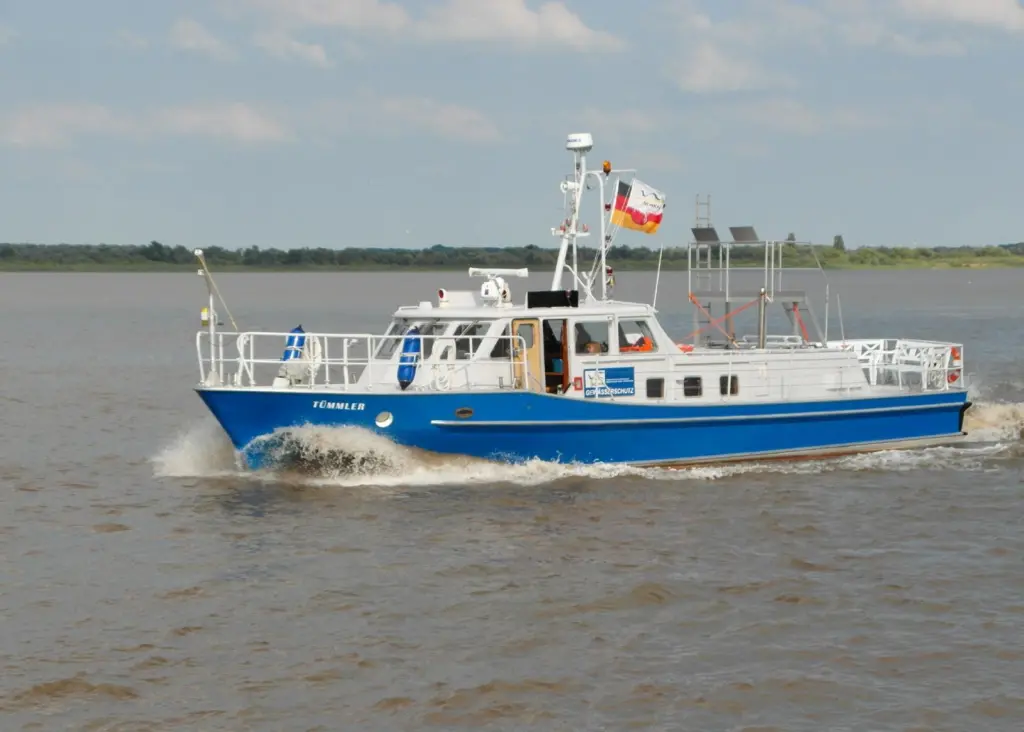
The 17.25m long and 4.35m wide Tuemmler was built in 1980 as the customs boat Rendsburg. It was one of 17 such boats commissioned in various German shipyards by Customs authorities between 1978 and 1990. Most are still in operation. Tuemmler is now in service with the Lower Saxony Water Management, Coastal Defence and Nature Conservation Agency (NLWKN) after conversion at the Behrens Shipyard in Hamburg. It is operating between Cuxhaven at the tip of the Elbe North Sea Estuary and Hamburg – a stretch of about 100 kms.
NLWKN spokesman Achim Stolz told Maritime Journal: Tuemmler was acquired because its 1958 namesake predecessor had to be withdrawn last year because of engine damage. He said the replacement had to date “performed very well indeed”. It was built entirely of aluminium, he reported, meaning it was completely rust-free and in addition was “technically much more modern than its predecessor”.
The new boat also boasted “redundant operation of all security-relevant equipment, for example engines and rudder plant” meaning a “considerable increase in safety and complete manoeuverability even with one engine down”, Mr Stolz added.
Redundancy was particularly important on Tuemmler because it was being used to take mid channel water samples and because the Elbe is one of the world’s busiest waterways. “We always have to give way to the big cargo ships”, Mr Stolz noted.
During conversion, a former sleeping area on the former Rendsburg was transformed into a floated laboratory with a pump providing a continuous supply of test water from the Elbe and electronic probes monitoring oxygen, temperature, conductivity and water clarity.
When the converted boat was taken into service, Lower Saxony Environment State Secretary Almut Kottwitz stressed how important its research work and data was for “plotting long-term water changes and drawing the necessary conclusions”. Data collected on the boat is processed at the NLWKN laboratories in Stade .
Tuemmler also has a special raised platform for observers to monitor river and estuary bird and seal populations under a co-operation programme involving both Lower Saxony and Schleswig-Holstein nature conservation bodies.
Mr Stolz noted that Tuemmler is driven by the same 2 x 250 hp turbo-charged Mercedes LKW engines which were fitted 34 years ago and that these were still “in very good condition”. The reason, he explained, was that the boat had previously been used on the Kiel Canal where there is a 10 knot speed restriction. Its total 500 hp available power and speed of 20 knots had never been fully utilised by the Customs authorities, he said.
By Tom Todd