![MaritimeJournal[Seawork]](https://www.maritimejournal.com/wp-content/uploads/2026/09/MaritimeJournalSeawork.svg)



Mustangs ali pilot flies at Seawork
Pembroke Dock based Mustang Marine has delivered a new 16m aluminium pilot cutter to the Port of Tyne Authority. Collingwood was completed in time to appear on the floating pontoon at Seawork International 2008 in Southampton last month.
The design and build contract heralds Mustang’s first award under the auspices of an exclusive cooperation alliance for production of alloy and steel pilot boats it has entered into with internationally known designers Camarc Ltd.
The arrangement further develops the relationship realised over the last six years during the construction of three 20m steel pilot boats for the Milford Haven Port Authority and the Port of Tianjin.
The 16m design for the Port of Tyne is similar to other Camarc designed boats in operation for PD Teesport and Falmouth Harbour Commissioners but these boats are constructed in GRP, hence the Tyne boat is the first in the UK built in aluminium. The 16 to 17m range of pilot boats is a key size within the UK market.
This hull structure is derived from that for 16m aluminium pilot boats in service with Sandy Hook Pilots of New York USA, four of which entered into service between 2000 – 2004. Around the world there are a large number of authorities that have been operating Camarc designed aluminium pilot boats for a great number of years, including the Dutch Pilots.
All Camarc pilot boats share the same general type of hull form whether constructed of steel, aluminium or GRP. This double chine form gives a finer entry than conventional chine boats whilst retaining the roll stability of that hull type. The result is a fast vessel with excellent seakeeping properties.
For Mustang Marine, the process of procuring this order began in the autumn of 2006 when the Port of Tyne commenced a competitive process. A number of designs were thoroughly assessed and a number were trialed, including the Teesport boat, which impressed with its seakeeping in similar conditions to those which are experienced at the Port of Tyne.
At the end of a hard fought competition, the order for the Tyne boat went to Mustang Marine. Designed for a minimum service life of 15 years, the structure exceeds the requirements of Lloyds Register Rules and Regulations for the Classification of Special Service Craft and the vessel complies with the MCA Small Commercial Vessel and Pilot Boat Code Category 3.
To further augment the durability qualities of aluminium, the proven structural design was allied with a Popsure fendering system manufactured by Trelleborg CRP of Skelmersdale UK. A modular polyurethane foam section with a polymer skin is fitted at the gunwale with a key fit to the hull for simple replacement, as also proven on the Tees and Falmouth boats.
Mustang Marine used the latest version of their Ship Constructor CAD software to develop the aluminium kit in-house. Construction began in January of this year following fine tuning with the software, after which the build progressed smoothly.
Collingwood‘s hull, deck and superstructure is fabricated throughout using marine grade aluminium alloy, with plate of Grade 5083-0 and section of Grade 6082-T6. There is transverse primary stiffening, with longitudinal engine beds, girders and stringers extend forward and aft as required. The hull structure is arranged to withstand normal operational loading and is specially reinforced for the high local impact loads associated an anticipated 1,000 vessel impacts per year during pilot transfers and the requirement to operate in 5m significant wave heights and 40 knot wind speeds. The ring frames incorporate deck knees and additional knees are fitted at half-frame intervals in the forward boarding area and in the after quarters.
Four transverse bulkheads divide the hull into five watertight compartments; the aft peak, aft compartment, engine room, forward compartment and fore peak. The aft compartment is further divided to include a tank space.
The aluminium wheelhouse is arranged on a single level with the bridge deck forward, an accommodation area aft, and access via a door in the aft bulkhead. Seaglaze windows include three front screens, three per side and two in the aft bulkhead, all with demisting outlets. Five tinted screens are fitted in the deckhead to allow uninterrupted views during boarding operations. The three front screens are cleared by Hepworth 50NM variable speed pantograph screen wipers and washers. Lightweight Alucore interior panelling is fitted throughout.
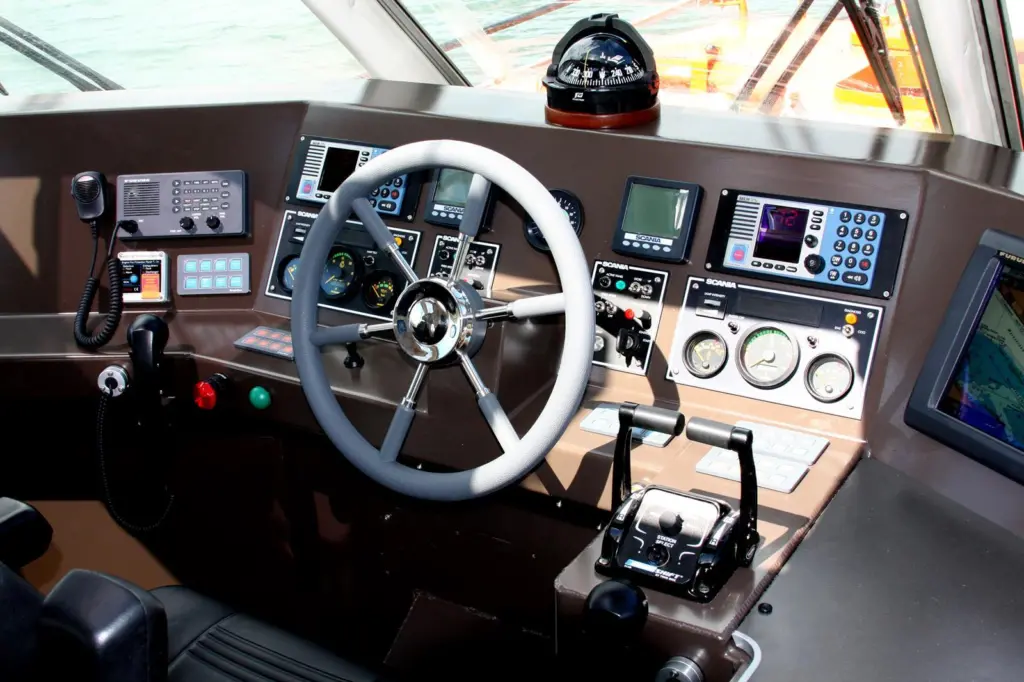
The central helm position is arranged with all controls, instrumentation and navcomms ergonomically close to hand. The coxswain and the second hand both enjoy KAB 301 suspension seats, of which three are also fitted for pilots. Aft are settees fitted with three seats to starboard and four to port, all fitted with lap belts.
Collingwood is the first Mustang built boat to use EmpirBus, a CAN-bus based decentralised DC power distribution system in which the cables for each consumer are connected to the nearest EmpirBus unit. Cables for switches are also connected to the nearest, but not necessarily the same, EmpirBus unit as the consumer, greatly reducing the number of wires required and the effort/cost of connecting them.
Consumers in the Collingwood wheelhouse include a Furuno DRS4/A radar displayed on a Furuno MFD12 multi function display colour LCD and interfaced with a Furuno SC30 Satellite Compass. There is a Furuno GP320B GPS sensor, a Furuno FA150 AIS and a Furuno DFF-1 digital network echosounder. Two Sailor 5022 VHF DSC radios are also fitted.
Collingwood is fitted with the same Scania DI16 42M engines already in service on the GRP vessels, rated 525 hp at 1,800 rpm and driving fixed pitch propellers through Twin Disc MGX 5114 SC Quickshift gearboxes to produce a top speed of 22 knots. Twin Disc EC300 electronic main engine throttle and gearbox controls are operated remotely by a twin lever single station unit on the helm console.
The flexibly mounted main engines each connect to a Manuflex wet exhaust system comprising a stainless steel manifold and spray head, aluminium and approved rubber exhaust piping sections and a glass reinforced plastic silencer.
There is a direct lift engine removal hatch fitted on the superstructure and an engine room escape hatch, both forward of the wheelhouse accommodation. The vessel has been designed with maintainability in mind. The engine room provides exceptional height and a distinct lack of clutter, as strainers, batteries, etc, have all been kept in the tank space aft.
Mustang Marine goes from strength to strength at its Pembroke Dock facility. Currently under build is a sister vessel to Skomer, the 20m steel hull pilot launch delivered for Milford Haven Port Authority two years ago, and the company was recently shortlisted in a valuable international tender for three 21m aluminium waterjet driven pilot boats.
A second enclosed building shed will be completed this month, doubling the yard’s newbuild capacity. The new shed will be 33m long and the first shed, itself only a few years old, has been extended to the same length.