![MaritimeJournal[Seawork]](https://www.maritimejournal.com/wp-content/uploads/2026/09/MaritimeJournalSeawork.svg)



New Heligoland ferry heads for Europe
Scheduled for piggy-back transport to Europe in February after trials in the Philippines is Germany’s new Australian-built, high-speed catamaran ferry for Heligoland service.
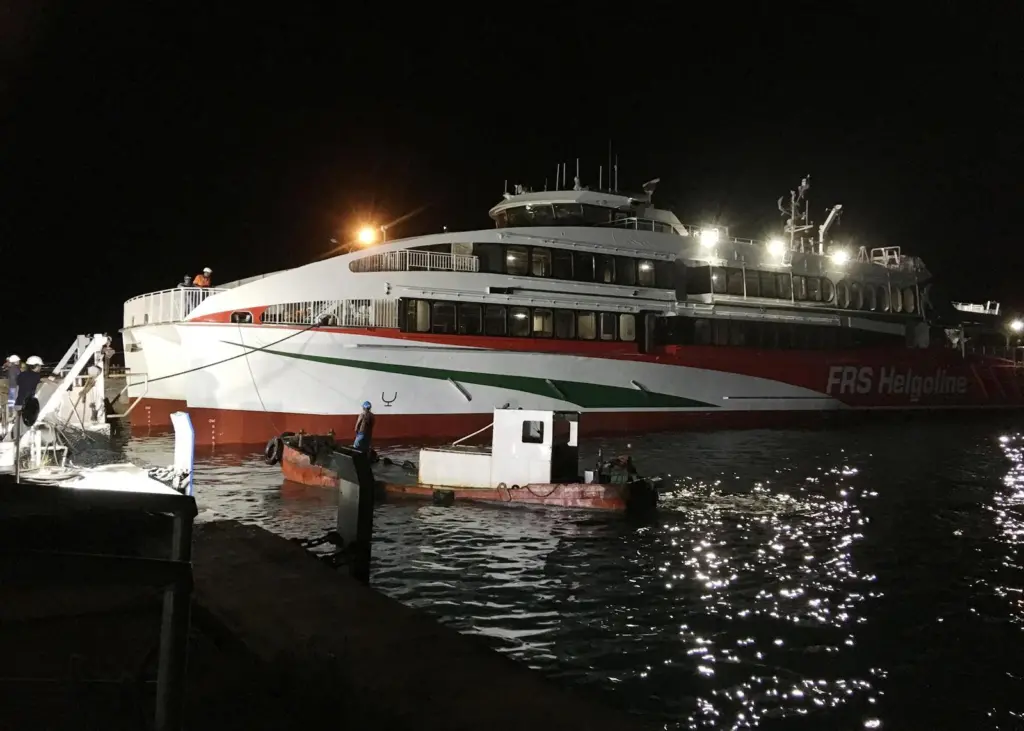
The 56.4m loa and 14m wide newbuilding, for 692 passengers, is expected to enter service at the end of March with Förde Reederei Seetouristik (FRS) subsidiary FRS Helgoline between the German mainland and the Island of Heligoland in the German Bight. Still unnamed, it will not be called Helgoland because a ship of that name – Europe’s first passenger ferry with LNG/DF propulsion – now also serves the route for another operator.
The FRS newbuilding is being transported to Hamburg on a heavy lift ship across the Indian Ocean and through the Suez Canal. It’s a trip reminiscent of that by its 51m predecessor Halunder Jet, which was carried on the heavy lift vessel Palabora across the Atlantic and through the Panama Canal to western Canada late last year. Now called Clipper Victoria V, it is part of the fleet of FRS North American subsidiary Clipper Navigation.
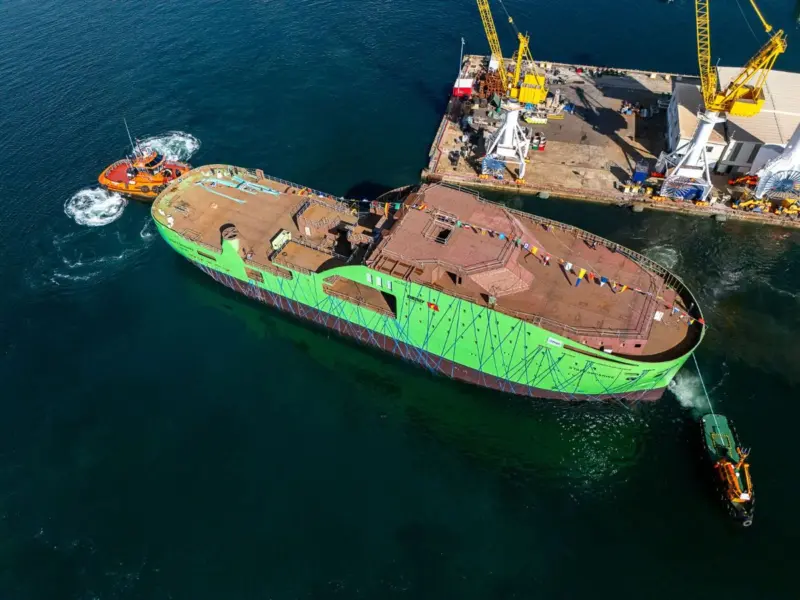
Australia’s Austal floated out the new FRS ferry in January from its Philippines Cebu subsidiary after 11 months of construction. FRS project manager Arne Jammer said “the launching was particularly exciting because it was our first chance to test the catamaran’s many pieces of equipment under real conditions. The main engine and generators were put into operation and thoroughly tested”. Deadweight could also be accurately assessed for the first time, he noted.
FRS said the ship was undergoing a series of trials involving yard and owner officials and the crew before its journey to Europe in February. Six tests alone were scheduled to assess maximum speed. Among further planned tests was a four-hour engine run at maximum capacity to determine engine plant reliability and calibrate navigational systems. Particularly important, said FRS, were manoeuverability tests with the new catamaran.
The all aluminium newbuilding of 1223gt is powered by four MTU 6V4000 M63L main engines, ZF gearing and four KaMeWa S71-4 waterjets from Rolls Royce developing a maximum 34.6 knots. It also has four Volvo D5A TA 85kW auxiliary diesel gensets. MTU said the technical concept behind the Series 4000 Ironmen engines was a major factor for the new FRS ship. It said that with common rail fuel injection, it was very economical and environmentally friendly.
An FRS official said the Ironmen engines had been “a conscious decision. We were impressed by the extended maintenance intervals, combined with what is nevertheless an excellent power to weight ratio and the low fuel consumption. … Their dynamic acceleration behaviour was also a key factor…”, he said.
Once just a local ferry operator, FRS is now an international group employing 1,500 people and operating 64 ships worldwide.
By Tom Todd