![MaritimeJournal[Seawork]](https://www.maritimejournal.com/wp-content/uploads/2026/09/MaritimeJournalSeawork.svg)

New tugs for Shetland: Late but worth the wait
Two of the most powerful tanker handling and escort tugs in Europe, with Voith Schneider propulsion systems, have arrived in the Shetland Islands.
The tugs, named Bonxie and Solan, were ordered by the Shetland Islands Council from the Union Naval Valencia (UNV) shipyard in Spain some three years ago under a fixed price contract valued at £14m.
With a bollard pull of over 80 tons, the tugs are needed to provide escort and berthing services to tankers frequenting the Sullom Voe oil terminal and extend the life of the Shetland tug fleet for the next 20 years, after which the terminal is expected to cease operation.
The completion of Bonxie and Solan has been delayed for several months due to technical problems related largely to problems with exhaust back pressure and steering. In spite of the delays, the tugs performed well during their final trials and subsequent delivery voyage. On the delivery voyage from Spain the tugs encountered horrendous conditions, including Force 9 winds, but completed the trip four days earlier than expected.
Commenting on the delays, Harbour Master Captain Roger Moore is reported as saying, ‘The council decided to buy the new tugs to ensure the port could keep going until 2030. The new design makes them more capable and manoeuvrable than the existing fleet. We have got good value for money because the contract and specification was drawn up before the country started to steam into the economic climate it finds itself in. If we were to start today it would have been a different picture.’
Bonxie and Solan were built to a high standard using a design drawn up by UNV, with input from the owners, Sener Engineering and Systems, and Voith Turbo Marine. A number of innovative features have been incorporated, including the choice of winch and propulsion controls. The design and construction meet the Lloyds Register of Shipping criteria for +100A1, Escort Tug (pt) +LMC, UMS.
These are big, extremely rugged vessels, intended to operate in the exposed conditions around the islands in the northern North Sea. The identical sisters measure 40.0m in length overall, with a moulded breadth of 14.0m and maximum depth of 6.4m. The hull and superstructure design incorporates a forecastle, one complete deck in height, and a deckhouse positioned well away from the bow. This offers maximum protection in heavy seas and allows the wheelhouse above to be mounted almost exactly amidships.
A high standard of fendering is applied all round the hull, including heavy ‘D’ section rubber moulding around the bow and forming rubbing strakes at the sides, and heavy tubular rubber fendering at the stern suitable for push-pull operation.
In keeping with the last two generations of tanker handling tugs in Shetland, Bonxie and Solan have Voith Schneider propulsion systems, making them highly manoeuvrable and capable of precise station keeping. Two Voith Schneider 36R5/250-2 cycloidal propulsion units, with a blade orbit of 3.6m, are fitted in the usual location side by side and forward of amidships. A large underwater skeg is fitted aft in the usual way and a protection plate beneath the propeller blades.
The units are coupled to a pair of MAN 9L27/38 main engines, each delivering 3,285kW at 800 rpm, at the maximum continuous rating (MCR) a total of approximately 8,810 bhp. The nine cylinder turbocharged engines have air starting and Blocksma box coolers.
Unlike the other Voith tractors in the Shetland fleet and the UK as a whole, Bonxie and Solan have an electronic control system for the Voith propulsion units in place of the more common mechanical arrangement. Electronic controls are now standard equipment on new Voith systems and offer several advantages in a tug of this type. Course stability is much improved, interface with the autopilot is more effective, and an inherent load control feature gives the tug master more positive response to demands for power.
This propulsion system has given the tugs a performance that exceeds the specified 70 tons bollard pull and 13 knots maximum speed by a healthy margin. On trials a bollard pull at MCR of 87 tons was achieved towing ahead, 81 tons astern (pushing) and a free running speed ahead of 14.1 knots.
Demands for electrical power aboard Bonxie and Solan are higher than those of most similar tugs of this type due to the choice of electrically powered deck machinery. Three identical Volvo Penta powered auxiliary generators rated at 220kVA each are located in the engine room between the main engines. All three supply power to the main switchboard at 415 volts, 3 phase, 50Hz and load share under electronic control. The auxiliary engines also use the box cooler installation.
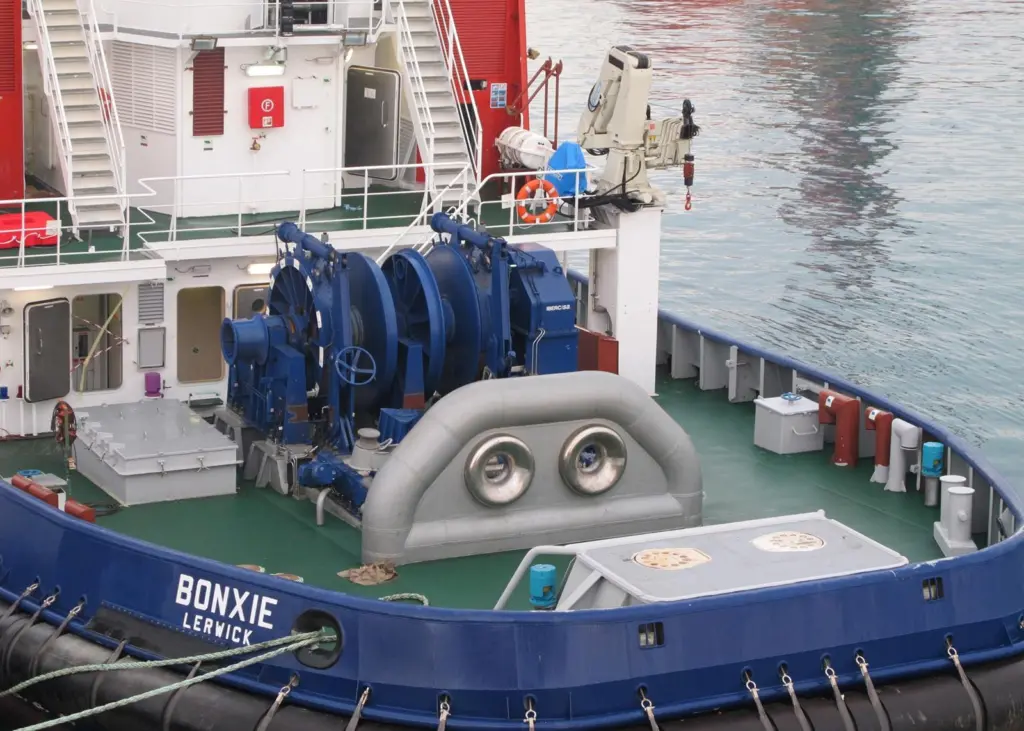
A vital piece of equipment aboard any escort tug is the towing winch and in this case Shetland has chosen an electrically powered winch, which is very unusual in the UK and Europe. An MR-E/180/2/150-68 twin drum escort winch by Ibercisa has been installed on the after deck of each tug. The winch has a brake holding capacity of 400 tons (on the 1st layer) and is powered by a motor located below deck giving ‘stepless’ control of speed and direction. Each drum can be driven and braked independently and is designed to accommodate 150m of 68mm diameter towline, in this case MBF Euroneema 12 strand with a ‘Tipto’ jacket from Lankhorst. Line pull varies from 72 tons (on the 1st layer) at the lowest speeds of 0 to10 m/min, up to the fast recovery of a ‘slack rope’ at 0 to 70 m/min.
The winch has ‘render and recover’ capability and is fitted with load and towline length/speed sensors. Separate spooling gear is provided for each drum, with each scroll shaft driven by a separate electric motor with its own speed control. Winch controls and instrumentation are located in a panel in the wheelhouse.
Both towlines are deployed through a substantial towing staple located aft of the winch. Two apertures, with polished stainless steel inserts, are provided, one for each towline. A pair of Triplex tow pins of the ‘raise and turn’ type are located just inside the aft bulwarks. When raised and turned inwards, the aperture formed acts as an alternative ‘point of tow’ if required during escort operations.
An electrically operated Ibercisa anchor windlass and massive tubular ‘H’ style towing bitts (100 tons SWL) are located on the foredeck. Also stowed on the foredeck is a six person Viking rigid inflatable rescue boat and its launching davit. A hydraulically operated knuckle boom crane supplied by Cytechma is mounted on the portside aft, at boat deck level. The 24 tons/m crane has a telescopic jib with a maximum outreach of 17m.
As previously mentioned, the wheelhouse is mounted high above the superstructure. From the two control positions, fore and aft, the tug master has a bird’s eye view of the working decks, winch and towing gear. All of the major controls and instruments are duplicated at both control stations. The tugs have a comprehensive outfit of navigational and communications equipment to GMDSS Area 2 standard, tailored to the duties the vessels have to perform.
The accommodation aboard Bonxie and Solan is fitted out to provide a well equipped living area for a maximum of six persons, with all the usual facilities. Single well appointed en-suite cabins are allocated to the Master, Chief Engineer and Mate. A larger cabin for a 2nd Engineer or general purpose hand has berths for two additional personnel if required.
After some crew training and familiarisation, Bonxie and Solan have joined the existing four tug fleet at Sullom Voe. Shetland tugs have traditionally been named using the local Gaelic names for seabirds. Bonxie is ‘Great Skua’ and Solan is the local name for ‘Gannet’. The fleet currently includes the 1983 built Tirrick and Shalder, with 45 tons bollard pull, and the 1986 built Tystie and Dunter with 56 tons bollard.
All four are Voith tractors, representing two distinct generations. Shalder will eventually be sold and the Tirrick retained as a ‘spare tug’ for the time being. The previous spare tug, Stanechakker, a 37m twin screw vessel built in 1978 for the very first Shetland tug fleet, formed for the opening of the oil terminal, was sold just a few months ago for further use in the British Virgin Islands.