![MaritimeJournal[Seawork]](https://www.maritimejournal.com/wp-content/uploads/2026/09/MaritimeJournalSeawork.svg)



Orca II at Home in the Waves
Ireland’ s Safehaven Marine have just launched the first of class vessel to their latest design.
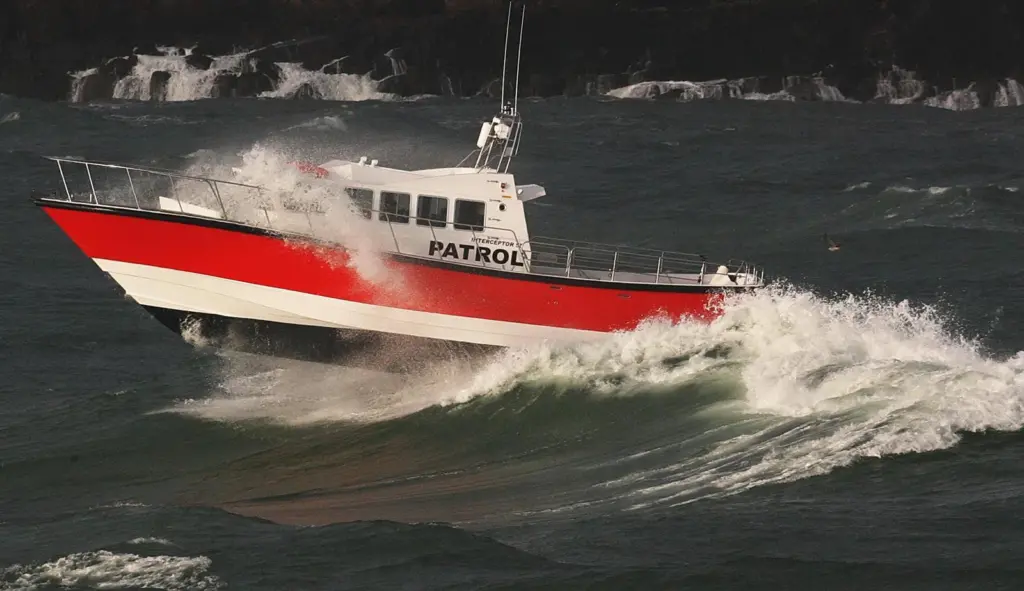
The Interceptor 55 Pilot/Patrol is closely based on the company’s very successful Interceptor 42, which has been built as class 6 passenger vessels, work boats, dive boats and pilot boats. In the latter configuration, pilot vessels have recently been supplied to the Irish ports of Cork and Dublin Portland in the UK and St Malo in France.
The Interceptor 55 uses a similar twin chine, deep ‘V’ hull design and the Interceptor 42, giving the excellent seakeeping for which Safehaven designs have earned a well deserved reputation.
Angus Cambell is the owner of the first Interceptor 55. ‘Orca II’, which replaces his previous Interceptor 42, the 2004 built ‘Orca’. Orca II is to be used as a passenger and patrol vessel, transporting up to 12 passengers and light cargo from its home port on The Isles of Harris out to St Kilda.
St Kilda is recognized as a wildlife and marine life habitat of world importance. There are a number of species unique to the islands, which are carefully monitored by conservation bodies. The awe inspiring landscape, human history, and the sheer remoteness of St Kilda intrigue many. The islands are a UNESCO Reserve, National Nature Reserve, Ancient Monument and a World Heritage Site.
The journey out to the islands is 45 nautical miles, straight out into the North Atlantic from The Isles of Harris, which is itself 50 nautical miles offshore from the Scottish mainland.
When undertaking this journey, a vessel’s seakeeping is paramount and is one of the reasons Angus Cambell chose an Interceptor . Over the past three years he has come to totally trust and depend on his Interceptor 42’s seakeeping abilities, which were tested many times when caught out 30 to 40 miles offshore when the wind blew up and left him battling the big North Atlantic seas.
The Interceptor 55 ‘s design is very versatile and is suitable for a multitude of roles. As a passenger vessel it has capability to be licensed for up to 60 passengers by both the IRL Department of Marine and the MCA as a class 6 passenger vessel. However, Interceptor 55 was specifically designed as a pilot boat and as such, the modular and customisable design of the superstructure allows it to be built for such roles, with the superstructure positioned aft. Wide 650mm side decks make passage up to the bow very safe and secure, with a clear spacious foredeck for pilot boarding.
Orca II is powered by twin Scania D12 engines rated at 650hp, giving the vessel a fully loaded maximum speed of 28 knots and an operational speed of up to 23 knots. The engines were supplied by Westward Scania, which provided excellent service and back up during the vessel’s construction and subsequent launch. The Scanias proved very powerful, with plenty of torque and have excellent fuel consumption figures.
Angus Cambell intends to run Orca II at 18 knots, corresponding to 1,600 rpm, figures which provide very economical fuel consumption and allow him to complete the passage in two and a half hours. Clements Engineering supplied the stern gear and were very involved in designing an efficient propulsion system which has proved to work very well in the vessel.
Interior accommodation has been specially configured to seat 12 passengers in the main cabin comfortably and securely. Twelve aircraft type seats with high backs, headrests and armrests are staggered in height, allowing each bank a clear view forward. This provides good visual orientation and maximises passenger endurance in adverse conditions.
Orca II has a full galley at the aft of the cabin and a heads compartment accessed from the aft cockpit. The forward cabin features up to eight berths in two cabins, with the lower cabin under the cabin sole having full standing headroom. The vessel is fitted out to Safehaven’s usual high standards, with all cabins fully lined and carpeted, whilst quality teak woodwork is in evidence throughout. The aft cockpit is clear and spacious, with two removable seating modules for 20 passengers.
A 3.5m RIB with an outboard engine is carried on a cradle on the aft deck and launched with an Opacmare stainless steel crane of a 500kg lifting capacity. The crane gives Orca II capability for light cargo transfer, adding to its versatility.
Access to the waterline via a transom door enables passengers to safely disembark to the RIB to be ferried ashore at the remote islands. With over a metre of freeboard, numerous hull subdivision and the wide beam, Orca II meets all the MCA’s stringent stability requirements for passenger and pilot vessels.