![MaritimeJournal[Seawork]](https://www.maritimejournal.com/wp-content/uploads/2026/09/MaritimeJournalSeawork.svg)



Ostfriesland LNG retrofit postponed
Germany’s first dual-fuel LNG car/passenger ferry Ostfriesland will now not enter service until November, six months later than planned, because its owners want more time for detailed work on the project.
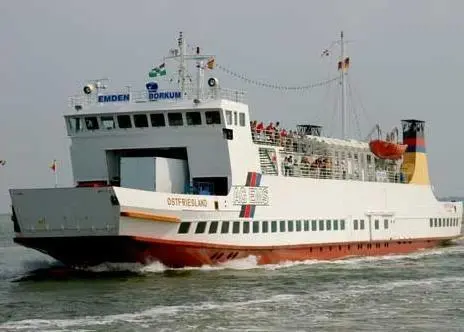
The 1,860gt ship will not go to Bremen’s BVT Shipyard in May as scheduled for installation of her new 15m stern and dual-fuel LNG technology prior to entering service in June.
AG Ems spokeswoman, Corina Habben, told Maritime Journal that instead, the ship would remain in operation until mid-September and then dock at BVT for conversion before going into service in early November.
Ms Habben explained there had always been an option to delay the ‘marriage’ of the ship and its new stern. A company statement said the delay would “create more time for detailed work” and added “it goes without saying that quality takes precedence over speed”.
AG Ems chairman, Bernhard Brons, and BVT managing partner, Thorsten Rönner, added: “the new technology will set new standards and so it is better to go forward a step at a time.” The delay also has the advantage of freeing the ship for summer season operation.
Meanwhile steelworks on the new stern section were proceeding as normal, AG Ems said. Ms Habben added that deliveries for the new propulsion system, including the engines were also as planned.
The new stern will increase the ship’s current 78.7m length to 92.7m and provide not only a bigger sundeck for 1,200 passengers but also space for the installation of the ship’s two 6-cylinder Wärtsilä 20DF dual-fuel gensets and a Wärtsilä LNGPac. Ostfriesland will also boast double rudder Schottel pods to provide 15.5 knots.
The dual-fuel engines will run primarily on LNG as the main fuel, but be able to switch to conventional fuels if necessary. The LNGPac comprises onboard LNG bunkering, storage tanks, and handling equipment with related safety and automation systems.
When the original timetable for completion of the seven week conversion/retrofit was announced, it was reported that the job would cost some €13m. It was not known if the delay had changed that.
When finished Ostfriesland will go back into service between Emden and Borkum. Officials said it will not only be Germany’s first dual fuel island ferry but also the first of her kind in Europe.
Significant operational savings and an increase in overall vessel efficiency are promised, with officials saying the new engine configuration will reduce CO2 emissions by 20% and NOx, SOx and particle emissions by more than 90%.
In the meantime, AG Ems is set to take the title as operator of Germany’s first new passenger/cargo ferry with LNG propulsion. Fassmer will deliver that 80m newbuilding, costing about €30m, in April 2015, just five months behind Ostfriesland.
By Tom Todd