![MaritimeJournal[Seawork]](https://www.maritimejournal.com/wp-content/uploads/2026/09/MaritimeJournalSeawork.svg)

Pilot praises ‘Quinoa’ after long voyage home
Ireland’s Safehaven Marine has delivered ‘Quinoa, a 14.5m LOA Interceptor 48 pilot vessel to the French port of Bordeaux.
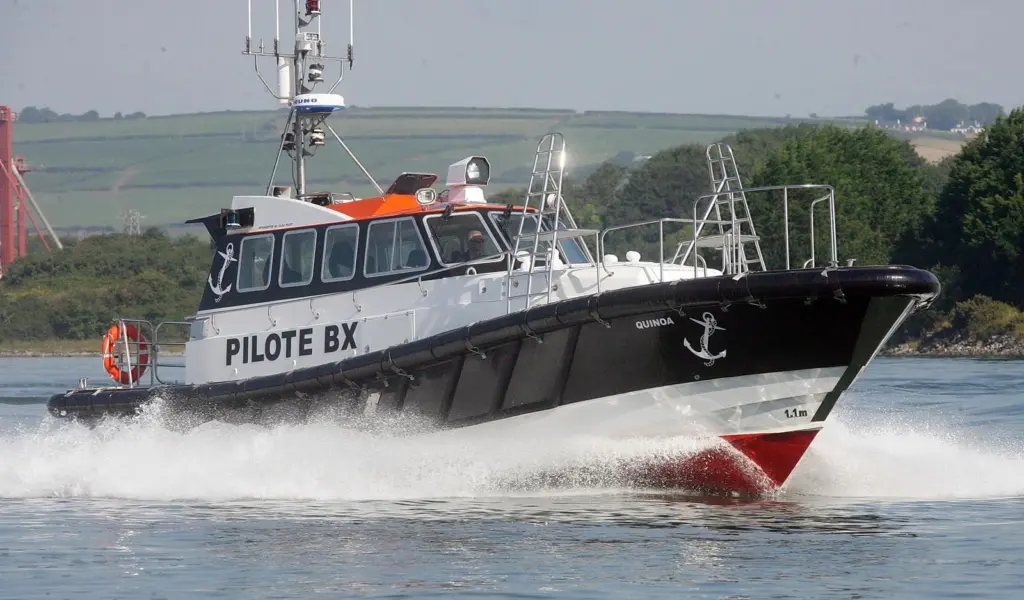
The Interceptor 48 is a completely new design based closely on Safehaven’s proven Interceptor 42, deep ‘V’ pilot boat hull, and sized to bridge the gap between the builder’s 42 (13m) and 55(16.5m) hull sizes.
It has been designed to provide enhanced seakeeping due to an increase in waterline length and displacement, yet still capable of being powered by engines of 12 litre capacity at their heavy duty rating. In this respect the hull has proved a resounding success, surpassing the contract speed of 23 knots by 2 knots to give a fully loaded operational speed of 25 knots and achieving 26 knots when lightly loaded.
Quinoa is powered by a pair of Iveco C13 engines at a continuous rating of 520hp, turning 28” diameter four blade propellers through Twin Disc 5114 QuickShift gearboxes. The hull design has proved so efficient that it achieves the same speed as Safehaven’s smaller 42 despite an increased displacement of 1,500kg to 17,200kg lightship (19,500kg fully loaded) with the same power. This is no doubt a benefit of the increased waterline length and planing area, which have allowed the engines to operate at only 70% of maximum power to achieve an operational speed of 22 knots, providing very significant benefits to the owner in both fuel consumption and engine longevity.
Quinoa also exceeds contract requirements regarding noise levels, achieving exceptionally low db readings of just 73-74db at 25 knots. This level approaches that of designs with an isolated wheelhouse, but without the associated cost and complication. Special attention to noise elimination and suppression during construction, and the incorporation of a foam sandwiched deck paid dividends, with Quinoa being exceptionally quiet and free of vibration. This results in a comfortable environment for the pilot and crew, who have a long (22nm each way) transit to the boarding area off the port.
The Interceptor 48 also features fendering by Ocean 3, which is to industry standard in France. This fendering design is of a high density 300mm diameter rubber coated foam, retained in a grove formed in the hull’s gunwale by tensioned straps to provide excellent protection to the vessel while allowing very soft boardings in rough weather. Further protection to the vessel is provided by numerous diagonals and a lower run of Delta section fendering. The bow of the Interceptor 48 is rounded and allows the pilot vessel to be used for the occasional pushing of vessels in assistance of tugs during berthing.
The interior of Qunoa was especially designed from the outset to combine the highest level of yacht standard fit out with the most comfortable and efficient crew and pilot environments. To this end the cabin is fully lined in off white headlining and black gloss laminates and features a teak cabin sole. The helm position comprises a wrap around GRP console incorporating all the navigation and engine instruments within easy view of the helmsman and providing an ergonomically comfortable, car-like driving position. Pilots and crew likewise benefit from five reclining Recaro air suspension seats on black gloss GRP pedestals. Seating can be increased to provide for six pilot seats if required.
The pilots at Bordeaux have to deal with very challenging and at times dangerous seas at the entrance to the harbour, where big Atlantic swells from the Bay of Biscay meet the strong 3 to 4 knot ebb tide from the Gironde River. These rage with special violence, causing breaking seas at the Bar which reach over 10m in height during the winter months. The pilot vessel is expected to capable of navigating the Bar safely in up to 5m wave heights. As a consequence, a fundamental requirement by the port was for a pilot vessel with very high levels of sea keeping, an area in which Safehaven Marine craft have a strong reputation.
An important part of the design brief was for the Interceptor 48 to be fully self righting in the event of capsize. This was achieved by virtue of a high buoyancy superstructure. Consequently, the vessel has been built with features such as automatically closing air vents, 15mm thick windows and watertight cockpit doors. The superstructure’s forward windows are aft sloping to minimise pressure loadings when taking green seas over the bow, a fairly regular occurrence due to the extreme conditions in which the vessel operates.
The Interceptor 48 features a large and spacious forward cabin, which was achieved by having the engines installed further aft under the main cabin, where they are subject to less loadings and accelerations in rough seas. They can also be quickly removed in the unlikely event of failure through hatches incorporated in the main cabin sole and cabin roof.
The forward cabin features bunk berths which allow the pilots to rest and relax comfortably during night transits and provides additional seating capacity which can be utilised in an emergency, or when additional passenger seating is required..
Quinoa is fitted with Safehaven’s unique pilot boarding ladder design which improves safety for pilots but causing minimal obstruction to visibility.
Quinoa was built under Bureau Veritas survey to the strict French Maritime authority requirements. The vessel was delivered at the end of September by Olivier Barreau, the pilot specifically involved in overseeing the design and construction, who had became good friends with Safehaven’s Frank Kowalski during the 12 months of construction.
The 500nm voyage from Ireland to Bordeaux was completed in challenging conditions and afterwards, Olivier sent an account to Safehaven Marine’s owner and designer.
Excerpts include, ‘Conditions continued to be very rough especially off the Island of Oleron where we had wind against tide with very steep 3 to 4m waves off the bow. We had to reduce speed here and I negotiated the seas comfortably by swinging the bow off the crests so she didn’t fall heavily into the troughs. We continued on towards Bordeaux, and when some 5nm offshore we slowed down to take bearing and to line up at the entrance to the harbour mouth and run NE to the river entrance.
This course put us beam on to the seas at the entrance to Bordeaux, which was quite stressfu, as it was night time, the wind strength was Force 6 and the 3.5m offshore swell in Biscay was running straight into the entrance of the Gironde river meeting a 4 knot ebb tide, and to make matters worse it was near low tide, causing the waves to break strongly over the Bar where they were reaching over 5m in height.
But beam on to the waves Quinoa was very stable so we had no concerns as at this point we had a lot of confidence in the vessel. At the outside of the Bar we turned to the SE to give us a straight run with the seas dead astern to cross the bar. We ran in at 1,700 rpm. This gave us a speed of 1 to-15 knots with Quinoa accelerating to over 28 knots when surfing on the face of the larger waves.
Quinoa handled very well as she crossed the Bar with waves breaking around us in what were quite dangerous conditions, especially as it was during the night, yet at all times we felt safe. Certainly some corrective helm was required to stay on course when she swung away to port or starboard a couple of times, but we always maintained control and what impressed us most was how stable she was, staying almost level, with very little heeling. In fact, she was as stable as our much larger 17m vessel in these conditions.
We came alongside at 11:00 pm after travelling over 500nm from Ireland almost non-stop in 24 hours, averaging over 20 knots. Quinoa has proved to be a fantastic vessel and I am very happy with her. My conclusion is of a pilot boat with excellent sea keeping, and I must say, Frank, that at all times throughout the voyage we felt completely safe in her.’