![MaritimeJournal[Seawork]](https://www.maritimejournal.com/wp-content/uploads/2026/09/MaritimeJournalSeawork.svg)




Plain end couplings save the day
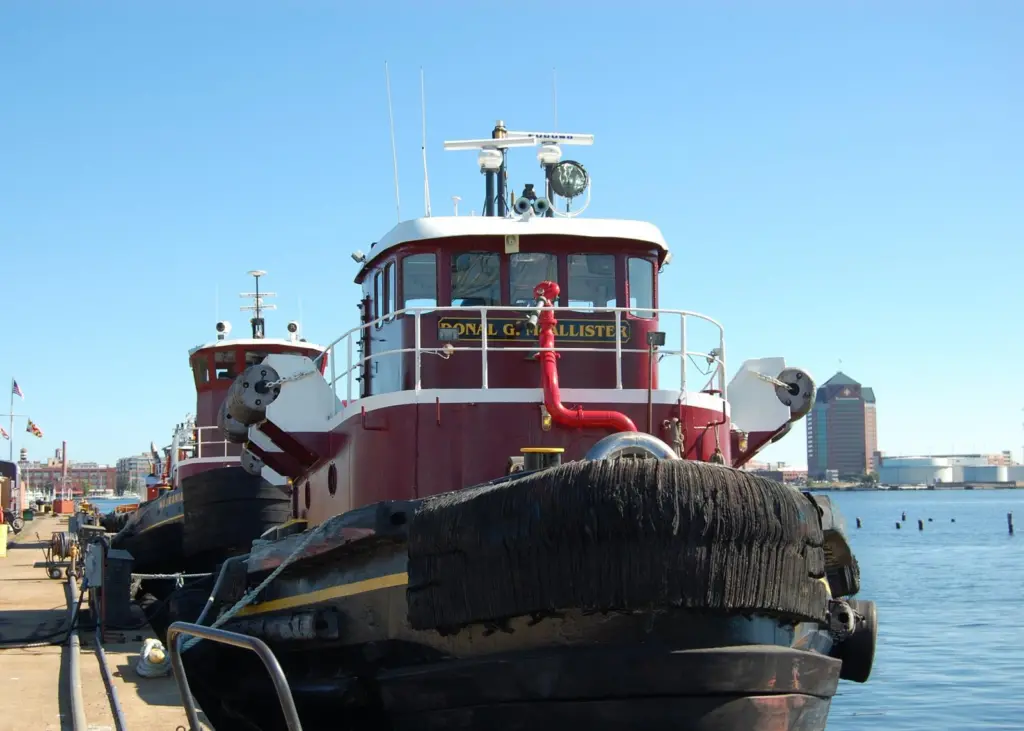
US towing company McAllister repeatedly experienced leaks in the engine cooling water line on its harbour tug, the ‘Robert E. McAllister’, when bolted-sleeve couplings failed.
This type of coupling is a non-restrained coupling, with nothing to hold it in place on the joint. If maintenance personnel simply tightened the joint there was no guarantee that the seal – or the coupling – would hold.
Port engineer Carlo Parrotta sought a better, long-term solution. Limiting the tug’s time out of service was the most important factor, so complete replacement of the line was not an option. “I was considering welding the pipe,” Parrotta said, “but the problem was that I didn’t have the luxury to go into the drydock.”
Having used Victaulic mechanical pipe-joining systems in previous roles throughout his 25-year maritime career, he called in the company to help.
Victaulic representatives visited the Baltimore-based Robert to review applications and recommended the Style 99 Plain End Roust-A-Bout Coupling to replace the bolted-sleeve couplings. The Style 99 is a rigid coupling that has integral hardened carbon steel “teeth” that bite into the outer diameter of each pipe-end, providing steel-to-steel engagement. Positive engagement of the pipe is achieved when the bolts are torqued to specifications, as marked on the coupling housing.
Plain-end couplings are advantageous for retrofit and repair services because there is little upfront tooling cost. The lack of extensive pipe-end preparation means the coupling can be installed quickly, reducing downtime. To complete the repair, the bolted-sleeve couplings were disassembled and removed, the pipe was pulled from the hangers, and the pipe-ends were cleaned where the new couplings would be installed. The pipe was then repositioned and the Style 99 couplings were assembled on the joints. The repair was completed dockside in just over an hour.
“I saved several thousand dollars on a marine chemist, several thousand dollars on cleaning the tanks, and the grievance of waiting several years until the next drydock,” Parotta said. “If you add all these costs, conservatively, it would have come to $15,000—all that, just to weld a little hole. When you’re doing all this, the boat is not available for work. By doing it the way we did, it was a fraction of the cost and it took us three hours, compared to probably a week.”
By Jake Frith