![MaritimeJournal[Seawork]](https://www.maritimejournal.com/wp-content/uploads/2026/09/MaritimeJournalSeawork.svg)



RNLI’s latest lifeboat – ready for service
The Royal National Lifeboat Institution’s latest class of lifeboat is preparing to enter service with arrival of the first £2m Shannon class station lifeboat RNLB The Morrell at Dungeness in Kent UK.
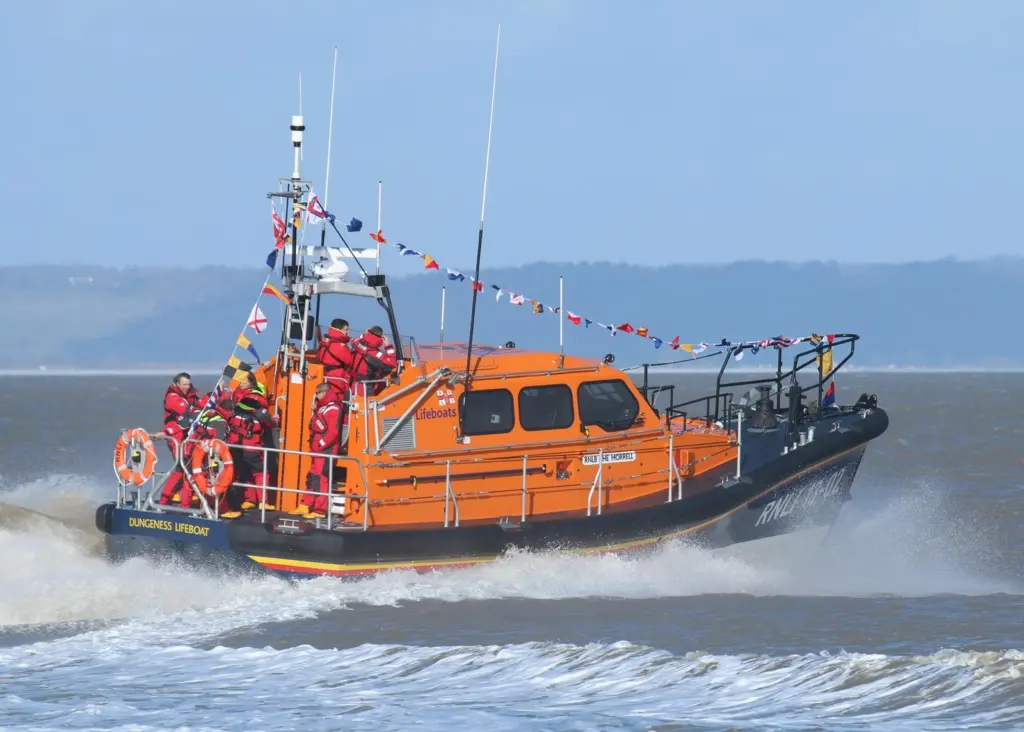
One of the most rewarding experiences for a lifeboat station is taking delivery of a new boat and recently that honour fell to the volunteer crew at Dungeness lifeboat station. Intensive training for the new Shannon class boat now continues on home ground as the crew get to grips with the first station example of the class. The Shannon marks a new era in lifeboat design, including first use for the RNLI of waterjet propulsion.
Not every lifeboat station has a convenient harbour or marina for the boat to lay afloat. At exposed locations they can be slipway launched from a boathouse at the foot of a rugged cliff. At others it may be housed ashore, transported to the launching site by tractor and carriage. While the Shannon class can be stationed at ‘afloat’ locations, its primary purpose is to replace Mersey class lifeboats, now nearing the end of their 25 year working lives, at carriage stations. It provides among other things, a 50% increase in speed and an improved method of launching and recovery thanks to a complete re-design of the existing arrangements.
METHODICAL DEVELOPMENT
Operational requirements for RNLI lifeboats are always demanding and the Shannon class is no exception, including: self-righting, able to withstand pitchpole, twin engines, capable of taking even ground without serious damage, operate safely in 16m waves and 60 knot winds, capable of 25 knots in BF2 and 17 knots in BF7, ten hours endurance at full-power with 10% fuel reserve, accommodate six seated crew and six seated survivors plus stretcher, and a minimum bollard pull of 3.3 tonnes. A design requirement was to accommodate the boat and rig within existing boathouses. Some older boathouses will be rebuilt but with a new boathouse costing upwards of £2m, rebuilding all is financially prohibitive. A maximum rig size of 21m x 5m x 5m and total rig weight of 50 tonnes was therefore agreed. This presented challenges, with limits on LOA, beam, depth and displacement of the vessel. Final dimensions came in at 13.6m LOA (11.6m waterline length), 4.54m beam and 18 tonnes displacement.
It is anticipated around 50 Shannon class lifeboats will enter service over the next eight to ten years, half of which will be carriage launched. Gradual phasing out of the Mersey class will result in the RNLI’s entire all-weather lifeboat fleet being capable of 25 knots, operating alongside existing Tamar, Trent and Severn classes. The Shannon was designed in-house with production of main structural components entrusted to the RNLI’s in-house hull manufacturer, SAR Composites. Lymington based Berthon Boat Company will complete the first batch of boats, fitting out eventually also being brought in-house with completion of the RNLI’s All-Weather Lifeboat Centre, which opens in Poole in 2019.
Development of the Shannon dates back around a decade, the RNLI historically designing most of their new lifeboats themselves. For what was originally designated the Fast Carriage Boat 2 project, the suitability of a commercially available hull based on a pilot boat was explored. Full-scale sea trials of such a design proved unacceptable for rough weather operations however, with issues of high slamming and excessive transverse accelerations. It was clear that displacement and length restrictions along with requirements for rough weather performance required an innovative hull design to match the operational requirements. Subsequently five potential hull forms were chosen for one-eighth scale model testing and comparison. The in-house design was also included and subsequently selected.
GENERAL ARRANGEMENT
The hull forms considered included a semi-displacement round bilge type with chine rails and a deep ‘V’ prismatic hull form. The eventual choice was for a double chine, warped form accommodating a wide, stable working platform with flat aft planing sections, high angle of deadrise amidships and a fine entry forward. The requirement to provide a consistent interface with the launching carriage keelway required a straight central keel with various factors limiting the keel depth. Side keels outboard of the waterjets were also included for roll-damping and directional stability. Fine tuning of both central and side keels results in only a slight inward heel when turning at 17 knots and above. The hull is a foam sandwich construction comprising typically four outer and one inner 1,200g/m2 quadriaxial glass skins separated by a 70mm thick Coracell P grade foam core. Variations and additional reinforcements are included locally where required.
Visually (above deck) the external profile bears similarities to the Mersey class but adoption of waterjet propulsion over traditional propellers results in a different layout below deck. Behind a small space in the bow are a forward store and survivor space. Beneath the wheelhouse, the fuel tank space (1,300 litres per side) and engine room are both accessed by a stairway from the wheelhouse leading to the survivor’s space. The jet space, beneath the after deck, is accessed via the engine room and a deck hatch set to starboard. A prominent feature is increased deck space behind the wheelhouse and upper steering position. The 2m difference between overall and waterline length allows for an extended ‘overhang’ beyond the transom, providing protection for the waterjets and presenting a curved surface to broken water impacting on the vessel’s stern. An unobstructed flat deck area is required overall for helicopter winching and general SAR operations and the carefully profiled and aesthetically pleasing hull form results in a particularly prominent high freeboard forward providing the all-important seakeeping qualities, leading to a lower freeboard along the side decks to assist survivor recovery. Fendering, considerably beefed up from that of the Mersey class, was supplied by Fender Innovations, based at Den Helder in the Netherlands, which also supplies the Dutch KNRM lifesaving organisation.
Twin 650 hp Scania D13 marine diesels drive twin Hamilton HJ364 waterjets, marking the first use of waterjets in an RNLI lifeboat. Apart from superior manoeuvrability over conventional propeller drives, significant advantages are gained from a reduced risk of damage when operating off beaches that comprise various grades of sand and mud up to different size shingle environments (such as at Dungeness). This feature is also important for stations that have to assist small craft running aground on offshore sandbanks.
The wheelhouse interior is worthy of especially close examination. When the RNLI’s previous newest all-weather lifeboat, the Tamar class was designed, particular attention was paid to reducing risk of injury and improving the working environment for the volunteer crew. Improvements included a new design of shock-mitigating seat (the Shannon includes integrated steering and engine controls in the arms of the helmsman’s seat) and introduction of a Systems and Information Management System (SIMS), crewmembers monitoring and operating the boat’s navigation, communication, machinery and systems from the safety of their seats via interchangeable display screen views. The intention is to reduce the amount of moving around within the wheelhouse, important in bad weather. The Shannon’s SIMS system has been designed and developed in conjunction with SCISYS UK Ltd, which also provided the Integrated Bridge System. Individual workstations and servers are provided by Vision4ce; monitors by Melford Electronics; NMEA interfaces by Actisense; power distribution systems by ETA Power and Power-Plex and networking by Harting. A comprehensive communications and navigation installation was specified, including radar from Furuno UK, VHF radios from Icom UK and Sailor, MF radio from Sailor, AIS from em-trak Marine Electronics, and communications system from SAVOX Communications.
LAUNCHING AND RECOVERY
A description of the lifeboat would not be complete without mention of the launching and recovery (L&R) arrangements. Up to and including the Mersey class, the L&R method evolved from when horses hauled the boat and carriage into the sea, tractors of course subsequently replacing horses. An important decision was made to completely re-design the operation, starting virtually from a clean sheet of paper, the aim being to make the operation safer, faster and more efficient. The resulting solution, designed and developed collaboratively by Supacat Ltd, Bosch Rexroth and the RNLI, retains a closely coupled tractor and carriage arrangement but similarities with the old system cease there. The design has to accommodate a wide range of beach environments up to 1:3 gradients, capable of operation in 2.5m water depths and able to be shut-down and withstand a 9m tide immersion.
The result is a bespoke four-track hydrostatic drive system (powered by the same engine, albeit at lower horsepower as in the boat, simplifying maintenance and spares holdings), a strop positively restraining the boat to a pair of hydraulic rams on the carriage and a winch for recovering the boat from either the water or beach. Depending on conditions, the carriage can be angled to form a mobile slipway for launching or driven into the water, the boat powering itself off. The coxswain controls launching by remotely operating the on-load release hook. For recovery, the boat is winched (bow first) from the water or beach onto the ‘recovery’ end of the cradle mounted on a slewing ring on top of the carriage. The cradle then rotates through 180 degrees to present the bow to the sea for the next launch. Boat recovery time is approximately 12 minutes.