![MaritimeJournal[Seawork]](https://www.maritimejournal.com/wp-content/uploads/2026/09/MaritimeJournalSeawork.svg)






Ro-Clean Desmi Delivers Oil Skimming Catamaran
Ro-Clean Desmi have delivered a 10m Pollkitten, the smallest in their range of Pollcat anti-pollution boats, to the CEPSA oil refinery at Spains rapidly expanding port of Algeciras. Within five days of delivery the Balim was mobilised for an oil spill incident in Algeciras Bay, collecting 2,000 litres of spilled oil with only 10% water content, to the delight of owners CEPSA.
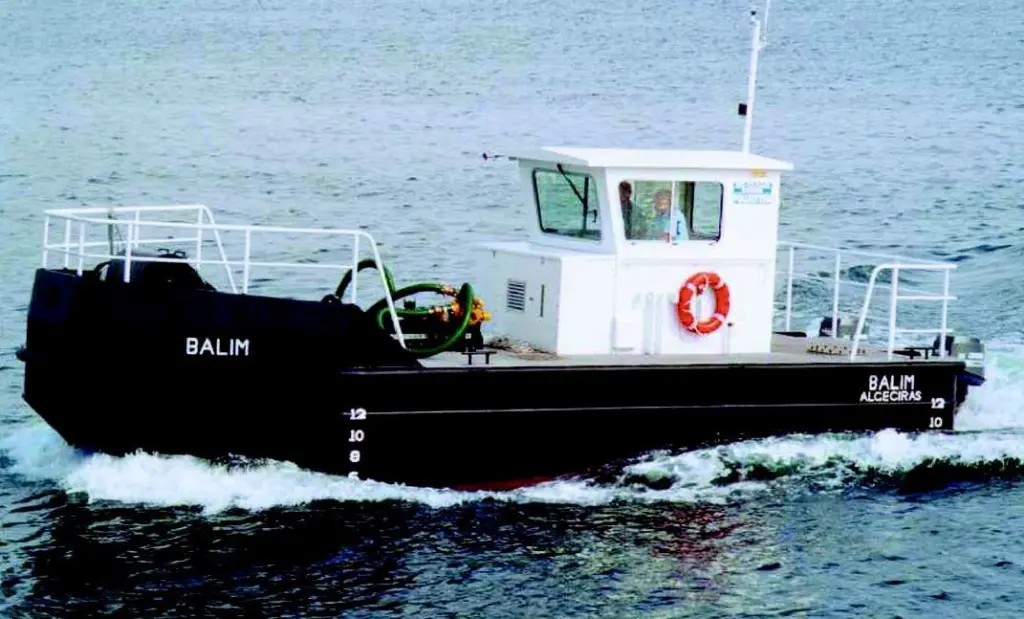
The Pollkitten was built at Manor Marine in Portland, Dorset UK to a design for Ro-Clean Desmi by Keel Marine Ltd. The dynamic oil skimming catamaran incorporates Ro-Clean Desmi’s zero relative velocity (ZRV) oil mop recovery system with recovery rates up to 25 tonnes per hour at up to 4 knots vessel speed.
Propulsion is by two D36 Yanmar 36hp diesel outboard units providing excellent manoeuvrability and speeds in excess of 6 knots. Cooling is thermostatically controlled to allow continuous running at slow skimming speeds. The engines draw their fuel from a 200 litre tank located on the aft deck which is sufficient for 16 hours of continuous running at 6 knots.
Oil recovery is via an integrated oil mop system deployed between the catamaran hulls at the front of the vessel. Capable of storing up to 11m 3of recovered oil on board, the vessel is equipped with its own oil transfer pump and diesel driven hydraulic power pack.
The oil recovery principle involves 3 x 300mm diameter oleophilic continuous absorbent rope mops covering the water surface between the hulls. These units selectively attract oil and water-in-oil emulsions ensuring the complete recovery of spilled oil entering between the hulls.
The oleophilic rope mops are passed into the water at the bow of the vessel and recovered over a roller fitted at midships. They then travel along a tunnel to an hydraulically powered wringer unit which both removes the adsorbed oil and drives the mops.
The recovered oil is initially collected in a sump beneath the wringer unit then transferred via an onboard pump to the onboard storage tanks or alternative storage such as floating tanks.
Operating in this manner allows the rope mops to achieve zero relative velocity, whereby the mops can be passed into the oil/water interface at a speed adjusted to that of the vessel, thus allowing them to be effectively stationary in the interface.
Typical water recovery with the ZRV system is less than 5%.
Unaffected by debris or ice, the rope mop is virtually indestructible and ensures pick-up in calm water or wave action since it is free to follow the contours of the waves.
Its dwell time on the oil water interface is far longer than other forms of skimmer.
Oil recovery mops can be lifted from the water and held tight under the deck when not in operation to avoid contamination during dispersant spraying activities and to maximise vessel performance when manoeuvring.
The hydraulically driven wringer unit is mounted forward with the oil collection sump below fitted with a debris screen to avoid clogging the oil transfer pump. It is also fitted with a drain valve which is normally left open to allow any water accumulated in the mop tray to drain out. This is closed prior to recovering oil.
A 75 mm sump discharge pipe is fitted, terminating on deck with a camlock connection to suit the transfer hoses.
The hydraulically driven 75 mm double diaphragm pump complete with hoses fitted with camlock connectors is located on deck for the transfer of recovered oil from the mop sump to the recovered oil tanks or other floating storage facility. The recovered oil storage tanks themselves are located midships in each hull, providing the total storage capacity of 11m 3. Each tank is fitted with both a 75mm filling pipe and discharge pipe fitted with the camlock connectors to match the transfer hoses. Access to each tank is via flush aluminium watertight hatches in the deck.
Electric bilge alarm sensors are fitted in each void space together with bilge discharge pipes terminating on deck with connectors to fit a hand operated diaphragm bilge pump located on the side of the wheelhouse. Bilge water can be discharged to the sea if clean. If dirty it is discharged into the recovered oil tanks directly or via the mop sump.
A fully enclosed wheelhouse is provided with access via a glazed watertight door in the aft bulkhead. Opening windows are fitted port and starboard along with fixed windows fore and aft allowing good vision all around.
A pendulum windscreen wiper is fitted to the forward window and a wheelhouse light is provided on the deckhead. The ship’s wheel is located on the control console midships along with engine start/ stop, throttle control, forward/ reverse clutch control, overheating alarm lamp and buzzer, tachometer and hour meter, bilge alarms, light switches and horn.
A diesel driven hydraulic power pack complete with hush pack is located midships forward of the control console. Hydraulic power is provided to operate the mop system and transfer pump separately or in unison.
The hull is of mild steel construction to Lloyds Grade A or equivalent. 100 mm hollow rubber D fendering is fitted around the deck edge and fixed guard rails are provided around the bow and stern of the vessel.
Grab rails are provided around the console and power pack arrangement.
With Balim now working at Algeciras, Ro-Clean Desmi is fielding enquiries for a further five examples of this innovative anti-pollution workboat.
MJ Information No: 17525