![MaritimeJournal[Seawork]](https://www.maritimejournal.com/wp-content/uploads/2026/09/MaritimeJournalSeawork.svg)


See a Specialist Survey Vessel at Seawork
Portchester UK based boatbuilder BWSeaCat Ltd has launched the first in class Specialist Survey Vessel ROV1101 for Norway based clients Robert Sorheim and John Terje of ROVas.
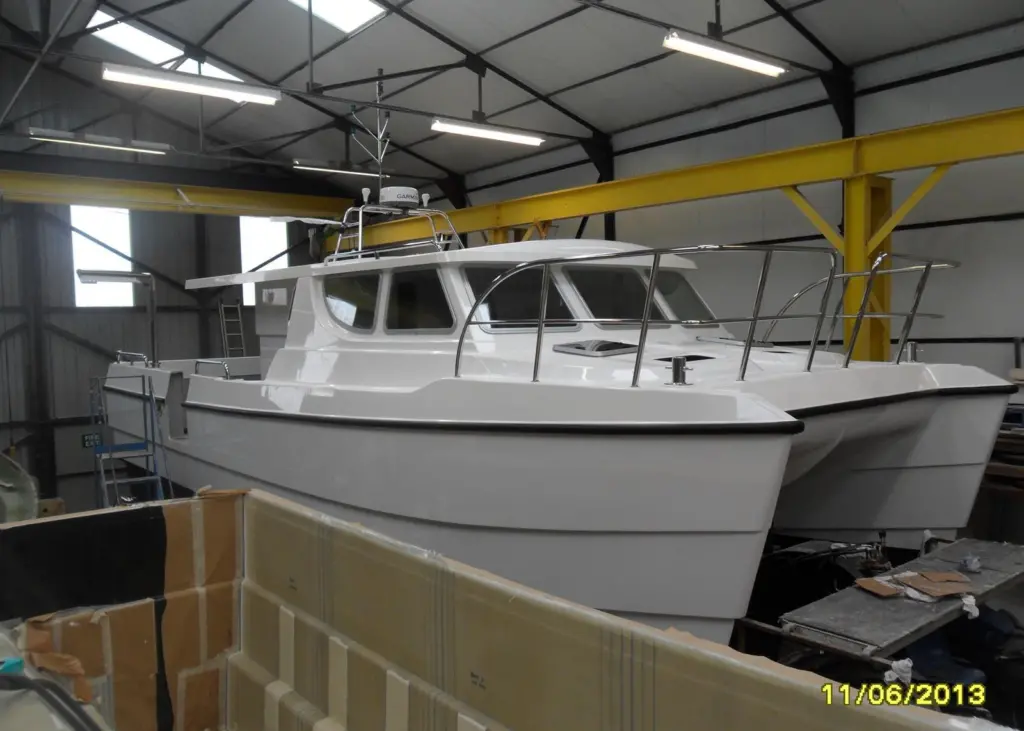
This first craft is part of an initial two vessel order from ROVas, with the likelihood of a further eight examples being ordered over the next four years.
The original vessel concept came about mainly for use in the Norwegian fish farm industry and has been conceived to replace the current method of using human divers to inspect corals and equipment, with ROVs, thus dramatically reducing any health and safety concerns from such a hazardous operation. But the vessel will also be used for other specialist marine inspection tasks along with complex and highly accurate seabed mapping.
Having first come across the high speed displacement hull form of BWSeaCat whilst browsing YouTube for a short list of potential vessel platforms, Robert and John were particularly impressed with the design’s aesthetics, adaptability and obvious performance potential.
After a series of initial phone calls and emails, both Robert and John visited the BWSeaCat production facility and were then taken for a sea trial aboard the company’s ex-demonstrator vessel, now named Emma Jayne and skippered as a charter vessel from Selsey by Colin Cooter.
This vessel was of particular interest to the pair due to the fact that it employs outboard powering, rather than the more usual inboard/conventional shaft set-up for a vessel of this size. It is a useful characteristic of the so called S.P.E.E.D. (Small Power Extended Efficiency Displacement) hull that it has the ability to be powered in this way and can indeed accept most propulsion systems currently available.
Powered by just twin 175 hp Suzuki four stroke engines, Emma Jayne is capable of 25 knot sprint speeds with a full crew of 12 and can easily maintain 18 knots in rough conditions, returning fuel burn figures of just over two litres per nautical mile for both engines combined.
Suitably impressed with the S.P.E.E.D. design’s ease of propulsion, twin Suzuki 300Hp four strokes were chosen for the new vessels to provide the high transit speeds and reliability that ROVas were looking for.
During this initial visit to the UK, the main vessel specification was agreed. To be based on the already popular ‘S.P.E.E.D. Eleven’ hull, this vessel’s extensive fit-out includes two separate and identical forward bunk compartments with wardrobe, changing area and storage, port side hot/cold shower compartment with toilet, starboard side parts storage area, full galley with induction hob, sink with hot/cold water and fridge, seating for two crew plus the helm to be converted into a third bunk when necessary, and cabin heating to all areas. A wheelhouse extension will be used as an ROV control room, housing the ROV operator and associated computer equipment. There are twin side doors, winch, davit, outside control position, 8KVa petrol water cooled generator, and a high end transducer capable of accurate seabed mapping at depths in excess of 900m. A full custom stainless rail package, double glazing throughout, and insulation of all hull and wheelhouse internal surfaces completes a most comprehensive package.
On paper, this was a daunting prospect for the small team of only five at BWSeaCat Ltd. Following initial consultation, the company’s full width forward wheelhouse was chosen as the basis of the project, giving as it does easy access into the hulls for accommodation space and access to a huge area under the foredeck for the forward bunks. It was decided to construct the ROV control room from sections of the popular Island style wheelhouse and then to marry these two elements together, covering the resultant moulding with a new 6m long roof.
BWSeaCat has a company policy of wherever possible utilising in-house design, making the most of the skill sets of all employees within the company in the complex task of making the client’d specification a reality.
Seacat MD Iain Worrallo explains:“The approach of designing in house came about originally from bad experiences with outside design in the past, but has proved to be of huge benefit to the company dynamic as a whole. Each member of the build team is actively encouraged to make a contribution to the design process and we feel that this makes for a better product and one for which the entire workforce can foster a sense of pride and ownership.
“This has resulted in a fluid and adaptable design process, unconstrained by the thoughts of one individual alone and has given rise to consistently high build quality in all of our S.P.E.E.D. series Catamarans, earning us an excellent reputation amongst professional skippers across the commercial spectrum.”
The vessel specification also stipulated that the operational draft be as little as possible and that the outboards should be easy to service, if possible when afloat, to minimise down time.
To this end the company sourced a pair of innovative hydraulically adjustable outboard mounting brackets from Florida USA based Porta Products. These brackets enable the engines to be lifted a full 24 inches whilst remaining in the vertical position. At survey speeds of three to five knots they can be lifted such that the propellers are tucked up behind the transoms, reducing the overall draft of the vessel to just 500mm.
Another benefit of the bracket system is that in the fully raised position, it is possible to do a gearbox oil change on the beach, using a small container under the leg to drain the oil. BWSeaCat is in the process of designing a container which can be partially immersed under the engine when still afloat, so that the oil changes can be done in calm conditions whilst still on the water, thus reducing lost time to an absolute minimum.
In order to insulate all internal surfaces of the accommodation spaces, it was decided to utilise the Nidaplast honeycomb core material, normally used for its stiffening properties, as a thermal barrier within all the laminated areas of the vessel. As a by product of this approach, the design is light and incredibly stiff. This has also meant that rather than the internal surfaces being covered with a difficult to clean carpet or some other relatively expensive and hard to apply material, all surfaces are left in standard flowcoat finish and can be easily wiped clean or indeed hosed down if necessary.
The task of deploying and retrieving the ROV is dealt with by a winch supplied by ROVas and works via a custom designed davit system coupled with an accurately positioned side door, enabling the ROV to be lifted and swung through the door and onto the deck. The helmsman is able to control the vessel from a small forward facing console on the port aft quarter, from which he has good visibility of both the vessel orientation and ROV position.
It is anticipated that this new class of survey vessel, weighing around 8,500kg will be able to maintain sprint speeds of around 35 knots for swift transit to remote locations and will be able to accommodate a crew of up to three in comfort for many days at a time away from shore.
With the prospect of a further eight vessels, these are exciting times for BWSeaCat Ltd, as the design represents a completely new direction for the company whilst at the same time being its first export order.
ROV1101 will be available to view at Seawork 2013 on berth V6 on the pontoons. The company will be running regular demonstrations throughout the event and SeaBotix, supplier of the ROV equipment, will also be running demonstrations of its submersible in the dock area.