![MaritimeJournal[Seawork]](https://www.maritimejournal.com/wp-content/uploads/2026/09/MaritimeJournalSeawork.svg)





Small is beautiful for Cathelco
A small tender being built at the Damen Gorinchem yard in the Netherlands has just been fitted with a pipe antifouling device. It may seem commonplace, but Richard Woolley of Cathelco told MJ just why this represents an innovative step forward.
‘When a pipe gets fouled it reduces the flow around the cooling systems, meaning the engine can overheat and, in the worst cases, fail entirely. So, antifouling devices are placed inside the strainers or sea chests, he explained.
‘Copper anodes keep steel pipes clear by producing a tiny amount of ions, around four parts per billion. This makes the pipes inhospitable to the larvae, in short they don’t like it and so don’t settle, passing harmlessly through the system.’
Aluminium anodes also help with the antifouling effect while also laying down a thin film of ions on the inside of the pipes, creating an anti-corrosive layer. Ferrous anodes are fitted to help keep cupronickel pipework clear.
But the application for the Damen Stan Tender 1905 is interesting precisely because it is a workboat, and certainly well below the size of vessel you would normally expect to be fitted with a pipe anti-foul device.
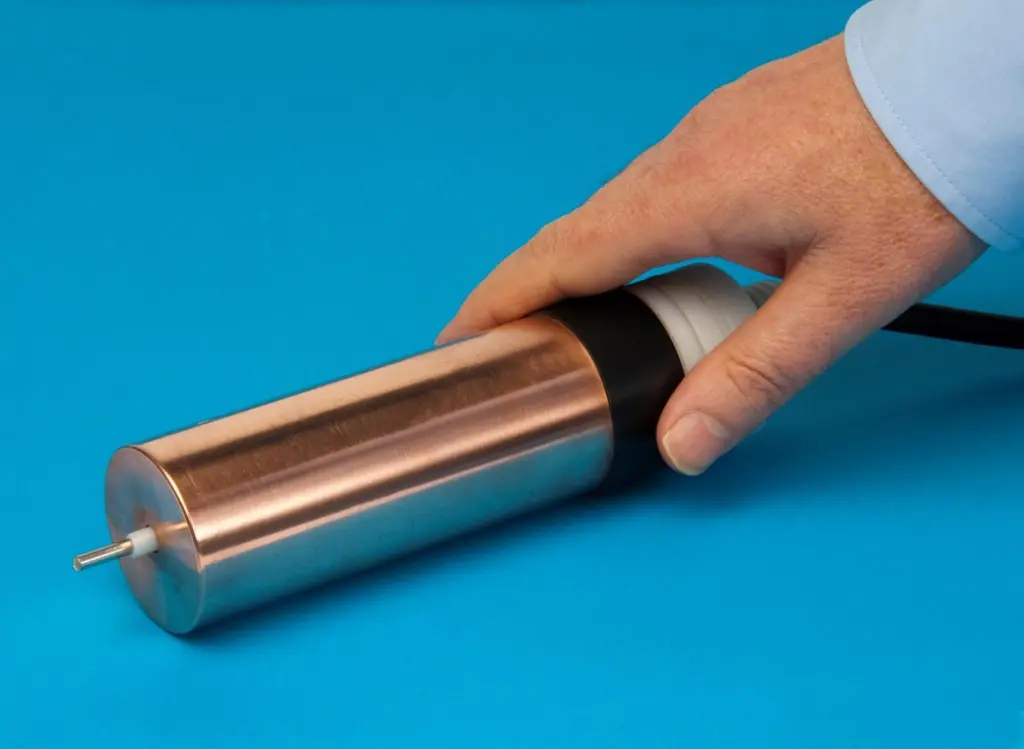
The tender has been the beneficiary of the company’s newly developed Omni-anode. ‘These anodes really are very small, the ones on the Damen tender are around 100mm in length and 50mm in diameter, and so they are ideal for confined spaces, small strainers or sea chests, continued Mr Woolley.
‘However, the key feature is that these Omni-anodes have an integral cathode to provide the necessary current, so they can be used in all sorts of circumstances where normal anodes cannot be used. For example, they can be mounted in strainer lids, submerged in sea chests and can also be fitted into plastic strainers and pipes with no problem.’
The new anode takes the best features of the existing designs and brings them together in something that can be applied to virtually any vessel in the workboat market, he added.
Another interesting feature is that it can be mounted in strainer baskets of 316 grade steel with no detrimental effect. Normally anodes with an inbuilt cathode are barred from this kind of application since a stray current can affect the steel of the basket.
The company also supplied its tiny Nano-anodes for the strainers in the air conditioning systems of the Damen vessel, keeping those clear of build-up as well.
Despite the size of its latest design, the company itself is no small operation, being the world’s largest manufacturer. Cathelco supplies anti-fouling and hull corrosion protection (ICCP) to over 40 navies around the world and has a record of more than 20,000 installations over a period of 50 years.