![MaritimeJournal[Seawork]](https://www.maritimejournal.com/wp-content/uploads/2026/09/MaritimeJournalSeawork.svg)



Sort of Like a Floating JCB
Williams Shipping Marine Ltd celebrated the arrival of thelatest addition to its fleet with christening and blessing ceremonies forWillendeavour at its Empress Dock facilities in Southampton UK earlier thismonth.
The well attended festivities were a good illustration of the strong family values which characterise the activities of the Williams Shipping Holdings Ltd group of companies, which are currently in the hands of the fourth and fifth generations of the family to manage an enterprise founded by George Williams in 1894.
The occasion also marked the birthday of Eric Williams, who joked that he would have to work until he was 95 to pay for the new vessel. Both he and Willendeavour were toasted by his friend Julian Clegg, the BBC Radio Solent breakfast show host, who said the newbuild looked ‘sort of like a floating JCB’.
With luck, Eric Williams may not have to work quite that long, as the ‘floating JCB’ in question is likely to be much in demand for a range of port, harbour and coastal marine activities throughout Europe.
Willendeavour is a Eurocarrier 2209 ‘multi-cat type’ vessel built by Neptune Marine Service BV of Aalst in the Netherlands. With dimensions of 21.6m LOA, a beam of 9.04m and a minimum draft of 1.8m, it becomes the largest of five such vessels now in the Williams Marine fleet. Its arrival, replacing the original ‘Wilcarry’ which has been sold, consolidates and extends the capabilities of the fleet with features such as a full length stern roller, additional potable water carrying capacity and a high capacity crane.
Neptune Marine Service builds seven models of Eurocarrier, ranging from 15.6m to 32m LOA. Williams went to Neptune looking for a quick delivery and were pleased to have their new vessel built in only 30 weeks, during which time Williams management visited the Aalst yard on a number of occasions. Coding and quality surveying throughout the build period was undertaken by Sliedrecht based marine consultants Van Woerkem, Nobels & Ten Veen (WNV), which worked closely on UK compliance with Norman Finlay.
Willendeavour is certified by Bureau Veritas 1 3/3 (E) HULL MACH Special Servive/Multi-Purpose Coastal Area and meets MCA Workboat Code category 2 (60 miles) for 15 persons. Flying the British flag out of Southampton, it has a net tonnage of 91.87.
The vessel is powered by two resiliently mounted Caterpillar C18 marine diesels with electronic control and generating a combined output of 1,200hp at 1,800rpm. Driving two fixed pitch four bladed, fixed pitch 1,350mm propellers in nozzles though Twin Disc MG516 DC gearboxes at a reduction of 4.52:1, the propulsion package delivers a free running speed of nine knots and a useful bollard pull of some 15 tons.
Auxiliary power is supplied by two John Deere gensets, one a keel cooled 68 Kw model 4045TF258 and the other a radiator cooled version producing 75Kw. The electrical system is 24V DC and there is a 220V shore supply.
Tank capacities include 42,000 litres of diesel and 57,000 litres of fresh water. Both tanks have transfer pumps.
Forward on the port side of a large, timber protected working deck is a Heila model 120-4SL hydraulic crane with winch rated at 120t/m and featuring remote control operation. It was supplied by Double D Marine. Other deck equipment includes a 50 ton Hydrauvision anchor handling/towing winch and a 10 ton tugger winch also by Hydrauvision. Mooring ropes have been supplied by Lankhorst. The sparkling livery seen on christening day was achieved using a range of durable Jotun Paints.
With full width rollers at both bow and stern, this highly versatile workboat will be capable of taking on towing duties, marine construction and dredging support, hydro survey work, diving support, passenger transfer, stores delivery, cargo transportation, anchor handling, laying moorings, piling work, plus oil spill training and response.
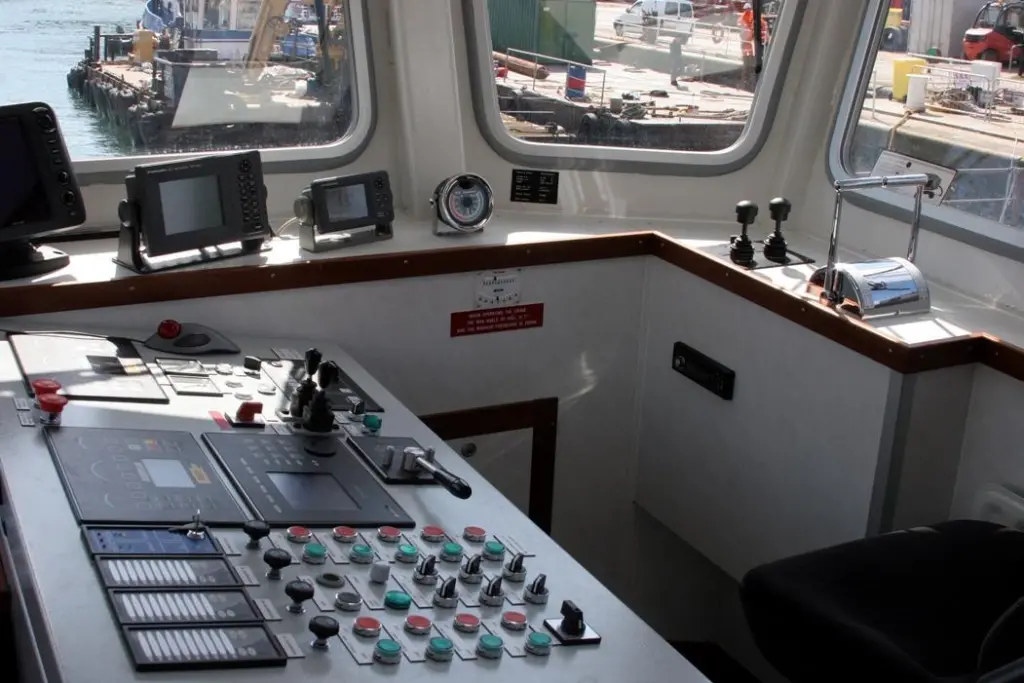
On board accommodation includes two single berth cabins and one twin berth cabin. There is a WC/shower room and an air conditioned day room/mess. Visibility is excellent from the raised port side wheelhouse, where a navigation package featuring mostly Furuno equipment includes radar with a daylight monitor, DGPS and a full colour chart plotter. There is also a Radio Holland autopilot and two Sailor VHF radios.
Williams has added an Iridium/Sailor satellite phone supplied by Aerial Telephones of Portsmouth which can be used anywhere in the world. Another useful addition is a Komar AIS receiver supplied by Mantsbrite Ltd of Essex UK. Featuring Euronav software also supplied by Mantsbrite, the unit receives information about all other ships in its area and transposes it onto the chart plotter, making it easy to identify which other vessels it may be working with or delivering to.
Willendeavour has already undertaken its first job, working for the Papendrecht based specialist in the installation of underground utilities and pipelines Visser Smit & Hanab. Duties focussed on anchor handling and support of a Stemat pontoon barge which was laying a water pipeline between the UK mainland and Gurnard on the Isle of Wight. Another major job is already in the books for May, and with a vessel of Willendeavour’s ability now available for work throughout Europe, Eric Williams should be able to retire whenever he chooses.