![MaritimeJournal[Seawork]](https://www.maritimejournal.com/wp-content/uploads/2026/09/MaritimeJournalSeawork.svg)





Successfully predicting failure
No, it isn’ t quite clairvoyance, but finding faults before they happen is almost as useful. And failing that, finding out what fault has just happened comes a good second. Marine hydraulics supplier MacGregor is utilising a very useful bit of kit that can do both of these things.
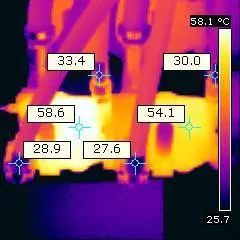
It is a hand-held thermal imaging camera, sensitive enough to pick up the tiny heat peaks that come from an internal seal that is about to fail completely, as well as those that have suffered more dramatic breakdown, without having to take machinery apart. It can even be used to pick up electrical stress, such as loose connections or component failure from outside the box.
MacGregor’s engineer Oliver Munday demonstrated how the unit worked at the Seawork exhibition in Southampton last month. He explained that the biggest advantage of thermal imaging is being able to ‘see’ inside sealed units.
‘It is a non-intrusive procedure, you don’t need to take the machinery apart to find out what is going wrong, he said. ‘All you have to do is get within a couple of metres, point the camera at the outside of the body you are testing, and it will show up any internal faults.’ The pump he examined for demonstration purposes obligingly displayed a heat spot where an oil seal was leaking inside.
Munday went on to say that the unit had recently prevented problems when a large cargo vessel docked in Southampton suddenly found it couldn’t open its main hatch. ‘Nobody knew what had gone wrong, they were just stuck’, he said.
The MacGregor team were called, and using the camera, found that the seal of the main cylinder on the hydraulic arm of the hatch cover had a 4″ rip in it. With the fault located, it became much easier to put right, and the crew wasted no more time in getting cargo off the ship.
All this ties in with MacGregor’s fault prevention strategy, which sees the company developing a new system which takes readings from onboard equipment, bouncing it back with GPS signals to a MacGregor base where it is compared with ‘normal’ readings. If the differences fall outside a certain range, a notification is sent through to the ship and the engineers so that planned maintenance can take place. It’s much less expensive than waiting for a costly failure.