![MaritimeJournal[Seawork]](https://www.maritimejournal.com/wp-content/uploads/2026/09/MaritimeJournalSeawork.svg)


Svitzer Pembroke is in a different league
The arrival at Milford Haven in the UK of the Svitzer Pembroke, a further new tug of the ‘RAstar class’, was met with a mixture of surprise and satisfaction in the port.
It is well over a year since a fleet of nine brand new tugs put in place by Svitzer Marine Ltd, based at Milford Haven, was finally complete and operational. Comprising six high-tech Robert Allan designed RAstar terminal tugs and three of the latest Svitzer ‘stretched M class’ vessels, the fleet is one of the largest and most powerful to enter service anywhere in the world. The fleet handles the LNG carrier traffic at two separate terminals and tanker traffic at a number of local jetties. (Maritime Journal – July 2009)
Although this latest addition to the Svitzer fleet has much in common with the existing RAstar class tugs, this one is in a quite different league. A visit by MJ highlighted several interesting features incorporated in the new vessel and the logic behind its employment.
Designated a RAstar 3600, Svitzer Pembroke is a highly versatile vessel capable of undertaking shiphandling, escort duties, deepsea towing, salvage and anchor handling operations. With an overall length 35.80m, a moulded breadth of 14.5m and operating draft of 6.65m, the tug is just a little larger than the five RAstar 3500 series tugs and smaller than the single RAstar 3900 tug in the existing fleet.
Svitzer Pembroke is classed for unrestricted operation and was built to Lloyd’s Register of Shipping Class: +100A1 Escort Tug, Fire Fighting Ship I with water spray, +LMC, UMS, IWS, and complies fully with SOLAS and International Loadline regulations. The tug was constructed and fitted out to a high standard by Astilleros Zamakona at Pasaia, part of the ‘Zamakona Yards group.
This latest vessel has the same classic ‘RAstar’ hull-form as the earlier tugs, ensuring the highest standards of both escort towing capability and the superior sea keeping qualities necessary for the wide range of operations for which it is designed.
The hull has a considerable sheer and a raised foredeck, stretching forward from a point close to amidships. An open stern has been incorporated for anchor handling and other offshore services. The central area of the after deck is protected by a hardwood covering and tie-down points are provided to secure cargo or equipment. Tubular ‘cargo rails’ offer some protection to the crew during offshore operations. The bulwarks at ‘after deck’ level have large opening ‘gates’ for rescue purposes. Adjacent to the gates, on both sides of the vessel, is a narrow cleverly designed gate, hinged at the lower edge, which can drop down to form a boarding ladder. The bow, stern and sides of the vessel are exceedingly well fendered to provide adequate protection during all of its various modes of operation.
The most obvious addition to this ‘RAstar’, when compared with the rest of the Milford Haven fleet, is the large Rolls-Royce double drum towing winch located on the deck immediately aft of the superstructure. The hydraulically powered three-speed winch has a maximum brake capacity of 250 tons and generates line pulls of 86 tons at 7m/min, 32 tons at 18m/min or 9 tons at 45m/min. Each drum, one large and one small, can be controlled independently from a small control panel at the rear of the wheelhouse overlooking the winch and after deck. One drum is equipped with 1,000m towline of 56mm diameter steel wire rope (SWR) and the smaller drum carries a 200m ‘work-wire’ of the same specification for anchor handling. Automatic spooling gear serves the towing drum, and a warping head is fitted to the winch shaft on the port side.
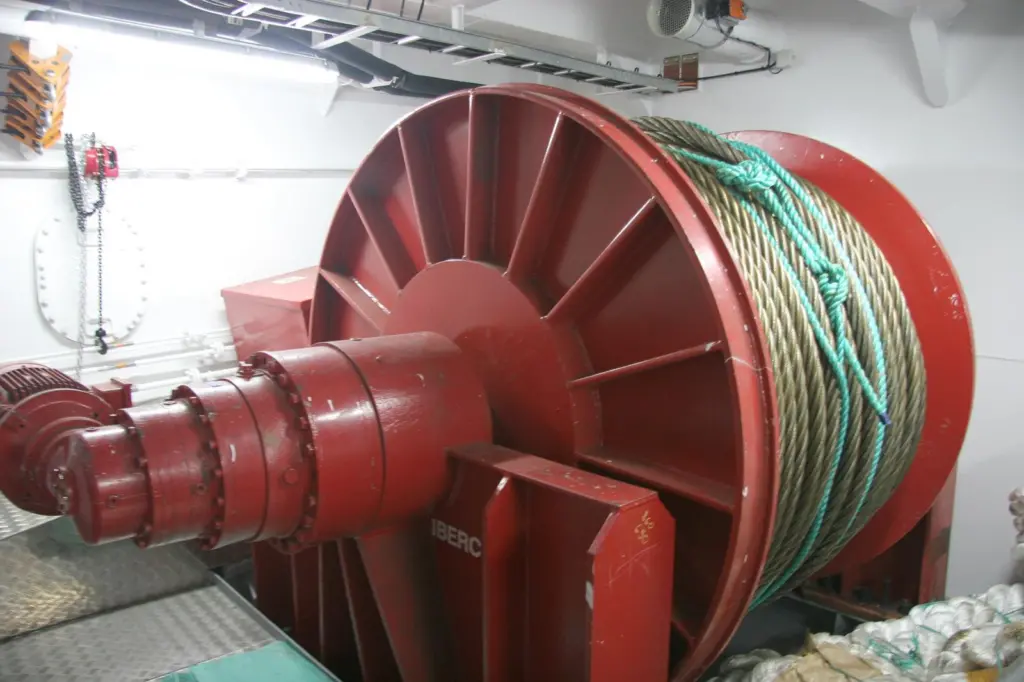
An electrically powered reel from Ibercisa, located in the stowage hold below deck, carries a spare 1,000m SWR towline.
Wires from the winch are deployed via a massive tubular fairlead structure mounted on the deck immediately aft of the winch. A Rauma Braatvaag ‘tugger’ winch of 12 tons brake capacity and 10 tons line pull is provided on the starboard side of the winch and a 5 ton capstan from the same manufacturer is on the port side aft. A single set of hydraulically operated tow pins and a line handling jaw, supplied by Industrias Ferri, is installed on the centreline forward of the stern roller. The pins have rectangular non-rotating heads and each pin can be raised or lowered independently, or in unison, to trap or control the towline or work-wire.
For shiphandling and escort work Svitzer Pembroke is equipped with a combined anchor windlass and towing winch from Rolls-Royce. The hydraulically powered winch features a towline ‘render and recover’ system for escort operations and has a single drum carrying 250m of 76mm diameter high performance manmade fibre towline. A massive tubular ‘staple’ acts as a fairlead for the towline during all shiphandling and escort operations. The winch is controlled from the wheelhouse for normal operation or, when necessary, from a panel on deck.
Other deck equipment includes a Guerra M170-90A-4 hydraulic knuckle-boom deck crane of 17tons/m capacity with a maximum outreach of 11.5m. The crane is fitted with a winch and wire hoist enabling 1,250kg to be lifted with the telescopic jib fully extended. A ‘SOLAS approved’ rescue boat is carried on a rack above the aft towing winch and launched/recovered by a ‘Servoship’ davit capable of manual or hydraulic operation.
The tug is fully equipped for fire fighting to FiFi 1 standards, with two remotely controlled FFS water/foam monitors located high above the wheelhouse roof. A self-protection water spray system is installed along with a comprehensive system of deck hydrants. The system is supplied by pumps driven by the main engines.
Svitzer Pembroke is a powerful tug, with a maximum bollard pull towing ahead of 105 tons and 97.5 tons towing astern and a maximum free running speed of 13.5 knots. The dynamic indirect steering and braking forces in the escort mode, are estimated at 115 tons steering and 150 tons braking at 10 knots.
The propulsion system comprises a pair of General Electric 16V228 main engines, each rated 3,052 kW at 1,050 rpm to generate a total of approximately 8,294 brake horsepower. Each engine is coupled to a Schottel model SRP 3030 fully steerable propulsion unit with a controllable pitch propeller. A 1,430cu/m/hour capacity fire pump from ABS Scanpump is driven from the end of each engine via a Kumera step-up gearbox.
Also located in the centre of the extremely spacious and well configured engine room are three auxiliary generators. Two are Cummins K19-CP380DM/5 powered alternators, each rated 390kW at 1,500 rpm. The third is a Cummins 6B-CS74DM/5 harbour generator set rated 74 kW, contained within a sound reducing housing. Both main engines and auxiliaries are cooled via NRF box coolers.
The main access to the engine room is through a soundproof engine control and switchboard room, with windows looking out over the machinery. A comprehensive alarm and monitoring system by SAM Electronics includes all main engine and propulsion unit systems, auxiliaries and tank soundings. Duplicate monitoring and alarm panels are provided in the wheelhouse and accommodation.
Aft of the engine room, with watertight doors at either end, is a stowage hold housing the spare towline reel and other equipment, in addition to the main hydraulic powerpack for the deck machinery. Entry into the Schottel propulsion unit compartment is gained through the stowage hold.
Integral tanks aboard Svitzer Pembroke can accommodate 320 cu/m of fuel, 31cu/m of fresh water and 16cu/m of fire fighting foam.
The wheelhouse is typical of the breed, with a single control console, chart table and GMDSS communications desk. A comprehensive outfit of navigational and communications equipment has been chosen to suit the wide range of work envisaged.
In common with the other ‘RAstars’ in the Milford Haven fleet, Svitzer Pembroke is fitted out to a very high standard for an operating crew of up to eight persons. Facilities on board include spacious crew accommodation for the full complement in four single (en-suite) and two large double cabins. Other facilities include a generous combined lounge/mess area and a fully equipped and modern galley.
A great deal of attention was paid throughout the design process to reduce the propagation of noise and vibration. That included, resiliently mounting the main engines, isolation of all exhaust system components, and the extensive use of visco-elastic floating floor systems throughout. The result is an extremely quiet vessel, with very low noise levels in the wheelhouse and throughout the accommodation when the tug is running free.
Although Svitzer Pembroke will be based at Milford Haven and participate in shiphandling and escort duties when required, the tug will also carry out deepsea, coastal towage, and anchor handling operations when suitable opportunities arise. An ability to tow over the stern at sea from a powerful winch gives this ‘RAstar’ an advantage that its running mates do not have.
By Jack Gaston