![MaritimeJournal[Seawork]](https://www.maritimejournal.com/wp-content/uploads/2026/09/MaritimeJournalSeawork.svg)



Swedish pilot boats for busy Elbe Estuary
The first of two Swedish-built pilot boats of a new type has gone into service for local shipping authorities in the difficult and busy Elbe Estuary region of north Germany.
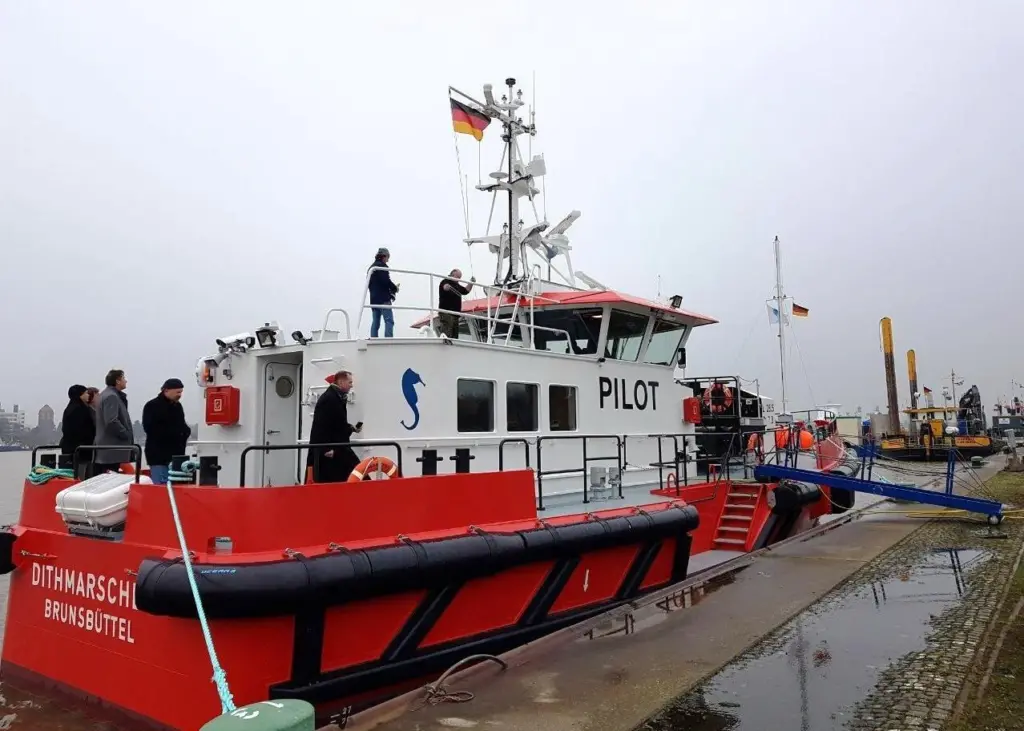
The Type AP 28M pilot boat Dithmarschen is 27.6 loa, 7m wide and draws 2.6m. It was handed over to German shipping and Waterways (WSV) officials in Brunsbüttel at the Elbe end of the Kiel Canal for operation by local pilots on the Canal and on the nearby Elbe and Elbe Estuary. Big ship traffic to and from Hamburg place heavy demands on pilots in that area.
A sister ship named Steinburg is being handed over in May, according to specialist pilot boat builder Dockstavarvet in Sweden. The cost of both boats is put at €11 million by the WSV.
Dockstavarvet has built a series of pilot vessels for German authorities in recent years including six fast 16m boats designed especially for Baltic service. The first went into service some seven years ago and the WSV said they had acquitted themselves well.
The latest boats replace three units in service for many years and will perform some 30,000 boarding operations each year while on duty 24/7. Reports said they were spearheading a programme to modernise the aging pilot boat fleet in Brunsbüttel. The WSV said they marked “the start of a new era” and added that their design was better adapted to the rising demands of shipping and that they were safer and lighter than their predecessors.
With steel hulls built by Riga Shipyard and Aluspec aluminium super structures, the engine systems are a package delivery from PON Sweden and comprise a Caterpillar C32 main engine rated 895kW at 1800rpm, Reintjes gearing and a CAT CPP system. PON also delivered the control and alarm systems as well as two CAT C4.4 / 38kW diesel generators. Top speed at full loads was put at 14.3 knots.
Other equipment includes an hydraulic Sleipner /Side Power bow thruster with pumps driven from a PTO on the gearbox. The steering gear is of yard design with a large fish tail rudder and with one main hydraulic pump driven from the main engine and a stand- by pump with electric drive. The navigation system comprises mainly equipment from JRC and has been delivered by Alphatron in Hamburg.
An interesting fender system comprises 400 and 500mm cylindrical fenders at deck level and 200 x 250mm D-fenders on the side. A pilot platform is installed forward of midships 1.4m over deck level. Fitted with hydraulic drive it can be pushed out in line with the fender system to both sides. Niches to port and starboard just 0.5m above the waterline permit low freeboard transfers.
By Tom Todd