![MaritimeJournal[Seawork]](https://www.maritimejournal.com/wp-content/uploads/2026/09/MaritimeJournalSeawork.svg)



Tamar Class is Most Advanced Lifeboat
The series production of the latest Tamar Class lifeboats for the RNLI is continuing at a steady pace following the recent takeover of builders, DML Group, by Babcock Marine. In October the new Cromer boat 16-07 was brought to East Anglia by its new crew, shortly after the Barrow in Furness vessel 16-08 had paid a visit to London. The 16-09 boat, destined for Salcombe, is due for delivery in this month.
Babcock (DML), the defence support specialist and builder of superyachts at Devonport, has been contracted by the RNLI to supply a series of this new generation of high-tech Tamars, the first of which was unveiled at the London Boat Show in 2006. The Tamar replaces the Tyne Class slipway launched lifeboat which was introduced in 1981. Although designed for slipway launches, several of the Tamars will be kept afloat on station.
The approximate cost of each vessel, including development, is £2.5m and a total of 17 boats have been ordered for delivery by 2012, although there may eventually be as many as 28 or 30 Tamars built before the programme is completed. The vessels’ dimensions are 16m LOA with a beam of 5m, draught of 1.35m, and weighing in at 32 grt .
With four boats being built at any time, deliveries of finished vessels are expected every three months. As of early this month there were four Tamars on station, two based at Poole as relief boats and another two waiting to enter service. The RNLI’s design team leader Neil Chaplin explained that the rate of delivery of the GRP/FRP boats is dependent on cash flow, saying, ‘We can either build three or four boats a year using the one mould. If we needed to build five boats we would need an extra mould.’
The 16m Tamar, developed by the builders and RNLI designers over five years, is one of the world’s most advanced lifeboats in terms of construction, materials and technology and, given the builder’s experience, a number of military processes have been integrated into the boat’s production. Designed for fast response times and to give greater protection to the crews, the aim, says Neil Chaplin has been ‘to make the boats as simple, safe and effective as possible for the crews.’
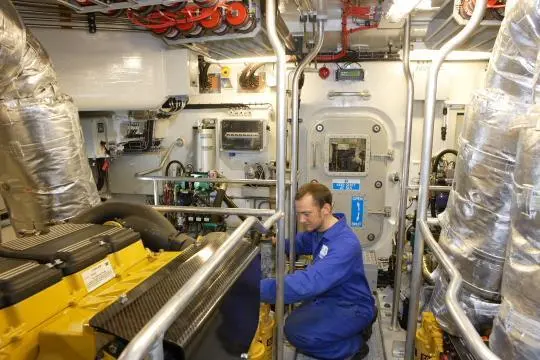
The Tamar class boats have a range of 250 miles at a top speed of 25 knots delivered from their twin 1,000 bhp turbocharged Caterpillar C18 diesel engines driving two fixed pitch five bladed propellers. The props and rudders housed in tunnels. There is a bespoke centralised hydraulic system that runs a 50hp Sleipner SidePower bow thruster, two forward capstans and one aft, a fan and compressor.
The Tamars are designed to carry a crew of seven (including doctor). A basket stretcher can be fitted to a trestle in the wheel house. There are 10 bench seats for survivors although the boats are capable of self righting with up to 44 survivors on board. The all-up quota to meet MCA criteria is 118 persons on board. A Y-boat inflatable is carried to get close inshore when needed.
The Tamar’s GRP/FRP hulls are moulded by Green Marine in Southampton, using a process called Sprint. The high density glass cloth comes layered with required amounts of resin making it easy to handle and to lay into the mould. The bottom panel of the hull is a 10mm thick single skin made of solid glass and epoxy. The sides are 2mm or 3mm with a 100mm foam sandwiched between that and the inner skin. A 20mm metal plate or shoe is fixed to the main centreline keel and on the bilge keels 10mm steel plates are fitted to protect the hull when launching down a slipway.
At Babcock’s yard a team of 80 workers in six disciplines is employed full time on the Tamar production line. Adrian White of Babcock Marine says, ‘We don’t attach anything to the hull itself. Components to be added are fixed to GRP pads which are bonded to the structure and then fitted with a threaded taper with a plate. Over 600 of those are fitted to the hull and made millimetre perfect in the GRP shop. That phase lasts 16 weeks, before the hull is moved into the paint shop for nine weeks, and then into fit out for up to 16 weeks.’ The time durations are deliberately phased to allow the boat ahead on the production line to be finished, with each boat 12 weeks behind the other.
A notable feature of the boat’s high tech fit out is the Systems and Information Management System (SIMS) which enables crew members to check engine performance and other operational information, including helm, communications, navigation, systems and alarms. Adrian White adds, ‘There are cameras all over the place. The old lifeboats did have some electronics but nothing like this system, which enables all functions to be controlled from the operators’ seats.’ There are five screens in the wheelhouse and one at the upper steering position on the fly bridge.
The Japan Radio Company (JRC) provides the RNLI’s lifeboats with a GPS compass for accurate ship’s heading information and the radar scanner for the RNLI’s propritary multi-function system, allowing for excellent target detection during navigation and rescue operations.
Inside the boat the wiring and ducting for the air conditioning is left exposed rather than hidden behind trunking to allow for quicker access if needed for inspection or venting. As Neil Chaplin explained, ‘This is not a luxury yacht and we don’t have aesthetic concerns, as long as the boat is nice and shiny on the outside to impress the public.’ He adds that it also ‘encourages the yard to do a top job if their work remains visible and it can be lot easier to quality check. And it is useful if conducting remote diagnostics by phone.’
Safety features include an ergonomically designed crew seat, with suspension characteristics that reduce stress on crew members’ backs while at sea and while launching.
There have inevitably been modifications since the pre-production boat. Chaplin says these are mostly for reasons of efficiency or cost saving although it is impossible to be totally consistent throughout the configuration control process. Among other things, with a kit made of several thousand parts some supplied parts will be improved or superseded as the project rolls on.
The original contract to help the RNLI design this new class of lifeboat was awarded to DML in 1998. An experimental/prototype boat was built at Devonport in 2001. This was based first at Devonport and then at RNLI headquarters at Poole, where it was used for further evaluation and training in the run-up to operational acceptance. It has since been sold to Kent police to be converted for anti-terrorist duties at Dover
The first of the production boats was delivered in November 2005 and is based at Tenby, where a new slipway was purpose built. The second is on station afloat at Peterhead. The third was destined for Padstow and the fourth for Longhope in the Orkney Isles.
DML was the principal support contractor to the Royal Navy, providing support services for submarines, surface ships, and defence systems and equipment. Through its Devonport and Appledore facilities it offered specialised warship design and build services for vessels up to 130 metres. Babcock also operates and owns Rosyth Royal Dockyard and manages the Clyde Submarine Base at Faslane under a contract from the MoD.
As DML, the company developed concept designs for a versatile patrol vessel (VPV) and future surface combatant (the next generation of frigate). The company has also outfitted new Severn Class lifeboats and refitted other RNLI craft, including eight Severn Class, five Tyne Class, plus a Mersey and a Trent Class. It was able to draw on its naval experience in the design and build of the Tamar lifeboats.
In addition to the Babcock workforce, a core team of about 20 to 30 RNLI people have worked on the Tamar programme, along with more than a hundred RNLI crew, whose input has been vital to the project. As Neil Chaplin says, ‘Continuity of employment is good for quality’.
By Graeme Ewens