![MaritimeJournal[Seawork]](https://www.maritimejournal.com/wp-content/uploads/2026/09/MaritimeJournalSeawork.svg)



‘Tridens’ refit
The Dutch governmental shipping company Rijksrederij (part of the Dutch Ministry of Infrastructure and Environment, Rijkswaterstaat) has recently taken delivery of its scientific research vessel ‘Tridens’ after the largest refit ever undertaken by the Damen Maaskant Shipyard at Stellendam.
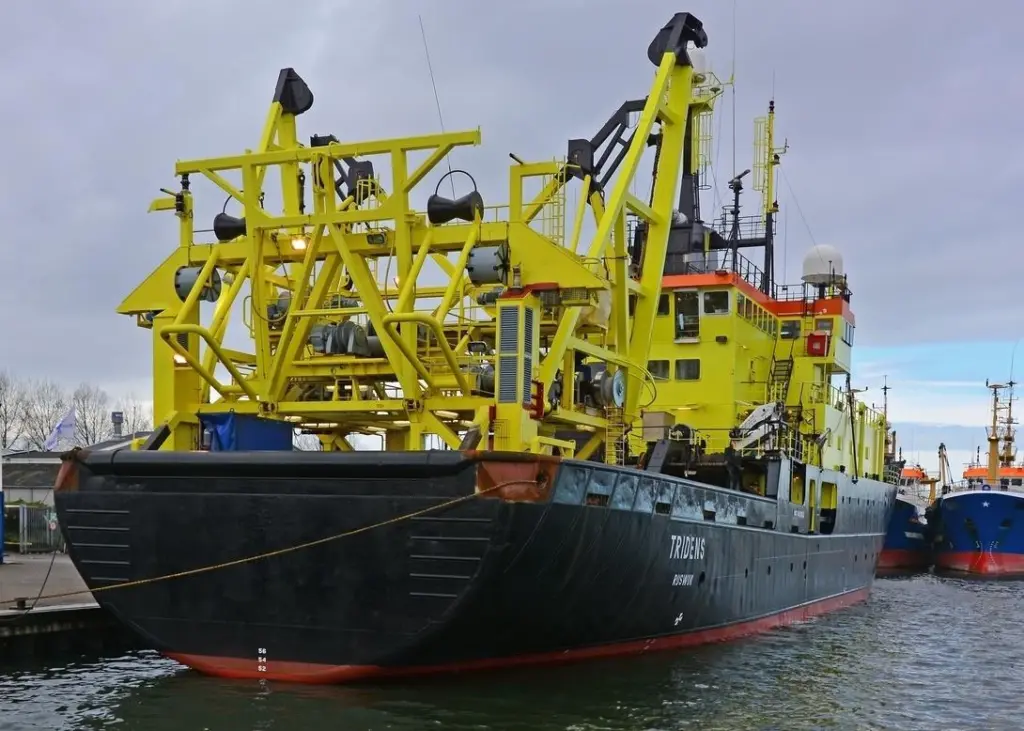
Tridens underwent a major midlife conversion to boost the vessel’s multifunctional capabilities for fisheries research, including installation of an innovative drop keel.
The Rijksrederij is the custodian of the North Sea and manages a fleet of specialist vessels. The maritime research institute IMARES, in collaboration with other European fisheries institutes, employs Tridens (73.5 metres in length and 14 metres beam) to help determine fish stocks in the North Sea, among other duties.
“We’ve worked with Damen Maaskant Shipyards Stellendam over many years for maintenance,” said Dirk Kuijt, Technical Manager at the Rijksrederij, “but this is the first time we’ve completed a refit of this scale and the first time we’ve installed a drop keel. The cooperation with Damen has been exceptional. It was a very big project for us and we had a very tight schedule. Tridens is departing immediately for survey trials and will shortly represent the Netherlands in a four-week joint European survey, so we were all under a lot of pressure. I’m very pleased with how Damen completed the project according to plan.”
During the refit, Tridens was fitted with a wide range of modern scientific research equipment, including the innovative drop keel with broadband multibeam echosounder installed by IJmuiden-based WNL Marine Electronics. With the new equipment, Tridens can accurately track biomass and fish shoals in the ocean as well as conduct bathymetric surveys. Deployed up to 3 metres proud of the hull, the drop keel eliminates interference from the air bubbles that normally form around the hull and can affect the performance of the echosounders.
The Rijksrederij was eager to ensure the conversion project would deliver a highly effective and efficient solution. The meticulous planning before the conversion included detailed studies on board the Irish research ship Celtic Explorer, delivered by Damen in 2003. Complex calculations were necessary to determine the most favourable arrangement of the (sonar) transducers within the drop keel to track shoals effectively.
Installing the drop keel also had far-reaching consequences for the rest of the vessel, requiring extensive engineering of the ship’s design and layout in order to accommodate the trunk – a kind of elevator shaft in which the drop keel is lowered.
The drop keel’s specialised engineering works lasted 27 days. But the extent of the project went much further. Making Tridens future-proof for another 10 years of demanding mobilisations required a complete refit and modernisation.
By Jake Frith