![MaritimeJournal[Seawork]](https://www.maritimejournal.com/wp-content/uploads/2026/09/MaritimeJournalSeawork.svg)




Triton heralds entry to new workboat markets
BWSeaCat Ltd is perhaps an unfamiliar name with many MJ readers, but 2010 has seen rapid growth for the Fareham UK based company which specialises in the design and build of commercial powered catamarans.
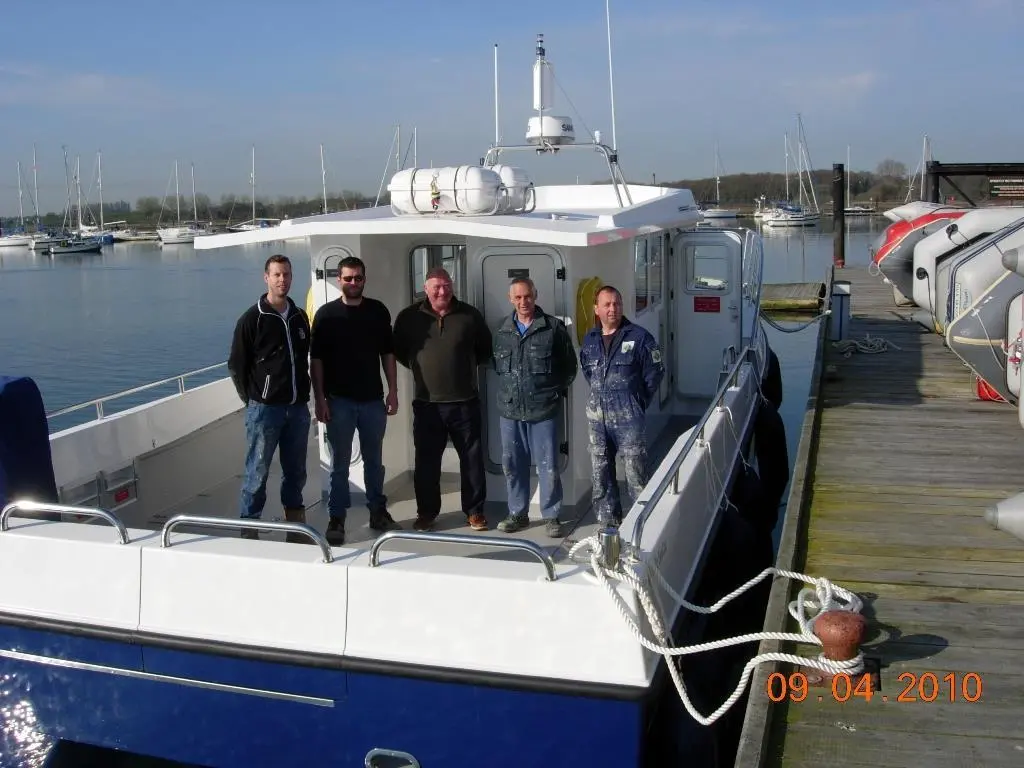
Following a long winter of plug, mould and vessel production spanning late 2008 and early 2009, the company debuted the first of its designs, given the acronym S.P.E.E.D., at the Seawork 2009 exhibition.
Standing for Small Power Extended Efficiency Displacement, this new design builds on the company’s heritage in displacement hull technology. BWSeaCat believe that with the cost of fuel increasing almost daily, this concept has many advantages in terms of efficiency, operating cost and ride comfort over the traditional planing approach to fast hull design.
A successful round of meetings followed an initial sea trial at Seawork 2009 and an order was secured to produce a fast recovery vessel for Tony and Jennifer Bradley of Jevington Logistics. The 11m Triton, to be based primarily at Tenby UK, was designed as a multi-role vessel for the recovery of drones used at Ministry of Defence offshore ranges around the country, and also to provide a safe and stable platform for charter angling.
The 8.5 ton vessel is powered by a pair of 320hp Nanni Diesels provided by A.R. Peachments and driving 21” by 23″ four bladed propellers from Clements Engineering through ZF63a gearboxes at a 2:1 ratio. This gives a sprint speed of 28 knots and comfortable cruising at 19 knots turning only 2,500rpm. On the delivery voyage from Portsmouth to Tenby, Triton achieved an average speed of 19 knots whilst burning less than three litres of fuel per mile.
Exhaust silencing is provided from Vetus and incorporates a waterlock and large muffler to reduce noise to an absolute minimum. Triton also uses propeller tunnels to great effect, which enables the draught to be kept to less than 1m, and the shaft angle can be maintained at a very efficient 8 degrees.
In order to meet the client’s design criteria, a new island wheelhouse was constructed and married to BWSeaCats’ existing foredeck arrangement. Access can be gained via a pair of stairwells from the cabin to a forward galley with ceramic hob and pumped water system on the starboard side and a full sized double berth on the port side. There are large under deck storage areas aft of these stairwells, with part of this section utilised as a generator room housing a Fischer Panda 4000i generator on the starboard side, accessed via a separate deck hatch.
For easy access in different ports around the country, Triton features side loading doors both port and starboard, with double doors in the stern to aid drone recovery. Excellent all round visibility is provided from the helm position through toughened glass windows from Technautic Marine Windows, which also provided the access doors into the wheelhouse on both sides and the rear. The cabin features seating for seven in addition to the helm position. On deck there is a toilet and storage locker and a deck mounted crane in the port aft corner provided by Penny Hydraulics. The crane is capable of lifting 300kg at full extension. It features hydraulic slew and a cable winch, and will rotate through 180 degrees.
Stainless work provided by Waterlooville UK based Fabtech is used extensively throughout the design to both enhance the aesthetics of the vessel and to improve safety on board.
BWSeaCat managing director Iain Worrallo said, ‘We are very happy with the first of our new S.P.E.E.D. vessels for a customer. It was a bold approach for us and an enormous risk to plough everything we had into this new design which is at odds with all other UK manufacturers of power catamarans. This was not a decision taken lightly however and we felt that the theory and the arguments for the superiority of a displacement hull over a planing one were sound enough for us to proceed with the in-house design of our new hull.
‘Having tested the hull form on our own demonstrator vessel with outboards, we were convinced that she could not only carry the weight required but could also perform the tasks and cope with the conditions that inboard shaft driven vessels are often subjected to. We had been trying to break into the charter angling/diving and offshore wind farm markets for some time and we feel that this is the vessel that will get us there.’
BWSeaCat Ltd now has a full order book until February 2011. On 29 April the company launched its second vessel, Wey Chieftain 4 for charter dive skipper Grahame Knott of Weymouth. Powered by twin Yanmar 240hp diesels from E.P. Barrus, it achieved a 26 knot sprint speed on its delivery voyage and cruised at 19 knots whilst turning only 2,600rpm. Experienced skipper Grahame Knott, who took his vessel away in a force 7, said, ‘We had breaking seas at the Needles. I wouldn’t have wanted to do that trip in anything else.’
The BWSeacat team is currently under way with the third vessel to the new design, Rapid Fisher 3 for Paul Smith of Poole. It will be used for charter angling and powered by twin Nanni 320hp diesels which are expected to provide a sprint speed of over 28 knots.
BWSeaCat Ltd will be exhibiting Wey Chieftain 4 at Seawork 2010 for those who wish to experience the S.P.E.E.D. concept first hand.