![MaritimeJournal[Seawork]](https://www.maritimejournal.com/wp-content/uploads/2026/09/MaritimeJournalSeawork.svg)



Versatile ‘MO1’ maximises 25m capability
A lot of hard thinking has gone into Scarborough UK based Mainprize Offshore’s new vessel, the MO1, which is due to be put in the water at the end of June.
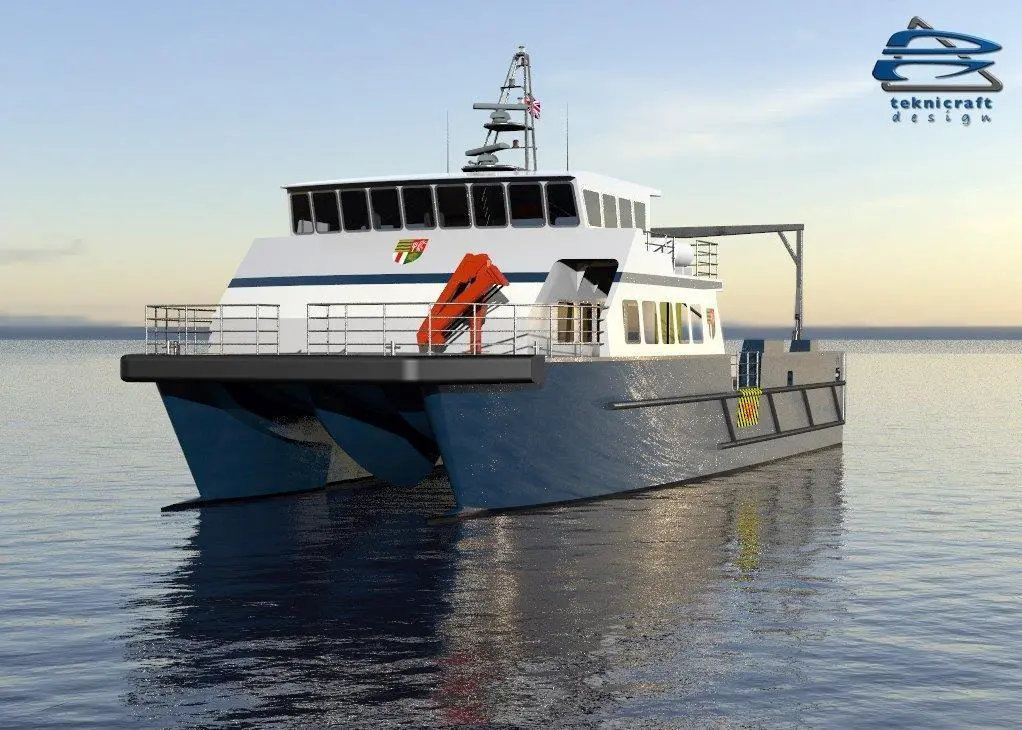
The 25m MO1, the first of two craft for the company being built at the Buckie Shipyard in Scotland, has been carved out to offer the kind of broad-shouldered support that both the windfarm and offshore sectors require. It has a truly huge deck area of 150m2, capacity for 36,000 litres of fuel and 40 tonnes of load, “This last figure being double that of its competitors” says MD Bob Mainprize.
However, Mr Mainprize is clear about what the new vessel is, and equally what it is not: “The market has been nearly saturated with very fast crew transfer boats, but we aren’t in that particular race.”
He points out that the windfarm support vessel evolution is following a similar pattern to the development of the offshore oil & gas sector, another market in which Mainprize has substantial experience. “The market is beginning to divide, there is still a need to get technicians out to site, but there is also a real need for flexible load capability.” So, although MO1 is based on a unique design from the Teknicraft stable, it has had an enormous amount of input from Mr Mainprize himself.
He explains that part of the idea was to keep the propulsion design as sturdy and straightforward as possible. Low speed manoeuvring is provided by a “beefy” pair of Caterpillar C32 main engines providing 1,200kW driving through ZF Marine transmissions to five bladed fixed pitch 1,200mm propellers from Clements Marine. But the very fine wave piercing bow has a hydrofoil dynamic, with multiple chines giving efficient lift and reducing drag. Speed calculations indicate the vessel will achieve 32 knots at 100% MCR with 15 people and 10 tonnes of cargo onboard but, more importantly, will cruise comfortably at 27 knots whilst consuming a modest 14 litres per mile.
“While this combination may be losing a little on the bollard pull, it still comes in around 18 tonnes, plus we are keeping a pretty good speed up and the vessel still gains something because the hull is really extremely efficient,” says Mainprize.
The aft deck can accommodate up to four 20ft containers, eight 10ft containers, a dozen 6ft containers or a mix of these. Forward, the MO1 can accommodate a mixture of two 10ft, three 6ft containers or 10 euro pallets. With these capacities, Mainprize expects these versatile vessels to be ideal for construction vessel supply, jack-up tow, crew transfer and various kinds of offshore support and for duties as survey vessels.
The ever increasing capacities of offshore wind turbines have added to the requirement to carry spares and both the room and capacity onboard to adapt to clients’ requirements is becoming ever more important. “With two runs out to site per day we expect to be able to deliver 70,000 litres of fuel or 80 tonnes of cargo per day, and on quick turnaround operations we could deliver up to 120 tonnes of grout or other cargo,” Mainprize points out.
The deck space also lends itself to plug-and-play kitted out shipping containers. Either Mainprize or the client can provide systems such as a geosurvey suite or laboratory in a standard ‘box’. The space onboard is sufficient for the vessel not to have to return to port and change over between operations.
Dive operations are also supported by the huge deck area. “We can load two 20ft containers, one each for the dive and ROV spread and still have over 100m2 of deck space, 72m2 aft and 30m2 forward,” says Mr Mainprize. However, the two bow thrusters and twin engine set-up assists with station keeping and a four point anchor system also helps.
The vessels has mounting points for two cranes, forward and mid-ships on the port side, and also room for an 8m by 3m reach 1.5 tonne A-frame which will handle a mid-sized construction ROV or the largest survey unit. Extensive cable tracking/depth of burial or survey spreads can also be fitted.
“When conducting underwater maintenance and repair work we plan to use the port mid-ship crane for the dive cage, the A-frame with ROV for diver monitoring and assistance, and the forward crane supplying the divers with any equipment or tools they require,” says Mr Mainprize.
Survey operations
With a 1.5m2 moonpool, three lifting points and the extensive bridge, the MO1 is also very useful for survey operations. This includes an impressive array of capabilities which run from bathymetric, sidescan sonar, 2D seismic and magnetometer surveys, bottom and sub-bottom profiling and AUV/ROV survey work. Additional capabilities include drop core, grab sampling, water sampling, trawl survey, depth of burial, object location-and-recovery and route surveys, plus scour monitoring, intertidal and bird surveys.
Mr Mainprize says the building process has brought a focus on attention to detail. Although the ship is big, internally the MO1 design has been examined in exceptional detail to get the best possible layout. For example, the bridge has been changed, extending the computer area so four or five people can be sitting to monitor either dive or survey work without becoming cramped. “There’s also number of apparently small things that make a difference. We shaved off 500mm from a table to give better access to a walkway.”
He adds that Buckie Shipyard has been “nothing short of fantastic” to work with. “I have thrown a lot of challenges at them. For example, there were six different possible wheelhouse layouts. The team at Buckie really exerted themselves to help us think it through, taking every piece of furniture and doing a mockup of all of them so it could be seen how each one of them would function within a different kind of support role and with different needs.”
Following this scrutiny, one of the ‘extra’ washrooms has been sacrificed to become a medical layout and treatment room. The CCTV and broadband system enables a patient at sea to have face to face consultations with a doctor ashore, to make sure the treatment is maximised.
Another benefit of such communications is that people onshore can check the actual sea state and instruments onboard. “If their mechanisms are showing a 1.5m significant wave height, but ours say 2.00m, they can look in and see what’s really happening,” says Mr Mainprize.
Extensive effort went into calculating the design of the 900mm tall by 750m wide fender which runs for 6m across the bow. Mr Mainprize expressed his gratitude to Colin at Buckie Shipyard, designer Nick Dewalt, and French fender specialists Nibs for enduring the many consultations which led to a fender that will absorb a four knot impact whilst offering protection to anyone in the bow area.
The final design for the bridge has seen it equipped with two helm seats, a five point computer station and lounge area, and an extensive communications package which means the vessel can be used as a main offshore coordination centre or as a backup.
The deckhouse is fitted with 12 suspension seats. There is a seven person dining and meeting table along with a large galley and medical treatment room. The two large 32” monitors also have input from the plotting system, safety DVD’s and presentations, plus relaxation functions such as computer games and satellite TV. Below decks are two twin berth cabins.
The vessel will be operated to ISO9001, ISO14001 and OHSAS18001 certification as well as MARAD planned maintenance systems and safety management to STCW95 standards. The vessel has added redundancy where necessary. The two point crane and A-frame, fully redundant bridge systems and twin generators have all been fitted to reduce down time. “We also offer to fit specific equipment such as salvage pumps, oil recovery and/or FiFi equipment. This gives both increased flexibility and allows our customers to adhere to client requirements, QHSE, international, regional or local regulations,” says Mr Mainprize.
However, it’s been important to keep an eye on the expenditure, he adds. “We kept the costs down so the charter rates stay down. After all, we could have gone for the whole nine yards, but this would have doubled the price and I think that a good day rate will be a big factor in the future. A DP2 vessel that costs £100,000 per day will add a very large chunk to any bill, and when people find out that something less expensive can do the job, that will win.”
He concludes, “We expect these vessels to hit the market running and we are already seeing quite a lot of interest from both the offshore renewable and oil and gas sector for a variety of work.”
By Stevie Knight