![MaritimeJournal[Seawork]](https://www.maritimejournal.com/wp-content/uploads/2026/09/MaritimeJournalSeawork.svg)


Vessel Launch: Rapid Fisher catches speed, comfort and economy
Portchester UK based BWSeaCat Ltd has delivered Rapid Fisher to charter skipper Paul Smith, who operates out of nearby Poole.
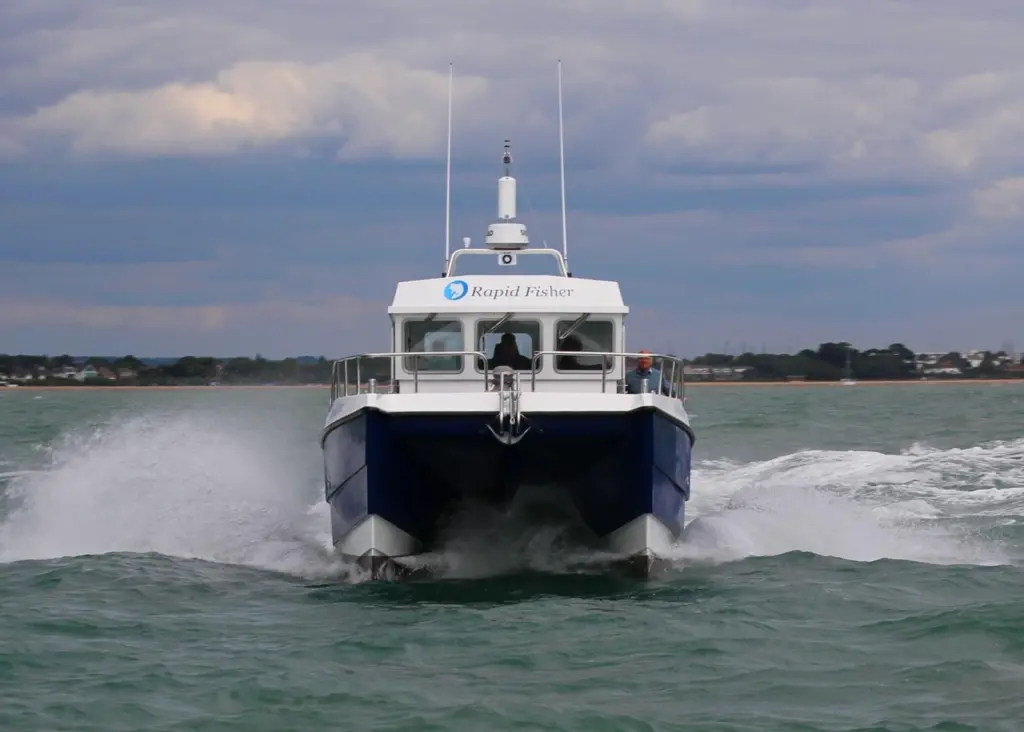
The 11m catamaran is built to the company’s new Small Power Extended Efficiency Displacement (S.P.E.E.D.) design, which called upon the builder’s considerable experience with displacement hull technology to produce a craft which maximises fuel efficiency and lowers operating cost whilst delivering optimal ride comfort.
With other charter skippers asking if the BWSeaCat S.P.E.E.D. Eleven Power Catamaran performs as well as claimed, Paul Smith is now able to answer with an emphatic yes. His first experience of the rough weather handling and comfort of the design came when accompanying his friend and fellow Poole charter skipper Steve Porter on a sea trial aboard Triton, the first inboard diesel powered S.P.E.E.D. Eleven to leave the factory.
At the time, Paul Smith was happy with his then current monohull charter vessel, which he had fitted out himself to a very high standard. However after five minutes of cutting swathes through the vicious Solent chop, heading straight into a gusty force 7, he quickly changed his mind and within a week had placed an order for a new boat.
Based around the company’s basic Charter Spec layout, Rapid Fisher features the classic island wheelhouse with access doors both port and starboard and also to the rear, to allow quick and easy access to all areas of the vessel. Inside the wheelhouse there is a small galley with water heater, sink, microwave, water tank and storage, plus benches down each side to give seating for six in addition to the helm. The view from the helm seat is excellent, with good all round vision through windows supplied by Technautic Marine Windows.
The electrical installation is again provided by Marley Marine, with a custom dash mounted switch panel and all components IP65 rated. The chunky 1.5” diameter stainless rails and radar arch were again designed and fabricated by Fabtech, a small but dedicated company also based in Hampshire at Waterlooville.
Vessel power was supplied by A.R.Peachements and comes in the form of the same Nanni 320hp six cylinder marine diesels employed to great effect in Triton. These drive the 21” by 24.5” four bladed Hyperform propellers from Clements Engineering via 2:1 reduction 8 degree down angle Tuff Torq gearboxes. This package, in conjunction with a streamlined skeg arrangement enables the vessel to comfortably take the ground and gives Rapid Fisher an impressive top speed of 28 knots at 3,650 rpm.
Of far greater significance to Paul Smith however is the cruising speed of 18 knots, which is achieved at only 2,500 rpm, delivering fuel burn figures for the boat of only 2.5 litres per nautical mile. Such a generous return enables a saving of between one and two litres per mile to be made over other similar vessels operating out of Poole.
Following a successful first trip, a three day charter to Alderney, Paul Smith said, ‘I am extremely happy with the boat. The lads at BWSeaCat have done a blinder! After all the hard work and long hours I am so pleased that they managed to deliver Rapid Fisher before the deadline, which enabled me to familiarise myself with the boat before my all important Alderney trip.
‘She has exactly the layout I wanted and her performance at sea has to be experienced to be believed. I am especially pleased with the fuel figures, which are causing a lot of interest in Poole, as is the whole boat. I can’t remember the last time I spoke to this many people on the VHF. I get people I don’t even know calling me up to tell me how good the boat looks at sea.’
BWSeaCat MD Iain Worrallo said, ‘2010 has been excellent for us. It is so gratifying for me personally to see the hull that I designed working so well for people in such different areas of the workboat world. Over the years, much has been promised from the Power Catamaran as a hull form, and yet I feel that to date only a small portion of its huge potential has been made available. Yes they give you more deck space than a monohull and yes they are far steadier in the water, but they have so much more to offer than this in terms of achievable service speed, comfort and economy, and I feel that these areas have been largely overlooked. Our new design is specifically intended to exploit these attributes and bring a whole new level of satisfaction to workboat operators throughout the UK and abroad.’
After a successful Seawork exhibition, where the company exhibited Graham Knott’s Wey Chieftain 4, the workforce is now knuckling down to produce the fourth S.P.E.E.D. vessel, this time a 10m commercial fishing version for Ken Turner of Plymouth. Powered by a pair of Nanni 115hp inboard diesels, this vessel is expected to achieve around 20 knots and is due for completion at the end of October.