![MaritimeJournal[Seawork]](https://www.maritimejournal.com/wp-content/uploads/2026/09/MaritimeJournalSeawork.svg)


Yogi, A first for Herman Sr BV
The family owned tug company Herman Sr BV of Zwindrecht in the Netherlands is well known in the dredging and marine construction industries both in Europe and further afield.
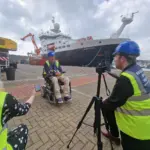
For many years proprietors Jack and Wendy van Dodewaard have operated two tugs and were among the first to make good use of various versions of the Damen Shoalbuster. But with two sons, Erwin and Chris, completing their training and qualifications at Nautical College, the family firm decided to add a third vessel to their fleet. Named ‘Yogi’, the new addition represents a significant change for the family business.
Yogi is a Damen MultiCat 2611, one of the more powerful and substantial multi-purpose work vessels from the Damen range. The vessel was formally named at Damen’s Hardinxveld yard on 30 May and sailed from the Netherlands to start work in the UK a week later.
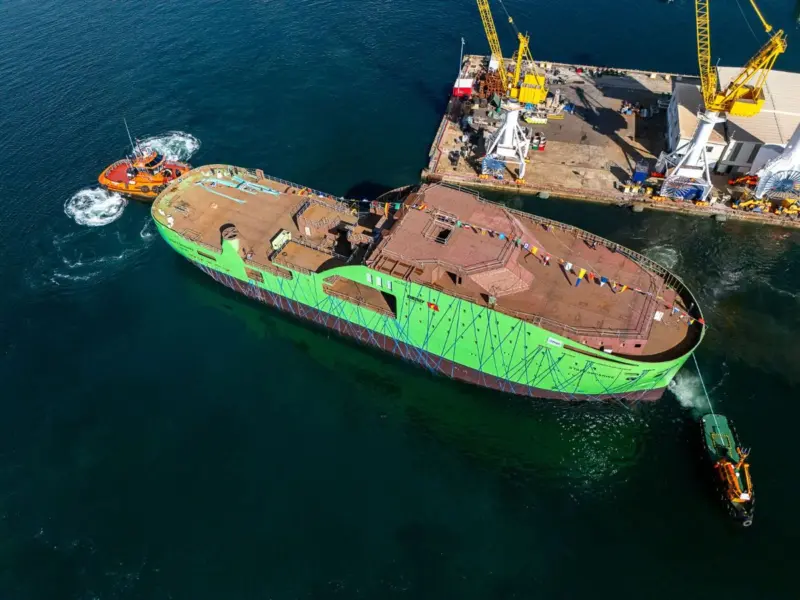
The vessel is very much a standard product ordered initially by Damen Marine Services (DMS) but purchased by Herman Sr BV before completion. The hull and all major steelwork was constructed in Poland and towed to the Netherlands for fitting out in the Damen Shipyard at Hardinxveld, where a certain amount of customisation was included in the final specification. Much of the fitting out was undertaken in the covered workshops at Gorinchem because the vessel was too large for the Hardinxveld facility.
Yogi is a triple screw vessel intended to combine a shallow draft with massive buoyancy for lifting and transportation, good seakeeping qualities, and a better than average towing capability.
Bureau Veritas has classed the vessel; BV 1 3/3 (E)* Tug Unrestricted Area *MACH. The hull is 26.0m in length overall with a beam of 11.5m and virtually rectangular in planform, with heavily radiused and fendered corners. The bottom plating is reinforced to enable the vessel to take the ground without damage and at the bow is rounded to improve water flow and seakeeping characteristics. This configuration gives a draft (aft) of 2.4m and depth at the sides of 3.5m.
Heavily constructed ‘push knees’ have been built into the bow and a substantial bow roller has a diameter of 1.2m and a safe working load of 150 tons. Bulwarks have been kept to a minimum and guard rails are used around the stern to prevent fouling during towing operations.
Deck space has been kept as free from obstructions as possible, with the working areas protected by hardwood sheathing. Internal tanks are provided for 120 cu/m of fuel oil, 48 cu/m of fresh water and 1.5 cu/m each of lubricating and hydraulic oils. Pumping arrangements are installed to enable the rapid transfer of fuel and fresh water at 50 cu/m per hour through hose reels mounted on the superstructure above the working deck.
The superstructure aboard Yogi is offset to the portside and follows Damen standard practice, being carefully configured to encroach as little as possible on the work deck. A well-glazed wheelhouse has a slight overhang to starboard offering a good view of the work deck and winch. Yogi has a Ridderinkhof twin drum ‘waterfall’ style winch installed on the vessel’s centreline and configured for towing and anchor handling.
The towing drum has a line pull of 50 tons at 10m per minute and is equipped with 600m of 44mm diameter steel wire rope. For anchor handling, the second drum has a line pull of 100 tons at 5m per minute and a 600m work wire of 52mm diameter. Both winches can be controlled remotely from the wheelhouse. Two Mampaey quick release tow hooks are also provided for secondary use.
Hydraulically operated line handling gear is fitted fore and aft, supplied by WK Hydraulics. The aft set of three pins is configured for towing and a more substantial set adjacent to the bow roller is designed and configured for anchor handling. Other deck equipment includes a WK Hydraulics 5 tons capacity capstan and an Argano S 100 tugger winch.
Two powerful hydraulic deck cranes are fited. A Heila HLRM 240-2 S/DRG mounted on the port bow is capable of lifting up to 16 tons at a radius of 12m. The second crane, mounted on a pedestal aft of the towing winch, to starboard of the centreline, is a Heila HLRM 200-4S capable of lifting up to 9 tons at 16m radius. This combination affords good coverage of the working deck and, with the cranes working together, offers many possibilities when supporting dredging operations and marine construction projects.
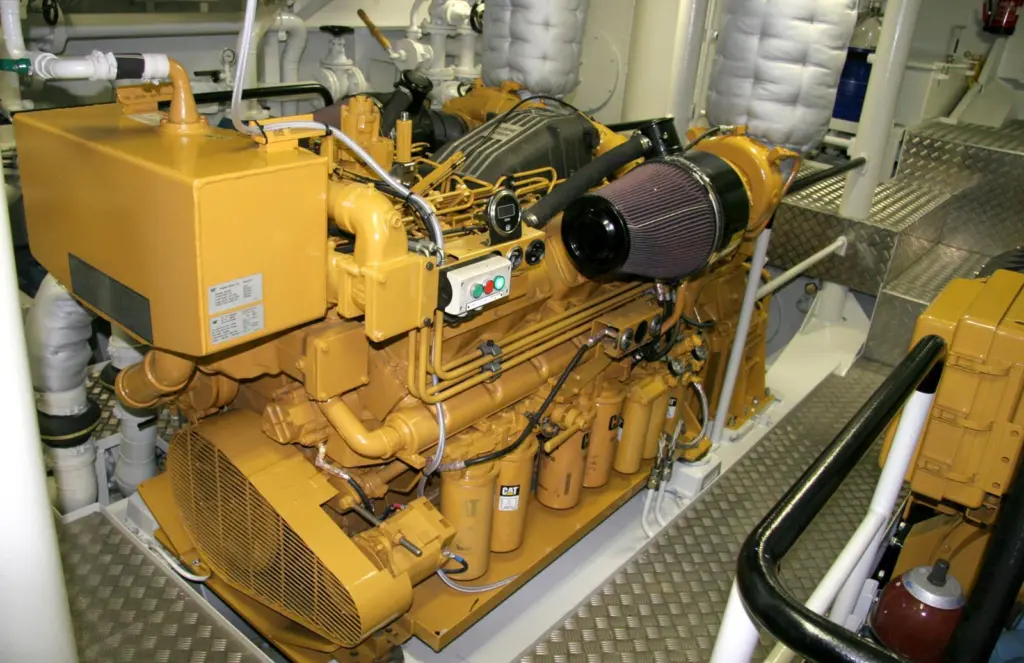
To propel this triple screw vessel Damen have fitted three Caterpillar 3412 D TTA main engines producing a total of 2,435bhp at 1,800 rpm. Power is transmitted via Reintjes WAF 564L gearboxes with a 5.59:1 reduction to fixed pitch Promarin propellers of 1,700mm diameter, rotating within Van der Geissen Optima nozzles. Three ‘fish-tail’ rudders have a maximum angle of 45° either side of the centreline. Manoeuvrability is enhanced with a hydraulically driven gill type bowthruster supplied by Gerlien van Tiem. The latter is rated at 225 kW and can direct thrust through 360°. On trials Yogi achieved a bollard pull of 30.8 tons ahead and a maximum speed of over 10 knots.
Electrical power is supplied by two John Deere 6068 TF258 auxiliary generator sets delivering 107kVA, 220/380v at 50HZ. A Caterpillar C18 diesel rated at 357kW powers the deck hydraulic system.
The wheelhouse affords excellent all round vision and is well laid out for both navigation underway and working on site. A comprehensive bridge electronics package installed by Radio Holland includes two Furuno FR 2117 radars with ARPA, a Furuno GP-150-D, a Tocimec ES-160 gyro-compass and Lehmkuhill LR-60 repeater.
The auto-pilot is a Radio Holland Sea & River Pilot 75, the magnetic compass a Kotter type with an electronic repeater and the chart plotter a Tresco ECDIS system. Communications facilities include three Sailor 5022 sets with DSC, a Furuno FS-1570 single side band set, Inmarsat C and an Iridium satellite telephone, Navtex via a Radio Holland Nav 5, and a Furuno FA 150 AIS.
Yogi has comfortable, air conditioned, accommodation for up to six persons in three double cabins located below deck in the forward part of the vessel. The usual domestic facilities include a mess room, galley and sanitary spaces. Considerable effort has been put into noise reduction and the result is a remarkably quiet vessel, fitted out to a high standard. .
Once the delivery formalities and naming ceremony had been completed Yogi was prepared for work and left the Netherlands bound for Liverpool Bay. The vessel’s maiden voyage passed without incident and it will be working out of Mostyn in support of a new wind farm construction project. In the meantime Herman Sr BV continue to operate their Shoalbuster 2609 Tarka in the Middle East and Shoalbuster 2208 around western Europe.
By Jack Gaston