![MaritimeJournal[Seawork]](https://www.maritimejournal.com/wp-content/uploads/2026/09/MaritimeJournalSeawork.svg)






Buoyancy control for renewable energy work
With more than 600 installations in the North Sea alone, the energy industry faces a daunting and hugely costly task in terms of decommissioning, with some putting the figure at £30bn.
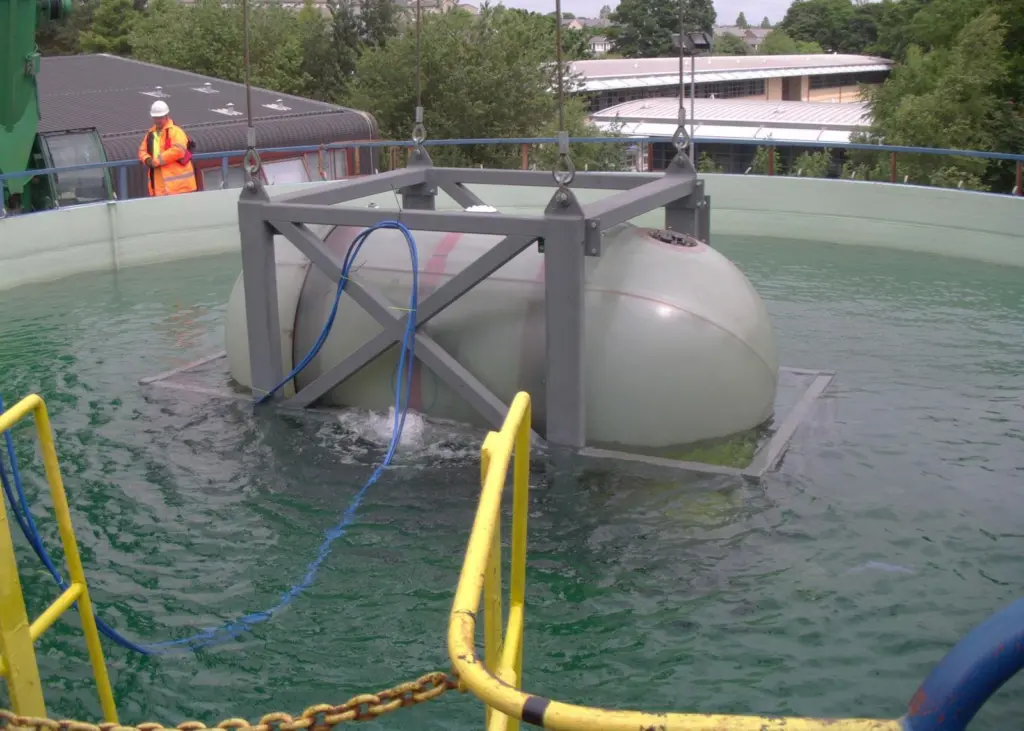
With this in mind, Deep Sea Recovery Limited has developed its Controllable Buoyancy System (CBS) to help tackle many of the issues associated with decommissioning and other subsea tasks requiring movement of heavy loads through the water column such as renewable energy device installation.
When working at great depths, challenges include increasing pressures and decreasing capacity of compressed gas, shortfall in heavy lift vessel (HLV) capacity, remote operation, and increasing cost per tonne. CBS technology is a variable buoyancy system, which uses liquid nitrogen as a subsurface buoyancy gas source, and as the system is reusable, it has the potential to save operators significant costs.
At present the only technology available for raising and lowering heavy loads is the HLV crane. CBS could provide a viable alternative, or complementary, technology to assist in cutting costs and improving safety for operators to utilise.
Having successfully trialled their first prototype at the National Hyperbaric Centre in Aberdeen, Scotland, Deep Sea Recovery has proven the ability to control the ascent, descent and hover of the CBS system using liquid nitrogen. CBS uses an integrated cryogenic gas generator within a lifting structure which makes extensive use of advanced composite materials that are both strong and light.
Duncan Bates, mechanical engineer and project manager at Deep Sea Recovery explained, “The industry is inundated with literature detailing the supposed costs of decommissioning and there is a constant drive to find cheaper methods of achieving each and every step of the process.
“If the industry sticks with the current equipment on the market, spiralling costs will be unavoidable. By providing an alternative to the industry in the form of our CBS technology, we can save organisations money, time, and provide a buoyancy system that is clean, scalable and, most importantly, reusable, significantly driving down operational cost.”