![MaritimeJournal[Seawork]](https://www.maritimejournal.com/wp-content/uploads/2026/09/MaritimeJournalSeawork.svg)


CFD modeling of artificial surfing reefs
DHI in Denmark has provided details of Computational Fluid Dynamic (CFD) techniques it has developed to model artificial surf reefs, in which there is growing interest in Europe and elsewhere.
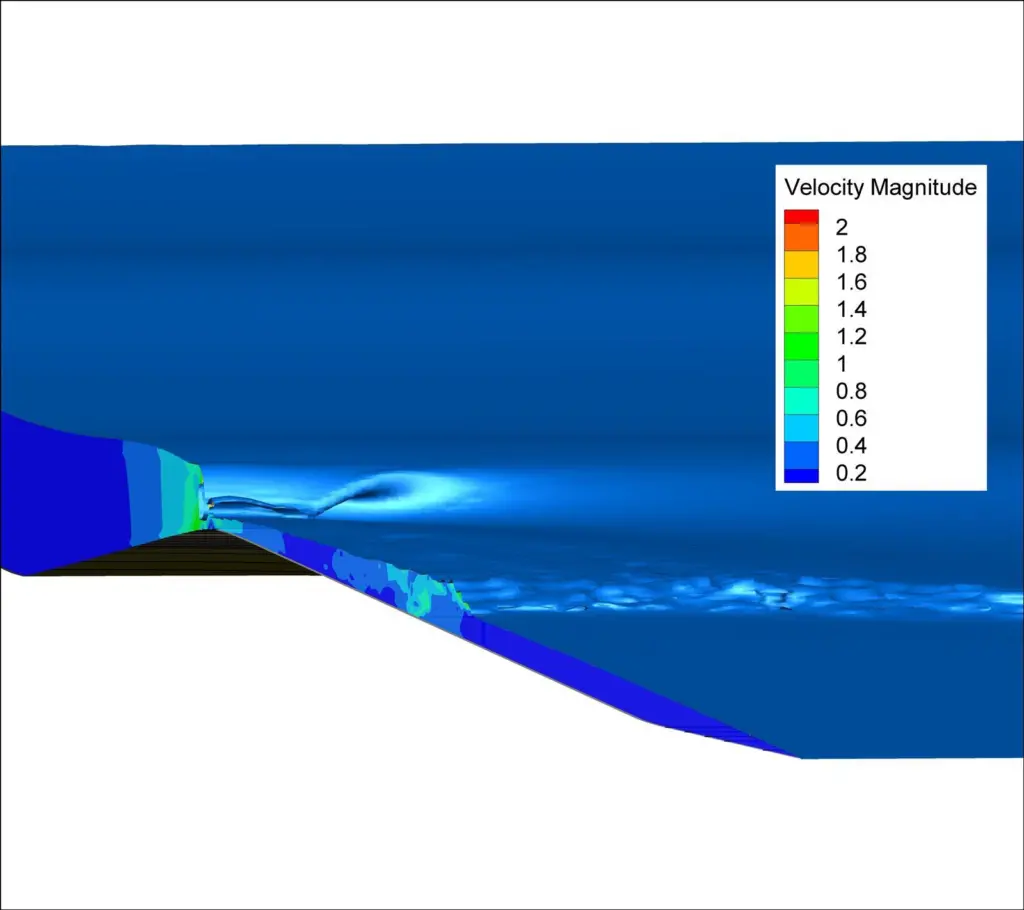
DHI said that during the last decade there has been a growing interest in multi-purpose reefs as a way of providing coastal protection while also creating favourable surfing conditions at the same time. Assessing the surfing quality of a submerged reef requires highly detailed information of the wave breaking characteristics such as the shape of the overturning wave and the propagation velocity of the moving breakpoint.
In addition, the powerful and highly non-uniform wave breaking conditions across the reef induce strong return currents and areas of high local velocities, both of which strongly affect the wave breaking characteristics of the reef, and are thus crucial reef design parameters, when assessing structural stability, induced erosion issues and adjacent beach safety.
DHI added that recent advances in CFD modeling and the utilization of a technique known as ‘code parallelization’ (allowing running simulations across multiple workstations) have now made it possible to carry out detailed studies of the complex and highly non-linear wave transformation and current interaction processes that occur.
DHI said it was using a CFD model called NS3which is based on a fully non-linear 3D Navier-Stokes solver with a Volume of Fluid treatment of the free surface. NS3 can be coupled with DHI’s MIKE 21 BW to provide details of the 3D offshore boundary condition, hence effectively decreasing the necessary NS3 model domain size and allowing the representation of regional effects such as non-uniform refraction around adjacent headlands.
Related Articles
 OTHER NEWS
 MARINE CIVILS
 MARINE CIVILS