![MaritimeJournal[Seawork]](https://www.maritimejournal.com/wp-content/uploads/2026/09/MaritimeJournalSeawork.svg)




Dirty Harry strikes again
UK based international diving equipment technology company Divex has announced a new contract to provide its Dirty Harry contaminated water diving system to a US government law enforcement agency.
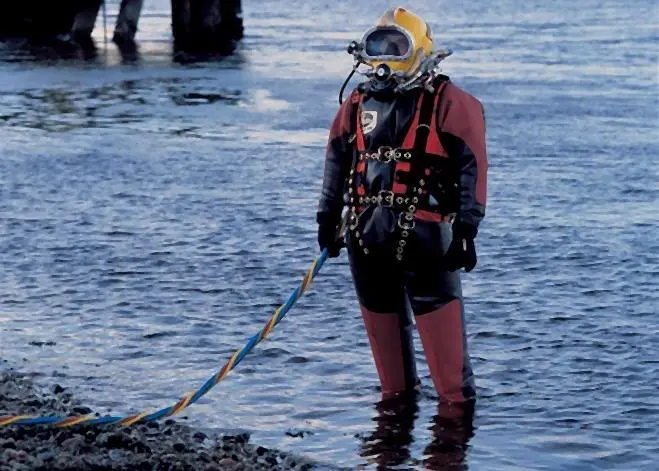
The systems are to be utilised by the technical recovery dive unit to ensure diver safety and protection whilst conducting recovery operations in nuclear, bio and chemical environments.
Divex’s joint managing director Derek Clarke commented, ‘Having such a high profile client endorse our product in this way is a credit to our design and production teams and the company as a whole. I’m delighted that our Dirty Harry system has been recognised as providing the highest of health and safety protection standards in such demanding environments.’
Dirty Harry, launched in 1998, was at the time seen as an improvement in diver safety worldwide. It provides its users with both respiratory and skin protection from a wide range of contaminants. Each two diver system consists of drysuits, dry gloves with lockrings, Ultrajewel Reclaim helmets, umbilicals and an exhaust control panel.
Dirty Harry is a safe and efficient surface supplied system which minimises the risk of contact between the diver and the surrounding water. It is a closed circuit breathing system whereby the divers’ exhaled gas is returned to the surface and exhausted into the atmosphere rather than into the water, ensuring that no contaminated water enters the divers helmet.
Conventional systems exhaust directly into the surrounding water therefore exposing an obvious route for water ingress, as each time an exhaust valve opens, water, water droplets or vapour can enter the helmet.
Existing users of the system include the Italian Fire Brigade, Japanese Maritime Self Defence Force, Turkish Navy, Indian Navy and the Israeli Navy, who use their systems during recovery offshore, inshore and onshore in environmental situations such as chemical spills into waterways, at sewage plants and outfalls, and at nuclear cooling ponds.

Related Articles
 OFFSHORE RENEWABLES
 OTHER NEWS
 OTHER NEWS