![MaritimeJournal[Seawork]](https://www.maritimejournal.com/wp-content/uploads/2026/09/MaritimeJournalSeawork.svg)


Falcon helps safeguard rockfish
Scientists at the Washington Department of Fish and Wildlife are undertaking a conservation study into the endangered rockfish species using a Saab Seaeye Falcon underwater robotic vehicle.
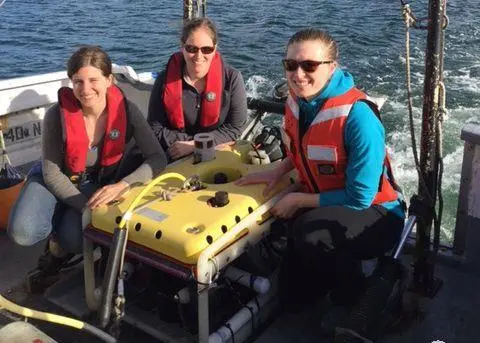
The rockfish in Washington’s Puget Sound have been depleted through overfishing and ecological degradation and managing the conservation and recovery of populations depends on accurate monitoring. The Falcon enables deployment of various camera and instrument payloads while maintaining the manoeuvrability and speed needed to explore complex habitats efficiently, explained Dr Dayv Lowry, senior marine fish research scientist at Washington Department of Fish and Wildlife.
He said: “Of the tools we’ve tested, only the Falcon can find and measure the rockfish and other structure-associated marine fish species found amongst the deep and rocky seabed.”
Capable machine
In addition to the vehicle’s precise maneuverability amongst the cracks and crevasses of complex underwater rock formations, the Falcon, whilst small in size, “has enough bulk and power not to be pushed around by the current,” said Dr Lowry.
Able to operate at depths up to 1,000 feet and in all seafloor habitats, the small, easily manhandled 1 x 0.5 x 0.6m vehicle features five powerful thrusters and an intelligent distributed control system.
Equipment fitted to the Falcon includes a high-definition camera to detect and identify many of the small and cryptic fish, along with a stereo camera for assessing both individual fish size and the density of fish in a measured field of view. This video data can be used to produce precise population estimates.
By Rebecca Jeffrey
Related Articles
 OFFSHORE RENEWABLES
 OTHER NEWS
 OTHER NEWS