![MaritimeJournal[Seawork]](https://www.maritimejournal.com/wp-content/uploads/2026/09/MaritimeJournalSeawork.svg)






Using AI for the restoration of coral reefs
A ground breaking UK – Saudi partnership is using AI to restore the planet’s largest coral reefscape in a first-of-its-kind marine science initiative.
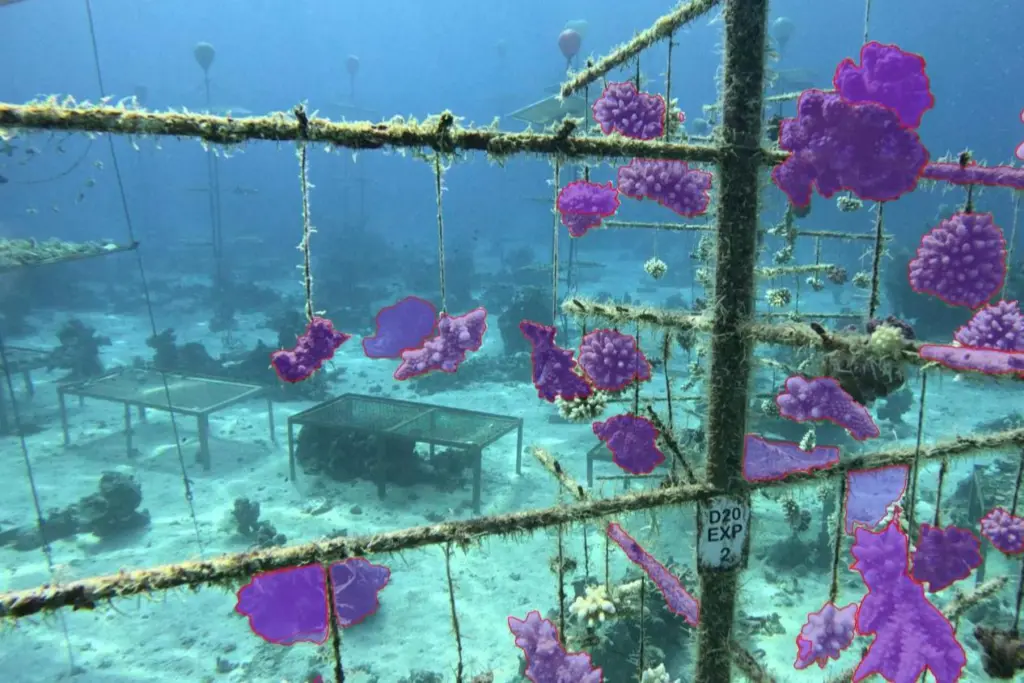
digiLab, a leader in artificial intelligence innovation, has joined forces with Saudi Arabia’s King Abdullah University of Science and Technology (KAUST) to create an AI-powered digital twin of a 100-hectare reefscape in the Red Sea.
“digiLab’s partnership with KAUST on the world’s largest coral restoration project marks a significant milestone in the application of AI technology to solve the world’s challenges,” said Anhad Sandhu, digiLab co-founder.
Machine learning
The initiative is part of the KAUST Coral Restoration Initiative (KCRI), the largest coral restoration programme in the world.
“Coral reef restoration has never been done at the scale which we are planning. Therefore, to accurately and efficiently plan, monitor and measure the progress and success of a project of this scale, we needed to look outside our typical coral reef restoration and monitoring toolbox,” said Dr Liz Goergen, head of monitoring, visualizations and database management at KCRI.
”Partnerships such as this allow us to optimise our processes, leading to greater learnings and to the development of tools not only for our project, but for the greater restoration and coral reef communities.”
By merging AI with ocean sciences, the project is looking to introduce a new era of marine monitoring, dramatically improving coral measurement, subsea sensor placement, and environmental analysis.
The digital twin system, projected to reach 22 petabytes, will simulate and predict reefscape behaviour in real time, aiding restoration efforts with unmatched precision.
Key innovations include chatReef, digiLab’s AI platform designed to extract insights from vast environmental datasets, and advanced machine learning tools to optimise marine survey processes.
These AI applications will cut coral assessment time from two months to two weeks, improve reef health tracking, and guide strategic coral planting, which is expected to reach two million corals by 2030.
Related Articles
 OTHER NEWS
 MARINE CIVILS
 MARINE CIVILS