![MaritimeJournal[Seawork]](https://www.maritimejournal.com/wp-content/uploads/2026/09/MaritimeJournalSeawork.svg)



A Coruña demonstrates autonomous port drones
Autonomous drones have been demonstrated at the Spanish Port of A Coruña in a bid to use them to improve safety, surveillance and infrastructure supervision in a port.
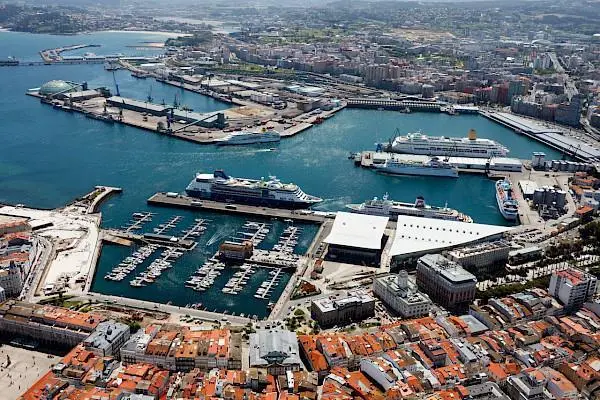
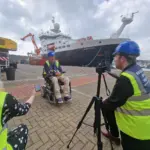
Practical demonstrations were carried out in six scenarios, including a person overboard, to show 50 guests how the technology, developed by the ITG Technology Centre, could work.
ITG develops drone technologies for the safe integration in urban environments.
The technology should be ready to deploy automated unmanned aerial vehicles (UAVs) by 2026, says U-ELCOME, an EU part-funded project that aims support market uptake.
With the person in the sea demonstration, the rescue was carried out with drones detecting the casualty in the water then sending the exact coordinates to another drone, which launched a float to the person in the water. A maritime drone then travelled to the person in the water and brought it back to the dock.
“There were also demonstrations of crane, parameter and breakwater inspection, port logistics, non-collaborative drone detection and how ITG technology works to obtain authorisations for simultaneous integrated and safe flight of drones performing these services,” a statement said.
By 2026, A Coruña will be one of the first cities in Spain to deploy U-Space zones that meet all the regulatory requirements and technology necessary for a large number of drone operators to deploy their operations in a simultaneous, coordinated and automated manner, says U-ELCOME.
U-ELCOME is coordinated by the EUROCONTROL Innovation Hub in the context of the SESAR 3 Joint Undertaking Digital Sky Demonstrator initiative, co-funded by the European Union under the CEF (The Connecting Europe Facility).
The Port of A Coruña is a well-established port in northwestern Spain, and in 2022 received a record number of visitors, according to the Cruise Mapper tracking website.
A total of 222,723 cruise passengers on 136 calls arrived in 2022, up from the previous record of 184,069 cruise passengers and 121 calls in 2017.
Related Articles
 OTHER NEWS
 ACCESSORIES & EQUIPMENT
 SPECIAL REPORTS