![MaritimeJournal[Seawork]](https://www.maritimejournal.com/wp-content/uploads/2026/09/MaritimeJournalSeawork.svg)

Damen launches first electric waterbus build
Dutch shipbuilder Damen Shipyards Group has built its first fully electric water bus as an entry into zero‑emission waterborne public transport. The 28.6‑metre catamaran was introduced at Damen Shiprepair Amsterdam on March 12.
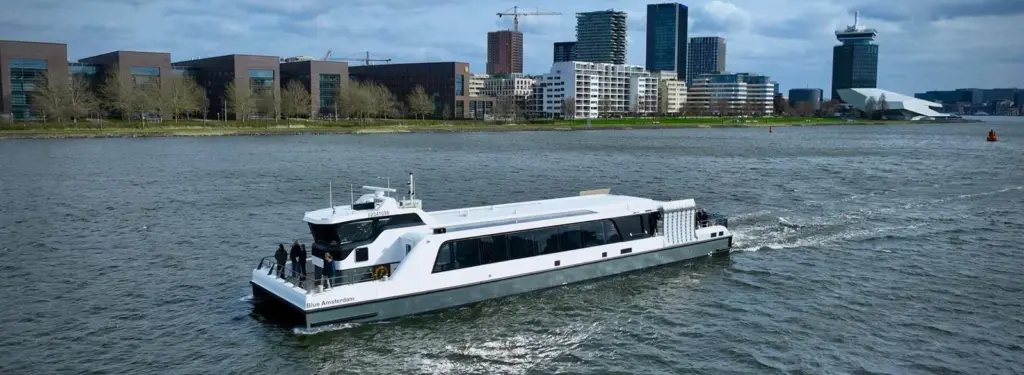
The Waterbus 2907 Electric’s propulsion system is built around two electric motors, each rated at 375 kW, driving a pair of fixed pitch propellers. Combined output delivers 750 kW of propulsion power, supporting a maximum speed of approximately 21 knots.
Energy for the motors comes from a battery system comprised of two 213 kWh units, giving a total installed capacity of 426 kWh, integrated into a 700–950 VDC electrical architecture. The high‑voltage direct current network supports rapid recharge cycles and underpins all major electrical loads.
Hull design and materials were selected to maximise efficiency and minimise environmental impact with a lightweight carbon fibre composite hull construction, which Damen says offsets the weight of the batteries and helps minimise wash.
“The development of the Waterbus 2907 Electric has been a fine balancing act,” said Damen’s product manager Fast and City Ferries Lodewijk van Os. “This is a vessel that will be in constant use, facing multiple mooring and boarding moments every hour of the day. As such, it needs to be robust. At the same time, however, it will operate in an environment where sustainability is paramount. We’ve put a lot of effort into creating a platform that is efficient in operation, producing zero emissions, and optimally comfortable for passengers.”
Manoeuvrability in congested river or canal environments is enhanced via twin azimuth thrusters, which offer 360‑degree thrust vectoring for precise control during docking and tight navigational passages.
Charging infrastructure is standardised around proven automotive connectors, with the vessel also prepared to accept the Megawatt Charging System (MCS), developed for heavy transport applications. Damen plans full trials of MCS capability this year, which could enable significantly faster recharge times between operations, it says.
With a passenger capacity of 110, The Waterbus 2907 Electric builds on Damen’s series‑production experience with hybrid variants of the same platform, transitioning fully to battery‑electric propulsion. It had a standardised DC system and modular battery cabinets for easier maintenance and upgrades down the line.
The project won support under the Netherlands Enterprise Agency’s Subsidie Duurzame Scheepsbouw programme, which encourages experimental technologies in sustainable shipbuilding.
“There is a lot of experimentation taking place in electric waterborne public transportation currently,” said Jan van Ooijen, Damen design and proposal engineer, Public Transport. “We see a lot of concepts in development. We wanted to take this to the next level of maturity with the creation of a solution that offers a reliable, sustainable service.”
Related Articles
 OTHER NEWS
 ACCESSORIES & EQUIPMENT
 SPECIAL REPORTS