![MaritimeJournal[Seawork]](https://www.maritimejournal.com/wp-content/uploads/2026/09/MaritimeJournalSeawork.svg)





Electric future: a growing battery fleet
The maritime industry is undergoing a transformative shift as battery technology gains momentum across various vessel types.
From ferries to tugs, workboats and cargo ships, an increasing number of operators are embracing electric propulsion, driven by advances in battery efficiency and energy storage capacity, as well as responding to stricter environmental regulations and a global push for sustainability.
With regulatory support and continued innovation, maritime batteries are set to play a pivotal role in shaping the future of shipping.
The growth in battery-electric vessels is also fuelling demand for specialist maritime labour skills such as electrical engineering and automation, according to Norway-based industry body Maritime Battery Forum (MBF).
Ferries on the charge
Ferry operators in UK waters going electric include DFDS and Brittany Ferries.
In May 2024, DFDS announced an investment of €1 billion (£836 million) in six battery-powered ships to sail between Dover and Calais/Dunkirk. The first are due to be in operation in 2030, however DFDS says they will not operate without access to sufficient power supply on land and infrastructure to accommodate charging facilities in ports.
DFDS says it is working with local authorities on this and with world-leading experts in battery technology, ship design and energy efficiency. The aim is to ensure the design encompasses safety and performance while using production methods with the least possible impact on the environment. Three vessels will sail under the French flag, according to DFDS.
Brittany Ferries’ new electric hybrid ship, Saint-Malo, entered service on 12 February, calling into Portsmouth as part of the company’s €550 million (£466 million) fleet renewal. It runs on liquefied natural gas, batteries, or a combination of the two.
Saint-Malo’s sister ship, Guillaume de Normandie, will be shorepower capable (charging available later this year). The first commercial sailing was scheduled for April.
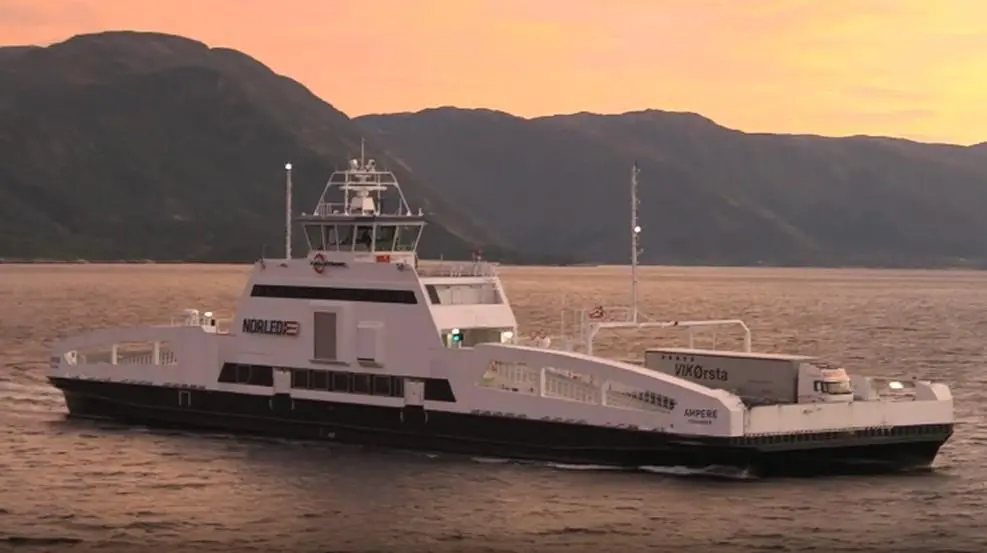
Norway’s Norled ferry operator has claimed the world’s first all-electric ferry, MF Ampere, built in 2014. Now, half its fleet is battery powered and growing.
And Denmark’s Molslinjen is planning to convert its third ferry to electric later this year.
Other vessel types up for electrification
While ferries are the most popular vessel for electrification due to their short voyages, other vessel types are increasingly adopting battery power too. These include tugboats and bulk carriers.
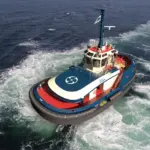
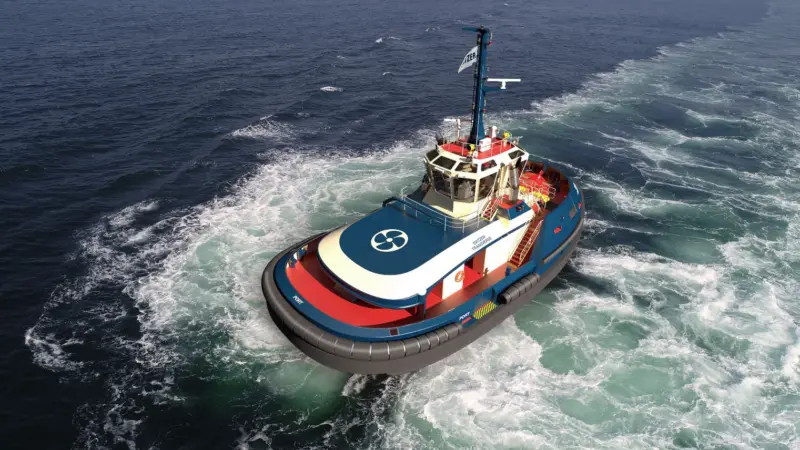
In March, marine battery maker AYK Energy announced an order to manufacture and supply the 6MWh battery that will power the world’s first battery-methanol tug for Svitzer. Turkish shipyard Uzmar is building the vessel, with delivery planned in the second half of 2025.
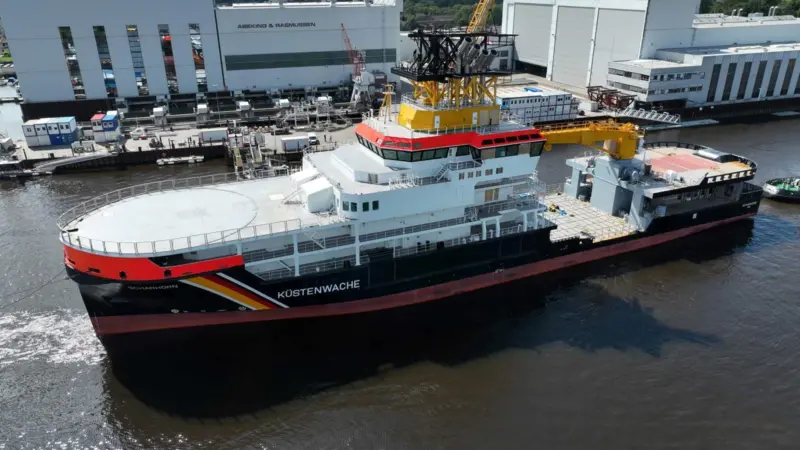
In January, Liverpool-based Bibby Marine announced the signing of a new shipbuilding contract with the shipyard Armon to build an electric commissioning service operation vessel. It will feature a battery system complemented by dual-fuel methanol engines able to run all day with a 24.4MWh battery pack and offshore charging.
According to the MBF Ship Register, the passenger vessel segment is, and is set to remain, the biggest battery-powered segment up to 2027 with some 500 ships. But offshore vessels make up the second largest segment, with more than 200 ships. Workboats and tugs represent a growing category, but remain at a low base due to a lack of regulatory demand, MBF managing director Syb ten Cate Hoedemaker.
says.
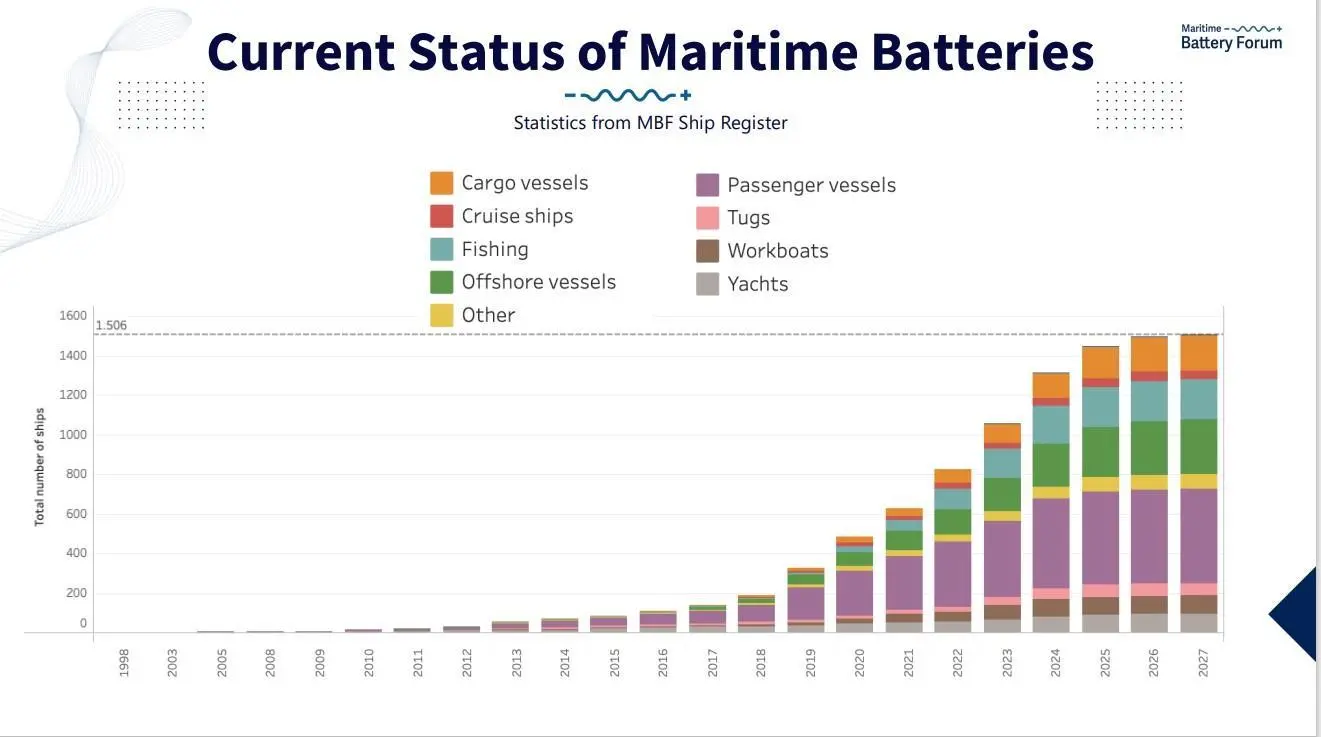
He says the biggest growth in maritime batteries was in 2019, with an increase of about 300% compared to 2018.
“After that there were two main events with a negative impact on growth. First of course the pandemic, which slowed down the adoption of batteries in the maritime industry and delayed a lot of projects,” he says.
“And then in 2023 the Norwegian government suddenly decided to pause a funding scheme for battery-powered ships. These two events both had quite a big impact, but in general the number of battery-powered ships kept on growing globally. Our statistics for 2025 and onwards are not complete yet. There is definitely an increase in growth, but we just don’t have all projects in our database yet.”
The MBF counts 86 members, ranging from classification societies to shipping and shipbuilding companies, battery recyclers, and manufacturers of batteries and their components. It registered its 1,000th battery-powered ship in 2023. The number has now risen to more than 1,500, it said. The ship type and installed battery capacity per ship is also expanding.
The organisation said 20% of ships in its database are fully battery powered, though they may have a small back-up generator too.
Part of the energy mix

The UK’s Faraday Institution, an institute for battery research, skills development, market analysis and early-stage commercialisation, issued a report in February on batteries in the maritime industry. It said battery technology will be an important part of the energy mix as heavy fuel oil is phased out.
Batteries offer energy efficiency, reduced emissions and improved performance for smaller vessels, it said. Hybrid fuel solutions are emerging for deep-sea shipping, according to report author Stephen Gifford, Faraday’s chief economist.
“As battery technology continues to advance, full electrification is becoming particularly suited for short routes and vessels such as short-haul ferries, coastal ships, recreational boats and inland waterway craft,” he said, along with hybrid systems.
Both Faraday and the MBF say while batteries can serve as the main propulsion source in full battery-electric or hybrid vessels, an alternative back-up power source is needed.
Hybrid systems with diesel generators alongside battery systems are expected to become more widespread as distances travelled grow, with vessels operating on batteries alone when entering and leaving port, and switching to other fuels at sea.
Faraday said the UK’s established strength in global shipping, alongside advances in battery technology and the creation of national innovation centres, positions it well to benefit from the shift to new energy fuels and technologies.
“Realising the full benefits of this transition will require coordinated investments in both vessel technology and port infrastructure to enable wide-scale adoption of clean energy solutions,” it said.
Education and Training
An important part of MBF’s work is education and training, and it runs an online introduction to maritime batteries and battery safety.
One of the organisation’s members is Ocomp, a Norwegian training centre and research institute specialising in maritime safety. It has a particular focus on lithium-ion batteries and safety at sea.
It has trained more than 3,000 seafarers in Norway on battery-powered ships, according to Hoedemaker.
He says Norway is the only country in the world with crew training requirements on battery-powered ships, something that was set out by the Norwegian Maritime Authority in 2022.
Related Articles
 OTHER NEWS
 ACCESSORIES & EQUIPMENT
 SPECIAL REPORTS