![MaritimeJournal[Seawork]](https://www.maritimejournal.com/wp-content/uploads/2026/09/MaritimeJournalSeawork.svg)






FEATURE: The towing icons who redefined emergency response
Half a century ago, South Africa launched ground-breaking ocean-going tugs to counter pollution risks from giant tankers –creating the blueprint for modern, state-backed emergency response towing. Peter Barker looks back on a legacy.
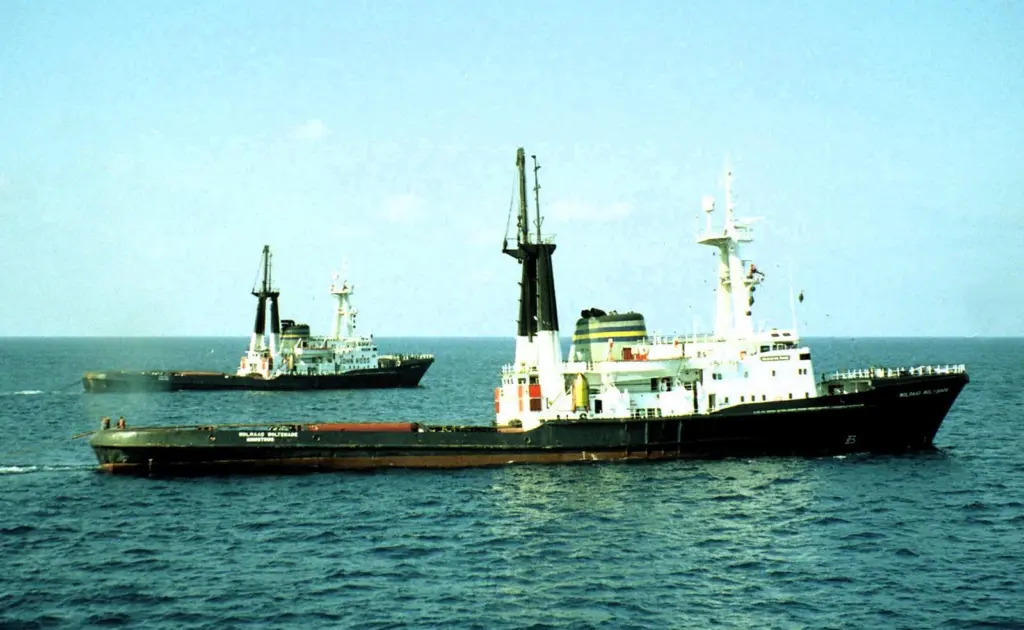
Fifty years ago, South Africa introduced the world’s fastest and most powerful tugs.
Their specific role was to respond to the threat of pollution from ever bigger ships, such as the ultra-large crude oil tankers that exceeded 500,000dwt that were navigating the Cape route.
But the story of these remarkable vessels is more than just two new ocean-going tugs satisfying the demands of the burgeoning offshore O&G industry: they came to redefine emergency response towing.
The expanding O&G industry involved drilling rigs, FPSOs and other ungainly objects being moved, often halfway around the world, under pressure of time and expediency. It was a service maintained by long-established tug owners who also provided rescue and salvage expertise when ships encountered difficulties.
South Africa’s tugs introduction was the first example of state-sponsored Emergency Towing Vessels (ETVs) that have since extended into many other regions.
Hostile waters
Understanding the reasoning behind the tugs and their extreme capabilities involves considering the environmental conditions, particularly during winter months, around South Africa’s rugged coastline.
Facing the South Atlantic and Indian Oceans and with Antarctica around 4,000km south, shipping routes relatively close inshore experience strong and conflicting currents including the Benguela, Mozambique and Agulhas Currents.
Waves over 20m in height are not unusual during storms, testing the strength of the largest ships and risking structural damage should loss of propulsion result in extreme hull stresses.
Economies of scale transporting crude oil meant tankers grew in size. Typically built in Japan and South Korea in the 1960s, VLCCs were followed by ULCCs of more than 500,000 dwt and draughts exceeding 19m.
While the largest vessels used the Cape route rather than the Suez Canal, it was the latter’s closure in 1967 that led to more ships diverting around the Cape and a surge in demand for ULCCs.
Shipping is facing the same issues today, with the need for salvage and towing provision should vessels succumb to the vagaries of the region.
Foreign tugs
On the plus side, this was the era of the powerful ocean-going tug. Dutch, German and British tugs often responded to casualties and between assignments were stationed in the region in anticipation of a lucrative Lloyd’s Open Form contract.
South Africa was conscious that foreign tugs couldn’t guarantee emergency cover, commercial commitments often taking precedence, and while individual ports had their own tugs – which carried out sterling rescue and salvage work – it became increasingly difficult with the increasing size of ships.
Two factors contributed to the situation becoming unsustainable: under ‘no cure no pay’ contracts, salvors were often not adequately rewarded if they prevented pollution and the vessel was subsequently lost, so saving the ship could (in theory) become a priority over protecting the environment. The SCOPIC clause was not introduced into Lloyd’s Open Form until 1999.
Secondly, ‘dry towing’, with rigs loaded onto barges and towed conventionally, and later semi-submersible ships with their own propulsion, gradually reduced demands for ‘wet towing’ and led to a reduction in numbers of powerful ocean-going tugs available for casualty work off South Africa’s coast.
Local provision
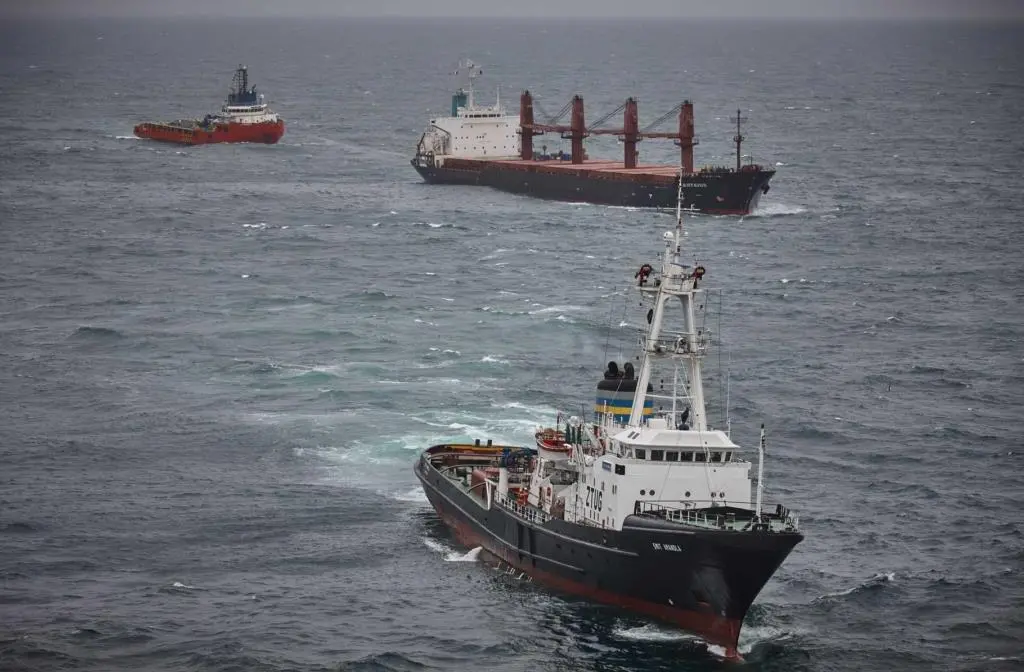
Against this background, partly state-owned shipping company Safmarine formed Saftug to build two ocean-going salvage tugs that were to become the fastest and most powerful tugs of their day with at least one on permanent standby in South African waters, the second also available for commercial long-distance towing.
Able to intervene when foreign-owned tugs were unavailable, they became first examples of state-sponsored ETVs, a model followed widely in various forms in the decades to come.
In 1973 the Robb Caledon Shipyard in Leith, Scotland and James Brown & Hammer Shipyard in Durban, South Africa were contracted to build the vessels. The first, S.A. Wolraad Woltemade, completed in Leith in April 1976, was followed in the same year by S.A. John Ross in Durban.
The 94m long vessels were built to withstand the worst weather with a free-running speed of 21kn via a single propeller powered by twin engines developing 23,000hp in total, producing a bollard pull of 206 tons.
They included an extensive range of salvage equipment and for more than 40 years completed dozens of difficult rescues, often towing disabled and damaged ULCCs to a safe haven and regularly including ship-to-ship transfers of oil cargoes.
Meanwhile, one of the pair was regularly gainfully employed in the commercial market, towing drilling rigs, platforms and FPSOs from one side of the world to the other.
Changes
The late 1990s saw changes within Safmarine and the pair underwent a period of ownership and name changes, but still maintained the role of ETV in South Africa.
This period included a spell as part of the Global Towing Alliance, formed initially by Dutch salvage giants Smit and Wijsmuller, for the O&G sector as larger FPSOs were introduced, often requiring several large tugs for towing from shipyards and positioning on site.
After nearly half a century of service the pair were nearing the end of their serviceable life, expensive life-extensions were deemed uneconomical and with modern, more manoeuvrable and powerful AHTS vessels becoming available it was decided to replace them. They were replaced by the AHTS Umkhuseli, owned by African Marine Solutions (AMSOL) and crewed by South African mariners.
Umkhuseli had pros and cons over its predecessors, but with shipping’s safety record in a better place than 50 years previously, she has continued with the work of protecting the country’s waters.
For the two supertugs, and despite determined efforts to preserve at least one, five days before Christmas in 2009 Wolraad Woltemade (under the appropriate name Icon) left Cape Town to be recycled at Alang in India.
Following further years in service, the South Africa-built John Ross, by then renamed S.A. Amandla, eventually faced the same fate and in 2023 also sailed to Alang, bearing the name Iconic 09.
Thus ended a significant period in the history of deep-sea towing and salvage, their legacy living on today in variations of state-sponsored ETV provision.
For the many dedicated crews who served on these giants they can say “we were the first.”
Related Articles
 OTHER NEWS
 ACCESSORIES & EQUIPMENT
 SPECIAL REPORTS