![MaritimeJournal[Seawork]](https://www.maritimejournal.com/wp-content/uploads/2026/09/MaritimeJournalSeawork.svg)




Habbeké combines with Sentinel on first hybrid daughter craft
Netherlands-based Habbeké Shipyard has contracted with Sentinel Marine to build a hybrid daughter craft for Emergency Response and Rescue Vessels.
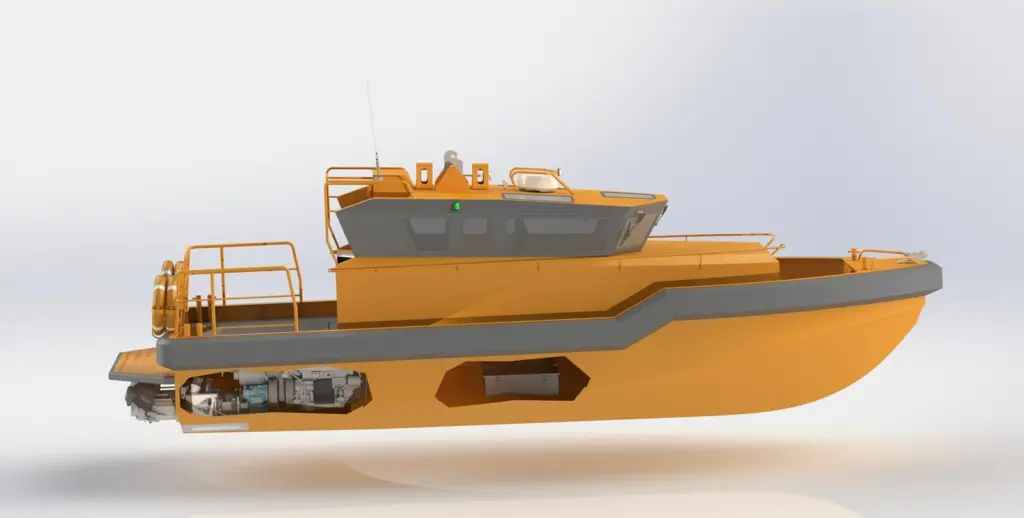
Netherlands-based Habbeké Shipyard has contracted with Sentinel Marine to build a hybrid daughter craft for Emergency Response and Rescue Vessels (ERRVs).
It will be the first fully redundant hybrid executed FDC 1003 daughter craft to come with a DNV Hull certificate with class Service R2 Notation – which means it can work up to 60 nautical miles from shore and is thus able to work with SOVs.
“Welding has begun,” said Habbeké global Sales director Arnoud Straakenbroek. “the hybrid technology of the selected system is already been used by the ferries in Amsterdam but the propulsion is a bit different because we are using waterjets instead of propellers.
“The drivelines are twin installation, each diesel engine has a hydraulic clutch and electromotor, and they both have their own battery package.
“The weight is critical – when the daughter craft is launched from the mother vessel it will have a maximum of one hour to reach its destination on diesel, then it can operate for four hours on batteries before returning on diesel.”
The partnership between Sentinel and Habbeké is a complementary one: Straakenbroek has worked for Sentinel in the past, and the two will combine their knowledge in integrating the daughter craft with the mother vessel, which charges the daughter craft when stored on deck of the mother vessel.
In total, three daughter craft will be built, with one already on her way to the UK.
The aluminium FDC 1003s are 10.47m in length by 3.42 metres, have capacity for three crew and twelve passengers and have a speed of up to >25 knots.
If the hybrid vessel is finished in time, Habbeke plans to bring her to Seawork – but failing that, one of the other daughter craft might be on the pontoons next June.
Related Articles
 OTHER NEWS
 ACCESSORIES & EQUIPMENT
 SPECIAL REPORTS