![MaritimeJournal[Seawork]](https://www.maritimejournal.com/wp-content/uploads/2026/09/MaritimeJournalSeawork.svg)






Human error sinks New Zealand Navy ship
An interim court of inquiry has determined that a New Zealand Navy auxiliary vessel ran aground and was subsequently lost due to human error, specifically where the ship’s autopilot was not disengaged while executing a turn.
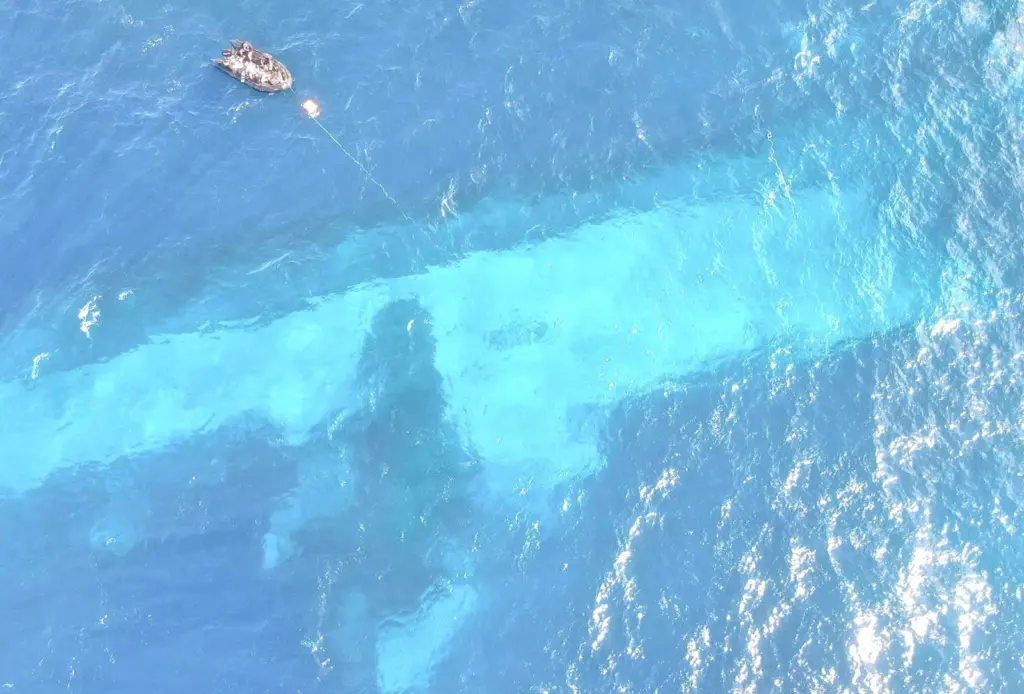
The former Norwegian offshore support vessel was carrying out survey operations on the southern side of Samoa in Polynesia at the time when, according to Chief of Navy, Rear Admiral Garin Golding: “The crew did not realise Manawanui remained in autopilot and, as a consequence, mistakenly believed its failure to respond to direction changes was the result of a thruster control failure.”
Timeline
Weather conditions at the time, in October 2024, were described as a strong breeze of up to 25kn and moderate swell with the survey conducted in a box-shaped area running east to west in survey lanes, starting on the outside and working inwards.
The ship’s crew attempted a routine turn to starboard, initially to a course of 340 degrees, within the survey area but after attempting to turn to starboard and off the 340 degree course the vessel did not respond as intended.
Shortly after, Manawanui left the approved survey area and despite efforts to correct the situation it did not slow or stop and instead started to “accelerate towards the reef”, grounding for the first time at a speed of more than 10kn. It then travelled a further 635m before stranding, grounding several times along the way.
Full control of the propulsion system was not regained until 10 minutes later, when the autopilot was disengaged and according to the inquiry, “the inability to turn the ship to an easterly direction from the 340 degree course and stop the ship is attributed to the ship being in autopilot mode.”
Unsuccessful attempts were made to manoeuvre Manawanui off the reef, the vessel brought to emergency stations, and while no flooding or damage was detected, stability assessments indicated the vessel was no longer stable.
Around 30 minutes after the initial grounding the decision was made to abandon ship, the action of keeping Manawanui’s generators running, “contributing to the successful abandonment process, likely preventing serious injuries or death.”
The ship suffered a series of catastrophic fires after being abandoned, before capsizing and eventually sinking the following day.
Detail analysis
“Having mistakenly assessed a thruster control failure, standard procedures should have prompted ship’s crew to check that the ship was under manual control rather than in autopilot,” said Rear Admiral Golding. “This check did not occur. Remaining in autopilot resulted in the ship maintaining a course towards land, until grounding and eventually stranding.”
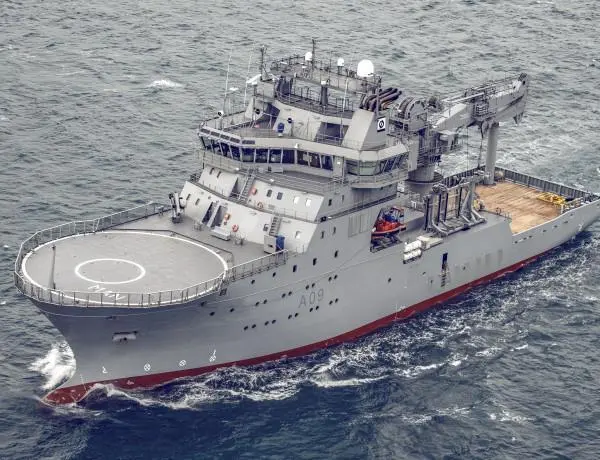
Manawanui was originally a Norwegian offshore support vessel
Why it happened and what would come next in terms of lessons learned were still being worked on as part of the wider Court of Inquiry, expected to be completed in Q1 2025. With human error identified as the cause, a separate disciplinary process will commence once the inquiry has concluded.
As well as the primary cause, there were also a number of contributing factors identified as leading to the ship’s grounding, which will be considered in more detail during phase two of the Court of Inquiry.
Thanks were expressed for the support from the Transport Accident Investigation Committee, the Royal Australian Navy and Royal New Zealand Air Force for the Court of Inquiry, including evidence gathered through interviews with the crew, expert witnesses and data from the ship’s recordings.
The New Zealand Defence Force also expressed its thanks for Samoa’s ongoing support regarding the situation, saying it is “committed to working alongside the Samoan authorities on the response”.
The 84m long vessel was built to a standard ST-253 design by Kleven Verft AS of Ulsteinvik, Norway with the hull launched by Severnav SA of Severin in Romania and completed by Myklebust Verft AS, Norway.
Delivered in 2003 as Edda Fonn for Østensjø Rederi AS, it was typical of the high-spec multipurpose vessels built to support industries including the offshore oil and gas sector, working in the North Sea before becoming part of New Zealand’s navy in 2018.
Related Articles
 OTHER NEWS
 ACCESSORIES & EQUIPMENT
 SPECIAL REPORTS