![MaritimeJournal[Seawork]](https://www.maritimejournal.com/wp-content/uploads/2026/09/MaritimeJournalSeawork.svg)





MAIB issues warning after tug almost capsizes
The near capsize of a small tug has prompted the UK Marine Accident Investigation Branch (MAIB) to issue warnings about safe speed and using a towline gob rope in its latest safety round-up.
The safety alert, in MAIB’s latest Safety Digest, concerns what is a routine operation performed on a regular basis but with risks leading to disaster and potential foundering.
One dark winter’s evening, a small conventional tug was assisting a small cargo vessel to its berth. The MAIB did not give details of when, or indeed where.
The vessel’s pilot instructed the tug to approach the starboard quarter and pass its towline while the cargo vessel’s speed was about 6kts.
The towline was secured and although the tug was fitted with a gob wire and winch, its master decided not to use it on this occasion. The tug was positioned alongside the cargo vessel, the tug master taking care to keep the towline slack.
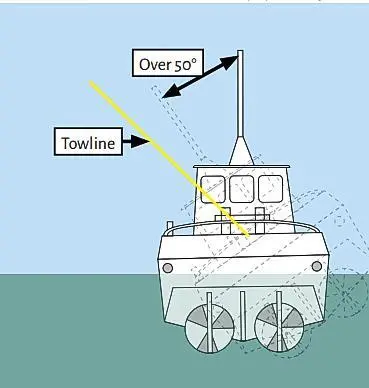
A few minutes later the tug master ‘lost concentration’ and inadvertently dropped back, causing the towline to come under tension, which led to the tug being towed sideways, girting and heeling over to an angle of 50o.
The tug master couldn’t control the tug and failed to operate the tow release from within the wheelhouse, but luckily the tug’s quick-thinking deckhand went aft and released the towline at the hook, allowing the tug to swiftly come upright, the cargo vessel later berthing without further incident.
Lessons
The MAIB notes that the sequence of events that led to the tug girting and nearly capsizing took just a few seconds, with only the swift action of the deckhand saving the vessel and crew.
Good communication between pilot and tug master before a towing connection is made is stated as ‘at the heart of’ safe ship-assist operations, particularly where harbour control/VTS will hear and share a common understanding of the plan.
MAIB considers the speed of 6kts was too fast and should have been kept below 2-3kts while the tug was connected, adding that conventional tugs should ‘almost always’ use a gob rope or wire.
Gob rope
The gob rope (occasionally known colloquially as a gog rope) is a device which in simple terms moves the tug’s towing point aft.
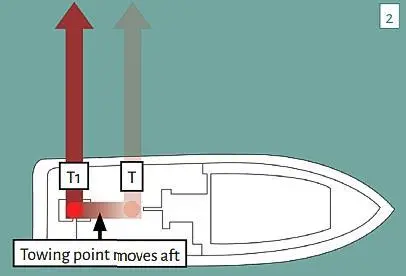
,On conventional tugs the point of tow, be it a winch or tow hook, is often close to the mid-length of the vessel and well ahead of the propulsion units.
If the towline angle increases such that the lead is more from on the beam than over the stern, the tug can on occasion almost be towed sideways by its charge which, coupled with the point of tow being on or near the transverse centreline, can lead to the tug being heeled to a dangerous angle from which it is difficult to recover by manoeuvring alone.
The situation can be exasperated if deck hatches etc are left open, leading to down-flooding into the vessel’s interior, although there is no suggestion of this being a factor here.
A gob rope is simply a line passed over the towline well aft and handled manually or by a winch which, when fixed or hauled in, moves the point of tow aft with the lead maintained more over the tug’s stern, making the manoeuvre more manageable.
Speed
Speed is a factor that appears regularly in accident reports involving ship-assist tugs.
Escort or indirect towing involves a different procedure carried out at a relatively higher speed, the tug connected to the vessel’s stern and using the hydrodynamic effect from its underwater hull form rather than the actual towline to influence the ship’s heading.
As the vessel reduces speed and steerage way it becomes dependent on tugs to control its heading, the risk of girting greatly reduced, suggested by the comment that speed should have been 2-3kts.
Defining the transition from the basics of indirect to direct towing is subject to variables including the type of tug employed, but for bow tugs the risk of being overrun by the ship when connecting the towline due to high speed and the tug’s reduced amount of reserve power can have catastrophic results.