![MaritimeJournal[Seawork]](https://www.maritimejournal.com/wp-content/uploads/2026/09/MaritimeJournalSeawork.svg)

Multiple support vessel order for Purus Wind
UK-based Purus Wind has placed an eight vessel order that highlights how the offshore wind industry’s principles of sustainable energy now extends to the vessels that make it happen.
In the early days of offshore wind, existing construction and support vessels were adapted for this new sector of the offshore industry, turbine components themselves often manufactured inland and transported to ports for load-out by road or inland waterway systems.
In August 2023 it will be 20 years since construction started at one of the UK’s first such developments, Kentish Flats Offshore Windfarm in the Thames Estuary. Today turbines five times the 3MW capacity, with individual blade lengths of 107m compared to the 90m complete rotor diameter of the Kentish Flats models, have led to major changes in how the industry handles these new giants during construction, installation and operation.
Subsequent limitations on supply chain access means manufacturing and assembly facilities have had to be built closer to the load-out port, typified by Sif Group’s giant assembly plant at Maasvlakte 2 in Rotterdam. Existing installation and support vessels have been gradually upgraded, including completely new designs to cope with increases in both demand and size.
At the same time, the relentless drive for decarbonisation has influenced the desire for support vessels to match the original principles of wind energy. This aspect is evident with Purus Wind’s multi-vessel order, which comprises seven Crew Transfer Vessels (CTVs) and a Construction Service Operation Vessel (CSOV).
Damen the builder of choice
Damen Shipyards Fast Crew Suppliers (FCS) has been selected for the CTV element of the package, comprising four FCS 2710 Hybrid and three FCS 3210 Hybrid models. The three larger 32m vessels will be equipped for ultra-low emissions operations, also designed to be upgraded to run on methanol when the opportunity arises. The four slightly smaller FCS 2710s will join three other hybrids ordered from Damen in 2022 for Swansea UK-based HST Marine, a subsidiary company of Purus Wind.
The vessels include latest modifications such as improved wheelhouse window arrangement and bridge console lay-out with the twin axe hull form ensuring stability and fuel economy as well as providing extensive deck space and accommodation, according to Damen.
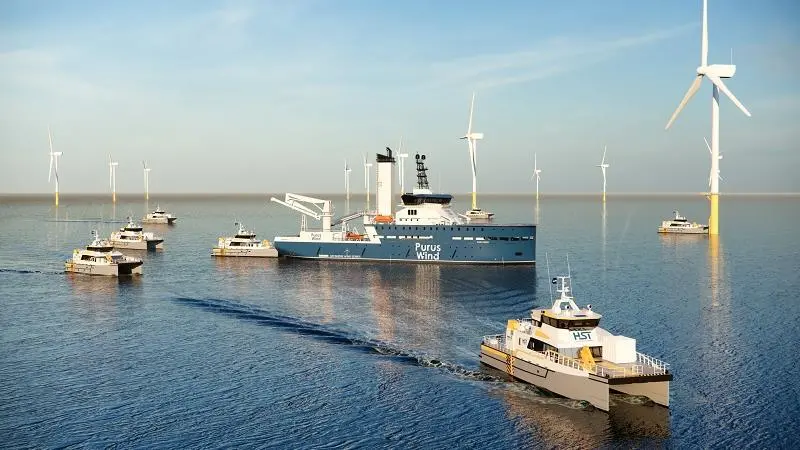
All seven CTVs have a hybrid battery package integrated into the design for zero-emissions operation and an exhaust gas after-treatment system ensures the vessels are IMO Tier III compliant.
When reviewing the second element of Purus Wind’s order for a Construction Service Operation Vessel (CSOV) it is appropriate again to reflect on another element of how the industry has had to adapt to the changing scale of offshore windfarms.
The construction phase sees a period of intense activity offshore starting with surveys through to foundation, transition piece, tower, nacelle and blade installation, along with inter-array and export cable laying and substation or converter station installation.
Once commissioned, the windfarm’s operations and maintenance phase involves a less frenetic extended period of routine maintenance and repairs and with early projects relatively close inshore a ‘day-boat’ operation was adopted, CTVs taking up to 12 technicians to work each day with a commute time of around one hour being typical.
As projects moved further offshore involving larger windfarms in more hostile waters, this method became unsustainable and a new model emerged, that of sea-going Service Operations Vessels (SOV) housing larger numbers of technicians in high-quality accommodation and remaining at sea for up to 30 days, transferring to the turbines by smaller craft or walk-to-work gangway systems.
Construction Service Operation Vessel
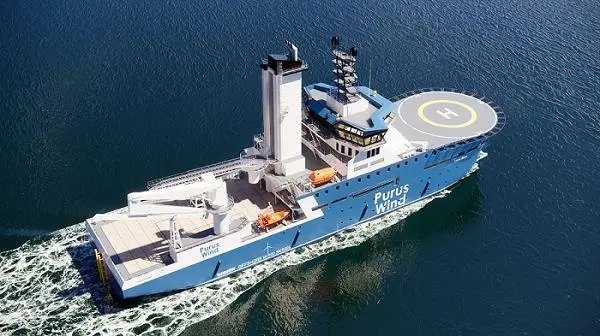
The final element of Purus Wind’s order is for another Damen product, a 90m CSOV (Construction Service Operation Vessel) providing accommodation for up to 120 people for up to 30 days at a time.
This will have a diesel/electric propulsion and battery array arrangement, its “innovative” features including a hull design almost symmetrical fore and aft below the waterline, on which will be mounted four Damen DPX-Drive identical thruster units, two forward and two aft, allowing highly precise manoeuvring and station keeping.
It is described as having excellent stability due to its design, enhanced by a large anti-roll tank with a motion-compensated gangway and crane providing smooth transfers of personnel and equipment.
As with the CTVs, space is reserved for additional battery capacity and the vessel will be pre-prepared for both conversion to methanol engines and offshore charging.
The eight vessels are scheduled to be delivered between 2024 and 2027.