![MaritimeJournal[Seawork]](https://www.maritimejournal.com/wp-content/uploads/2026/09/MaritimeJournalSeawork.svg)






MV Wavelab advances autonomous navigation
The MV Wavelab research catamaran is continuing its work on the Kiel Fjord in Germany, collecting data, training AI-based algorithms and testing new functions, sensors and systems.
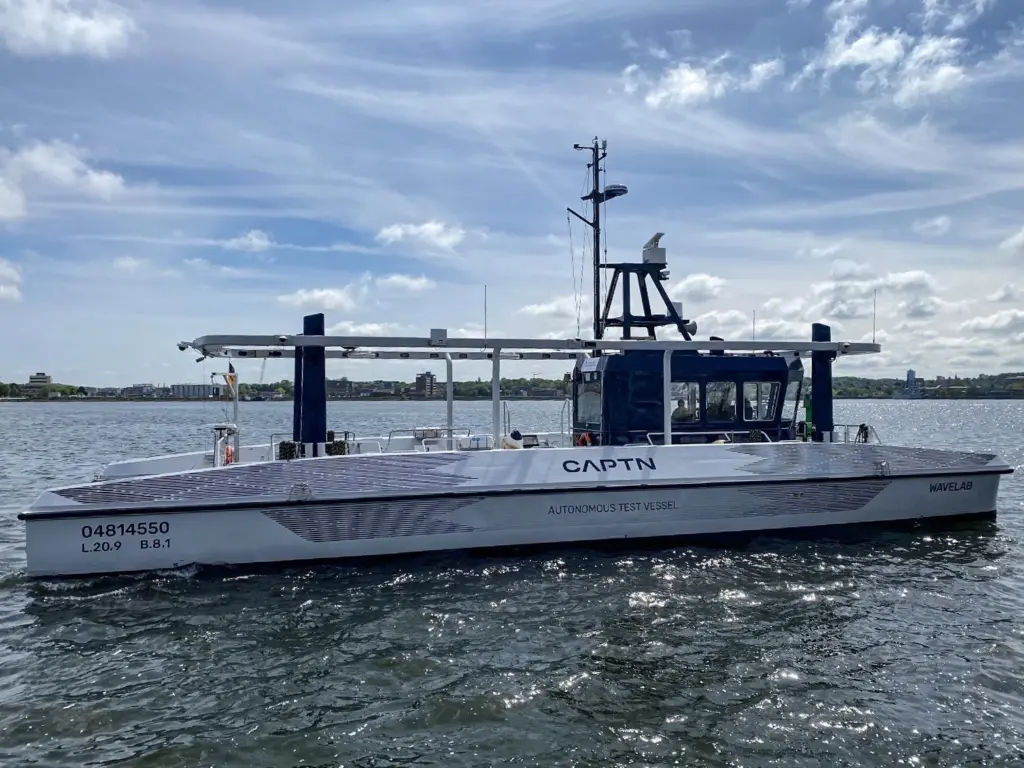
Part of the CAPTN initiative to develop autonomous public transport, the Wavelab’s current priority is to develop assistance systems for navigation.
On board the vessel, Germany’s largest autonomous research catamaran, is the Anschütz integrated navigation system (INS), designed to enhance maritime safety and navigation.
The INS collects, analyses, and evaluates sensor data and alarms, providing a comprehensive view of the maritime environment, navigation risks, and operational security. The system integrates optical sensors and communicates with a shore-based remote operating centre for monitoring and trials.
“Anschütz’s INS is proving itself as the basis for a consistent, secure system and common maritime picture for monitoring and controlling autonomous ships”, said Daniel Sommerstedt, head of research projects at Anschütz.
“With track and speed control, we can already keep a ship safely on a planned route, and we can also use our radar to automatically track other vessels and detect when they’re about to collide.
“In our current research phase, we are gradually extending these capabilities, for example by analysing data from other sensors or developing innovative assistance systems that simplify the assessment of complex maritime situations and make navigation safer.”
Current research is focused on a support function for collision risk assessment which is able to adapt to different types and sizes of ships and to the safety requirements of shipping companies.
One function being tested is an overlay of radar and ECDIS that continuously analyses available own-ship data, tracks and information from the maritime situation picture and automatically assesses possible targets in accordance with ColReg.
Related Articles
 OTHER NEWS
 ACCESSORIES & EQUIPMENT
 SPECIAL REPORTS