![MaritimeJournal[Seawork]](https://www.maritimejournal.com/wp-content/uploads/2026/09/MaritimeJournalSeawork.svg)

New tug to protect Australia’s coastline
Netherlands-based Smit Lamnalco has signed a 10-year contract with the Australian Maritime Safety Authority (AMSA) to provide emergency response services in Australia’s Torres Strait and Great Barrier Reef regions.
Commonly known as Emergency Towing Vessels, ETVs are now widely employed as coastal states try to protect their coastlines from pollution.
South Africa was considered to be the first country to adopt such arrangements, and while the idea had already been a topic of conversation, the grounding and subsequent loss of the laden tanker Wafra near Cape Agulhas in 1971 provided the catalyst for the provision of two state-sponsored super-tugs to protect the country’s coastline from shipping casualties.
The principle, now adopted widely, is to provide emergency towage assistance when normal commercial provision is not readily available.
At 25,760km Australia’s coastline is the sixth longest in the world. Protecting the entire coast with ETVs is therefore not practicable, and the existing and new arrangements can only cover the Great Barrier Reef and to the north, the Torres Strait, which separates Queensland from Papua New Guinea. These are regions of high traffic density where there is more potential risk to the environment and wildlife.
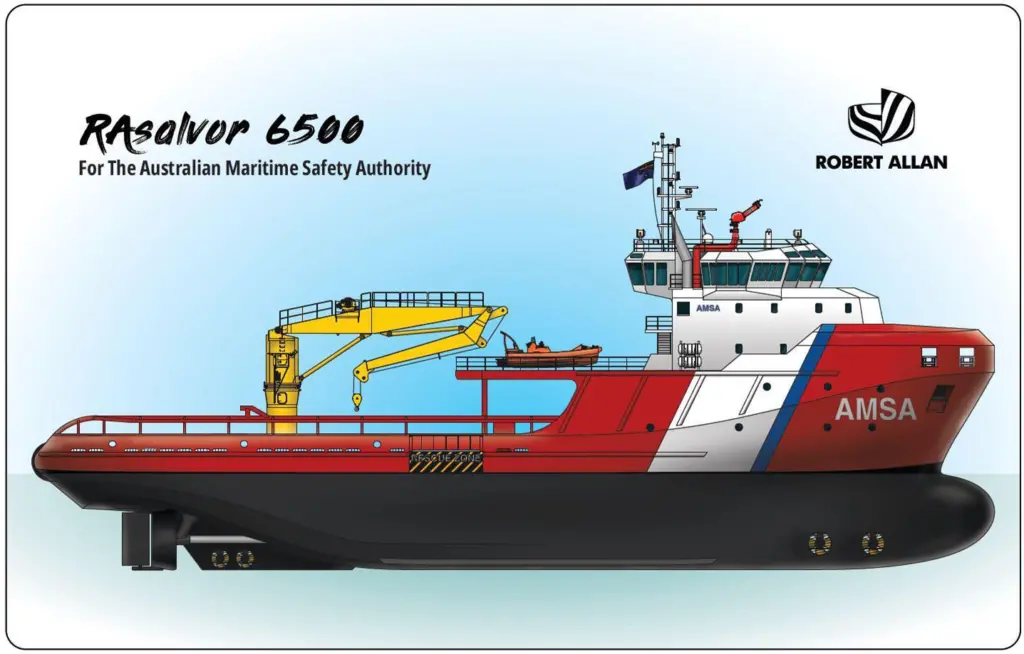
The existing contract, due to end in July 2024, is currently served by the 2014-built AHTS Coral Knight. The new contract with AMSA which will start then, will involve Smit Lamnalco providing an interim vessel for two years of the 10-year contract, whereafter it will be replaced by a newbuild vessel based on a Robert Allan Ltd RAsalvor 6500 design.
The interim tug will provide enhanced capabilities over the current vessel with an increased bollard pull of 100t and a faster top speed.
More power, more speed
A feature with world shipping influencing the planning of tug owners and in particular coastal states is the trend for ships of greater capacities, particularly container ships, that have significantly increased quantities of fuel and consequentially greater environmental risks should the vessel encounter difficulties.
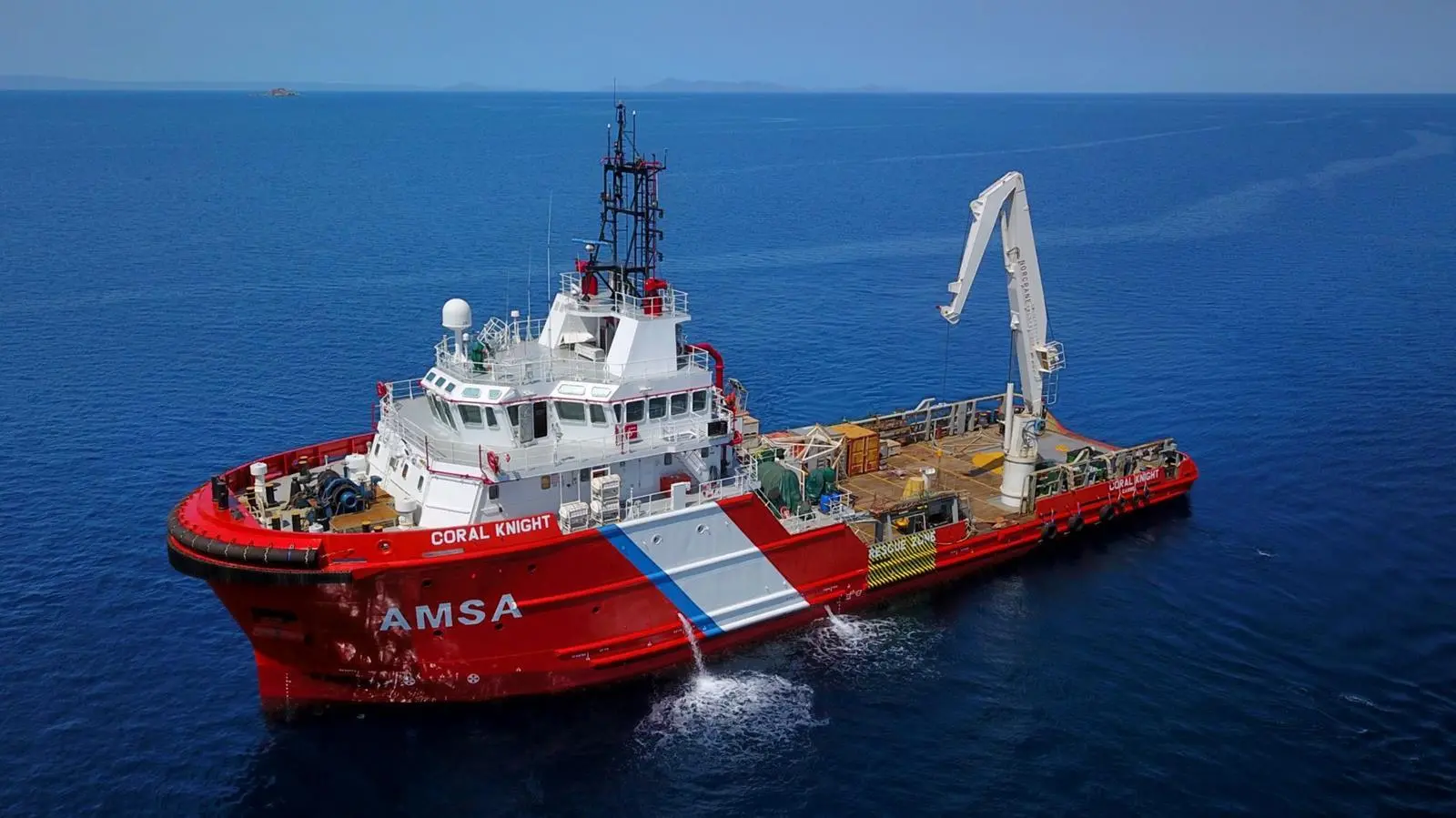
The new contract has taken this trend into account with the new tug providing a 46% increase in bollard pull of 120t compared to the 82tbp of Coral Knight. It will also have a greater top speed allowing for a faster response time when attending casualty vessels.
The newbuild RAsalvor 6500 tug will be more fuel efficient than its predecessor with a hybrid propulsion system allowing the power generation system to be optimised for the desired operational profile and speed.
Fuels of the future is another subject exercising the minds of the industry currently, particularly where such vessels are seen as long-term investments. Consideration has been made at the design stage for the use of methanol as an alternative fuel source, which aligns with a global push to reduce emissions as well as reap benefits from a more efficient operating environment.
Design details
Robert Allan Ltd’s RAsalvor designs include vessels featuring ASD propulsion, but the rendering of Smit Lamnalco’s new addition indicates a typical AHTS-type profile with a conventional twin-screw arrangement augmented by twin bow thrusters both forward and aft.
It is equipped with a firefighting capability and the continued provision of a large knuckle-boom crane on the aft deck suggests the vessel will have a multipurpose capability in addition to being a standard towing vessel.
It will also have an extra crew compliment, totalling 12 persons in total. Smit Lamnalco overall employs 340 Australian seafarers and shoreside personnel and the newbuild RAsalvor 6500 tug is expected to enter service in mid-2026.
AMSA executive director Response Mark Morrow said: “Unprecedented pressures on the global maritime industry and powerful economic drivers are seeing the rise of bigger ships that can carry more cargo than ever before.
“While this is good news for economies, it must be matched with an increase in emergency response capability that can ensure the continued protection of Australia’s precious marine environments, the mariners who live and work in them and local communities.”
Smit Lamnalco managing director for Australia and Papua New Guinea David Fethers said the company was delighted to have been chosen to provide this critical service to AMSA, adding: “Having delivered on a number of successful casualty responses in recent times within the region, we know the operational task sits well within our capability. The Robert Allen designed RAsalvor 6500 will be a game changer in terms of first-response capability, as well as environmental sustainability.”