![MaritimeJournal[Seawork]](https://www.maritimejournal.com/wp-content/uploads/2026/09/MaritimeJournalSeawork.svg)

SPOTLIGHT: The world’s largest ROV fleet
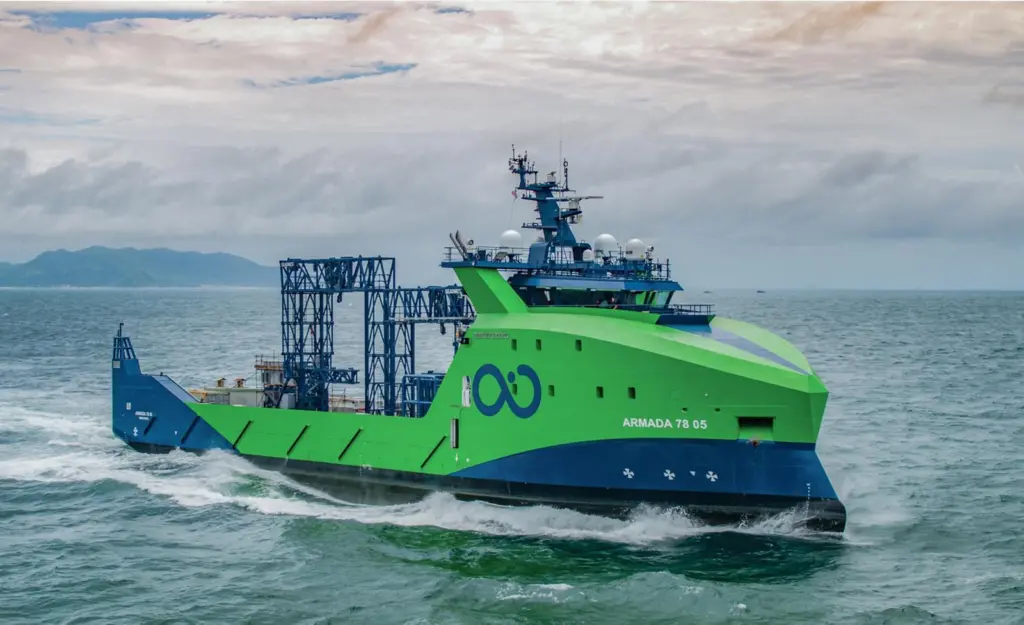
Ocean Infinity is creating what will be the world’s largest fleet of remotely operable vessels, including unmanned motherships designed to work in force-multiplier teams.
It’s a hugely complex challenge – but it could benefit the wider industry, as Andy Tourell says, presenting the firm in Maritime Journal’s Get Set for Workboat 2050 series.
While the UK company has its roots in offshore inspection, repair and maintenance, it’s a stepping stone: “There are almost no offshore activities that take place above or below the waves that can’t be made significantly more efficient, greener and or safer, thanks to robotics,” says Tourell.
The pathway is logical. “We’ve been deploying subsea robotics from conventional vessels since its inception. And now we’re taking those ambitions a big step further by creating the fleet of robotic ships,” he says.
Armada strategy
There’s good reason for thinking big – the advantages of this Ocean Armada strategy run from operational efficiencies to build and construction economies.
Locating these ships around the globe entails lower transit costs and, as Tourell says: “It makes it interesting for our partners as well, as we are a single customer that can scale technology from the outset.”
Ocean Infinity (OI) is moving fast. It now has a complete series of eight 78m low-to-no crew, DP2-enabled motherships: launch and recovery of smaller unmanned craft is supported by a pair of 9m-by-4m moonpools, while a 15m beam yields plenty of deck space for additional containerised kit.
At time of writing, three of these 78s were operating commercially and another five undergoing final commissioning and mobilisation.
There’s an 86m version on the way for next January, with the full fleet of six expected by the end of 2025 and the first 36m variants also targeted for mid 2025.
Although these motherships will be fully unmanned in future, the 78s’ current operations drop onboard personnel by almost three quarters, to a maximum of 16. That allows optimising the design for the task rather than the crew.
“Smaller vessels will have the same capability as conventional vessels twice their size,” says Tourell, dramatically lowering both operating costs and emissions.
OI’s approach is already proving the point: February saw a mothership team up with a pair of 8m USVs to capture 58% of a 28-day survey’s bathymetric data while contributing under 4% of the project’s total carbon emissions.
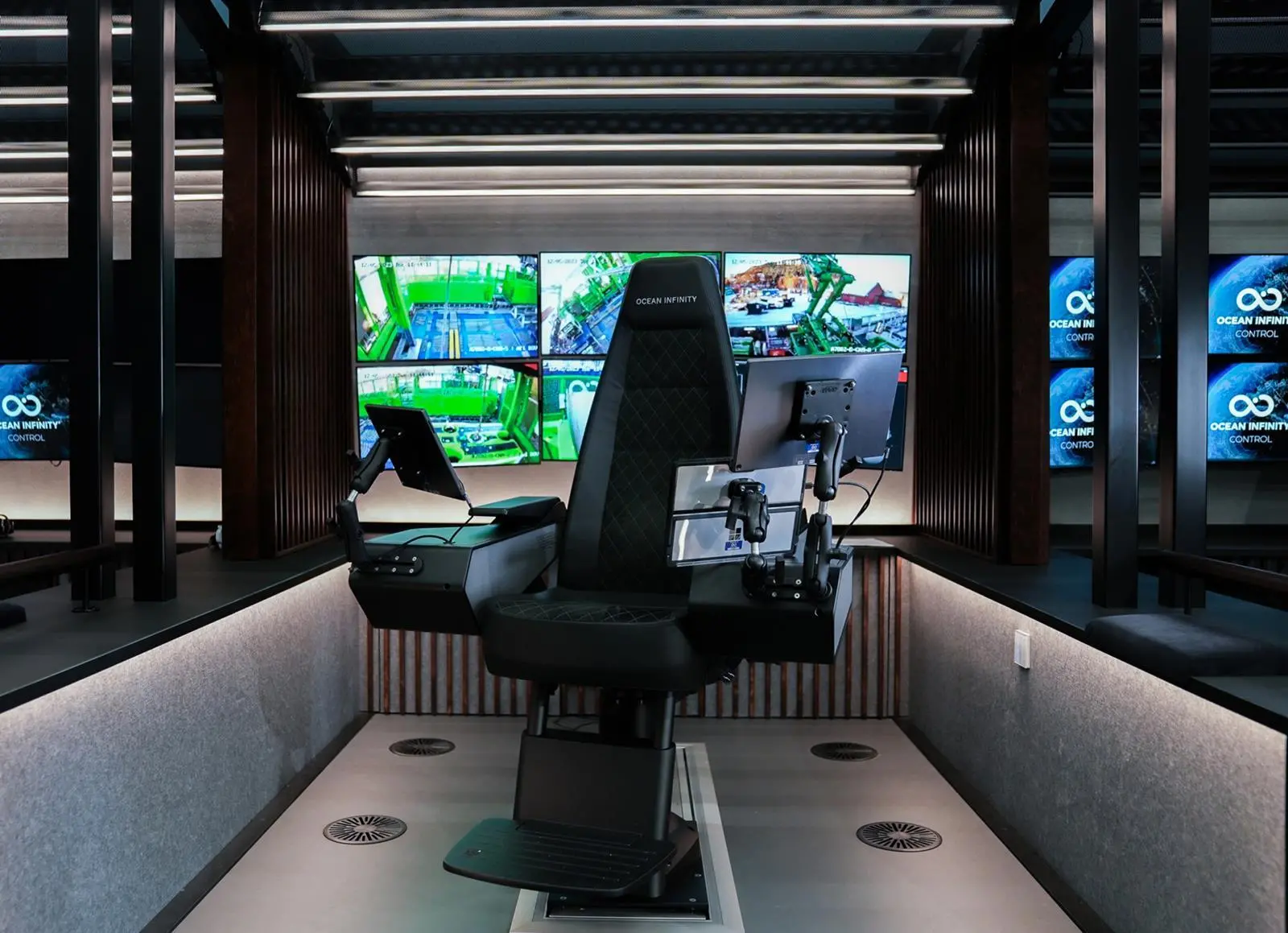
As previously noted it wouldn’t be effective without paring down transits – something that also applies to personnel.
There are already remote stations in Southampton UK, Singapore, Tasmania, and an Asian one will likely come online in 2025 – but OI won’t be flying people around the globe.
“We’ll be recruiting for those roles where we have the operating centres,” says Tourell, adding the company is developing an upskilling and recruitment pathway.
New fuels
Power is also under review. While biofuel is an immediate option, “this won’t shift the needle” far towards the end goal of true sustainability. Therefore the company has developed its Armada vessels with space allocated for ammonia storage tanks and fuel processing rooms. A desktop design study has also led to scalable ammonia/hydrogen combustion engine architecture.
While Ocean Infinity still believes that “ammonia is the long game” for OI’s high endurance, low-speed fleet, commerciality is further off than initially expected, says Tourell.
So OI is involved in the ZEVI (Zero-Emission Vessels and Infrastructure) initiative, focusing on developing a methanol conversion package that will allow vessels to operate on both methanol and diesel.
Despite this, refuelling remains a thorny issue.
“We’re not working in and out of one port. We don’t have a regular route… Whilst we locate the vessels geographically to minimise transit times, we’ve got to be able to access these fuels from multiple countries in fairly close succession,” he says, adding collaboration with governments and other stakeholders is central to success.
Again, scale helps.
“These demonstrations are going to be quite instrumental for the rest of the supply chain [to show] whether it works… or whether we should be thinking about something different,” he says.
While this space is a competitive one, Tourell concludes: “If we can pull together and share those learnings, not only will we advance the technology quicker, we’ll be able to unite behind the key messages [to government] to make sure that support is being provided where it’s needed.”
Related Articles
 OTHER NEWS
 ACCESSORIES & EQUIPMENT
 SPECIAL REPORTS