![MaritimeJournal[Seawork]](https://www.maritimejournal.com/wp-content/uploads/2026/09/MaritimeJournalSeawork.svg)

Tsavliris rescues grounded bulk carrier
Greek salvor Tsavliris has assisted a laden bulk carrier after it grounded in Indonesia.
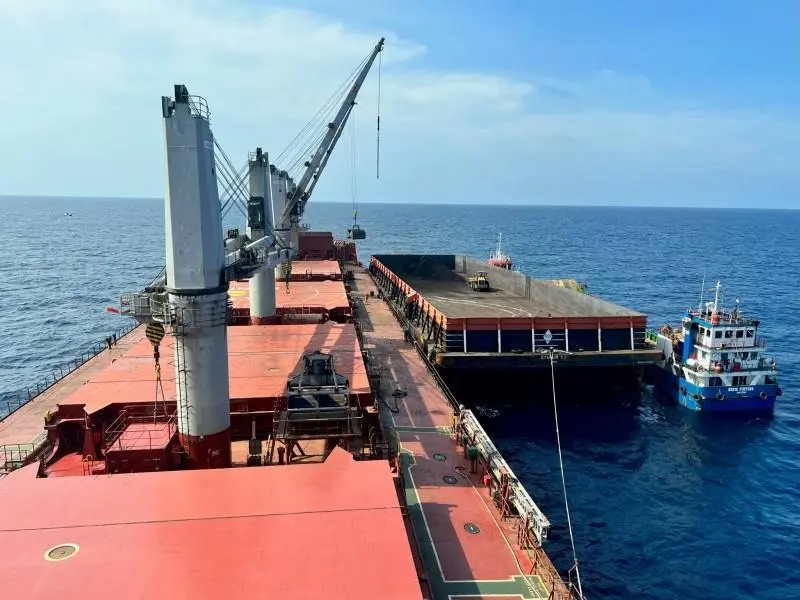
Caravos Liberty was on passage from East Kalimantan, Indonesia to Magdalla Port, India when it grounded around 50 miles south of Balikpapan, Indonesia. It was laden with 60,500 tonnes of coal at the time.
The following day Tsavliris despatched the 80tbp AHTS NMS Bravery from Balikpapan to assist. Two utility vessels carrying a salvage team were also mobilised to the stranded vessel’s location, the team comprising a senior salvage master, two salvage engineers, a naval architect, a rigger and a seven-man diving team.
Adverse weather and strong currents were experienced at the time and once conditions improved NMS Bravery was berthed safely alongside the casualty. Underwater inspections revealed significant damage in the forepeak/bulbous bow area, including a “gaping hole” approximately three by three metres in size with internal elements bent inwards/upwards approximately four metres from the vessel’s bottom.
Damage included smaller holes and cracks and a “significant quantity” of broken rock and sand was observed inside the forepeak tank.
A salvage plan was drawn up involving a combination of ballasting forward tanks to keep the vessel in position, lightering through the removal of 1,000t of cargo, pressurising the forepeak space and ballasting/de-ballasting several compartments to adjust the trim and achieve the desired draught forward. The tug Syukur 52 along with the 7,000t capacity barge Syujur 53 were deployed to remove the required cargo.
Some two weeks after initial grounding Caravos Liberty was successfully refloated, allowing the lightered cargo to be reloaded. NMS Bravery escorted the vessel to Balikpapan Anchorage, but for Tsavliris the salvage operation was far from over.
Temporary repairs approved by the vessel’s classification society were required for Caravos Liberty, the scope of which included Brocco crack arrestors to stop crack propagation, the cropping of protracted bottom plates and connection of the ship’s air supply to pressurise the forepeak tank. This involved a further five weeks of work for Tsavliris and upon completion Caravos Liberty resumed the voyage to its destination.
The operation as described illustrates the multiple skills and disciplines required by professional salvors, demonstrating that refloating a stranded ship is not always simply a case of employing a powerful tug to provide brute force to refloat the vessel.