![MaritimeJournal[Seawork]](https://www.maritimejournal.com/wp-content/uploads/2026/09/MaritimeJournalSeawork.svg)






VIDEO: The ‘flipping’ research platform saved from scrappage
A research platform nicknamed ‘FLIP’ for its ability to position itself vertically or horizontally has been saved from the scrapyard by UK-based subsea design firm DEEP.
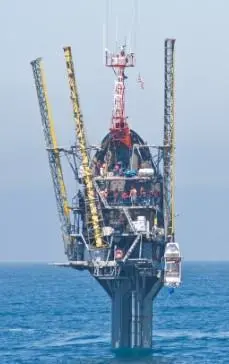
After more than half a century’s work for the US Navy’s Office of Naval Research and the Scripps Institution of Oceanography (Scripps), the Floating Instrument Platform was decommissioned in August 2023 and towed to Mexico to be scrapped.
When DEEP heard about it, the company says, it assembled a team within 48 hours and went to Mexico to intercept.
They were successful, and the platform has been towed through the Panama Canal and across the Atlantic to the Mediterranean, where MB92 Shipyard, which has facilities in Barcelona and France, will refit and modernise the vessel.
FLIP was built in 1962 for the US Navy to help study long-range sound propagation for submarine warfare, says Scripps, but during her life supported research in geophysics, meteorology, oceanography and other scientific fields.
The 108m platform, described by Scripps as a non-propelled manned spar buoy, was towed to the area of operation in a horizontal mode.
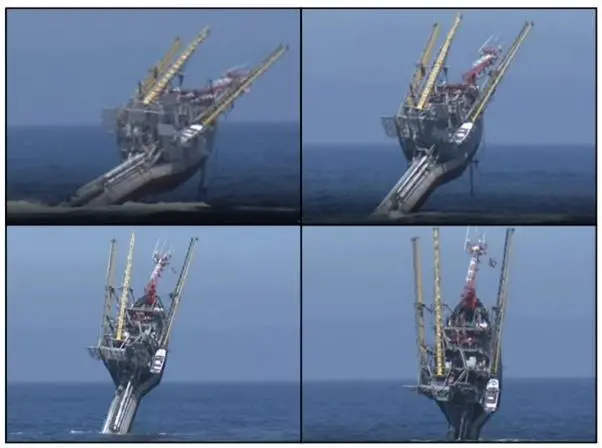
How it flipped
The process of ‘flipping’ would take around 30 minutes, says Scripps. The flip was done by pumping water into ballast tanks in the stern, which would then sink, causing the bow to rise.
The stern would sink to around 100 metres below the surface, which is the depth needed for submarine acoustic research.
The hull diameter was 6.5 metres from the 91-49m depth, tapering to four metres at 20 metres’ depth – a change in diameter that made the platform less responsive to wave motion. In 10m waves, FLIP’s total vertical motion was less than a metre, Scripps says, and the hull was also designed to resist twisting.
The platform was made of about 700 tons of steel and carried a research team of 11 people and a crew of five. It could remain on site for a month without re-supply. Three diesel generators supplied 340kW for on-board needs and could be operated whether FLIP was in the horizontal or vertical position.
“Because its design accommodated riders in both horizontal and vertical positions, FLIP’s interior spaces often appeared misleading and even bizarre, with doors mounted on the floor, portholes in the ceiling, objects mounted on swivelling trunions, and sinks and toilets mounted for both configurations,” says Scripps.
“Deep-water moorings took a full day to accomplish, from first light to past dusk, in waters 4,000 to 5,000 metres deep. About 50 tons of gear aboard the tow vessel were required for a deep mooring. Moorings in 4,000-metre water with a mooring scope of 1.5 have had watch circles in the range of 80 to 200 metres, depending on currents. The mooring lines were recovered and reused.”
Past and future
DEEP says the platform ’played a crucial role in advancing scientific understanding of the ocean, particularly in acoustics and hydrodynamics, and its contributions to oceanography remain highly significant, having enabled decades of groundbreaking research in marine science’.
This kind of work is going to continue, says DEEP, with a stated mission ’to make humans aquatic by enabling our species to live, work and thrive underwater’.
“FLIP will play a key role in the DEEP fleet, providing a one-of-a-kind platform for ocean research and being capable of supporting DEEP’s Sentinel habitat deployments as part of our extended research network,” said DEEP CEO Kristen Tertoole. “We look forward to announcing her relaunch in early 2026, and I’m thrilled to confirm that many oceanographic and research groups are already in contact to ensure access.”
The retrofitting at MB92, including enhancing FLIP’s capabilities with new sensors and lighter materials to support contemporary ocean research, is expected to take up to 18 months.
“The complete modernisation of FLIP to further our understanding of the ocean is what’s in our DNA,” said MB92 Group managing director Rob Papworth. “MB92 is exceptionally proud to be involved in this historic project.”
Related Articles
 OTHER NEWS
 ACCESSORIES & EQUIPMENT
 SPECIAL REPORTS