


On the spot marine realigning
Nottinghamshire UK based Fine-Align focuses on getting vessels repaired and back into service in the shortest possible time by realigning and chocking line shafts, gearboxes, engines and other equipment.
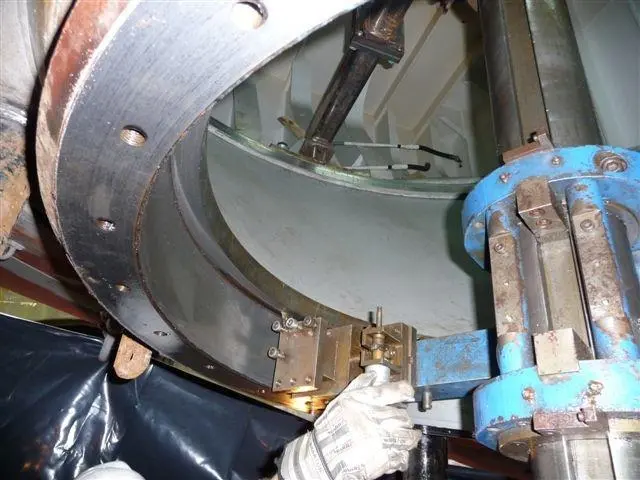
In order to minimise delays, the company pre-plans all jobs and brings the equipment, materials and expertise needed to site, and can often be on board a vessel within as little as five hours from initial contact. It provides ‘as found’ hard copy alignment results there and then, invaluable in any decision making process. One marine company recently used Fine-Align’s services on one of its vessels’ rudder propeller units for just this reason.
Richard Moore, Fine Align’s engineering director said that the company had been approached by an owner with a ‘significant problem’. One of its vessels had collided with a submerged object, resulting in not just damage to the propeller but also distortion to the hull, gear housing and bearing carriers.
Moore explained that the forces generated in the collision were extreme, the lower 1.5m diameter bore had become seriously distorted and made elliptical by the force. All the affected areas, faces and bore, had to be made true. This meant bringing back the bore to the round and realigning it, while the other sections had to be refaced, with each area conforming to the original manufacturer’s tolerances and alignment requirements.
All options were considered. However, to replace the complete cone and tube section would have resulted in major steelwork being undertaken. This alone would have added weeks to the repair with no guarantee that on site machining wouldn’t still be required at the end of the day.
Finally, with input of the Fine-Align team, it was decided to take on repairs in situ. It was to be an exhaustive process. The first stage was one of mapping out the damage, followed by building up the bore by internal spiral welding. A bespoke mounting was manufactured for the boring machine in the company’s workshop whilst the welding took place at the site. Once the welding was completed the boring machine was installed and ‘clocked in’ to the predetermined and agreed datum points.
Richard Moore concluded, ‘Even though several planning visits took place, it was still only 10 days from start to finish once the way forward had been agreed, a very quick turnaround considering the time the other options would have taken.’
Related Articles
 MARINE RENEWABLES
 ACCESSORIES & EQUIPMENT
 ELECTRICAL SYSTEMS