

Patented technologies for more efficient hullforms
A ship design and research company is bringing a number of revolutionary technologies to market for both oceangoing and inland waterways vessels.
The new technologies from Canadian company NaviForm are protected by patents in USA, European Union and several other countries, with four already granted and another three pending.
THE WINGED BOW
This oceangoing vessel bow is claimed to reduce resistance of the hull resulting in either higher speed, or less power, fuel consumption and GHG emissions. It also reduces motions in waves, shown in testing and in operation to be 50 percent lower than conventional bow fitted hulls, and eliminating slamming, therefore making it possible to design a lighter structure. It also increases capacity of the hull or reduces it length and cost for given capacity.
FLOW SPINNING STERN BULB
The stern bulb spins the flow of water into propellers counter to their rotation, increasing their efficiency.
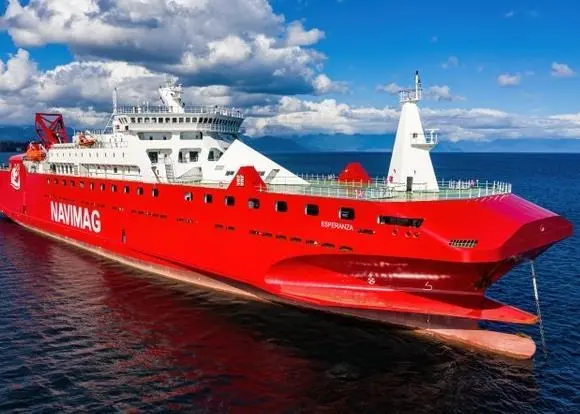
This has recently been delivered to Navimag Ferries in Chile. MV Esperanza design combines these technologies to such effect that this 150m, 10500 mt displacement vessel needs only 2500kW into her propellers (1250 kW each) to sail at 14 knots, with capacity of 1800 l-m on only two decks. This makes MV Esperanza so efficient that her EEDI (Energy Efficiency Design Index) not only meets present but also future IMO targets without a need to reduce speed, as many operators are presently forced to do in order to meet IMO emission standards.
EXOSKELETON STRUCTURE
This structure is fitted outside the hull to provide the required longitudinal strength, rather than to rely, as all ships do, on the hull structure. This allows ocean going and river hulls to be lighter and in case of river hulls, also extremely low draught.
ZERO WAVE BOW
A bow developed for river vessels, or self-propelled barges, which is claimed to generate no bow wave, thus eliminating the problem of shore erosion, which limits speed of river or coastal vessels. Featuring two side skegs with a foil between them. It captures the flow and directs it under the hull, rather than to the sides in form of waves which represent wasted energy and cause shore erosion
The Exoskeleton structure and Zero Wave bow have been combined in the design of the first large river container carrier for service on the Mississippi. Construction of the first 181m x 30.5m hull is due to begin in Q1 2021, with three sister ships to follow at 6 months intervals. At 2.7m draught, hull depth is only 3.9m and steel weight only 2300 mt. It will carry an unprecedented 1700 TEU at speeds up to 16kn, although the owners anticipate that when slowed by the traffic these LNG powered vessels will only use half of their installed power, reducing not only operating cost but environmental impact as well. In other words, moving along at half the power of other conventional river vessels of similar size.
DETACHABLE STERN VESSEL (DSV)
The DSV concept is said to offer the same benefits as an Articulated Tug Barge (ATB) but without the speed and power penalties ATBs suffer from. When connected, it is essentially a single hull. And when combined with all other new design features listed above, it is expected to outperform conventional monohulls.
A privately owned and relatively small firm, NaviForm offers full scope of ship design services from feasibility studies and concept design, through Class approval design package, to production data. The company is located in Vancouver, BC, Canada.
By Jake Frith