![MaritimeJournal[Seawork]](https://www.maritimejournal.com/wp-content/uploads/2026/09/MaritimeJournalSeawork.svg)






Shearwater showcases Dry Space underwater solution
Shearwater Marine Services has showcased its breadth of underwater problem solving by addressing an ongoing challenge of underwater acoustic tiling for the Ministry of Defence.
Military submarines are typically covered in acoustic tiles to reduce their sonar signature and hence their detectability, but the tiles, which are glued to the hull surface in their thousands, often detach. Replacing them is a regular, difficult and expensive task.
With dry docking not an option and temporary fixes insufficient, Shearwater Marine Services developed a solution to control the underwater environment and ensure tile adhesive curing.
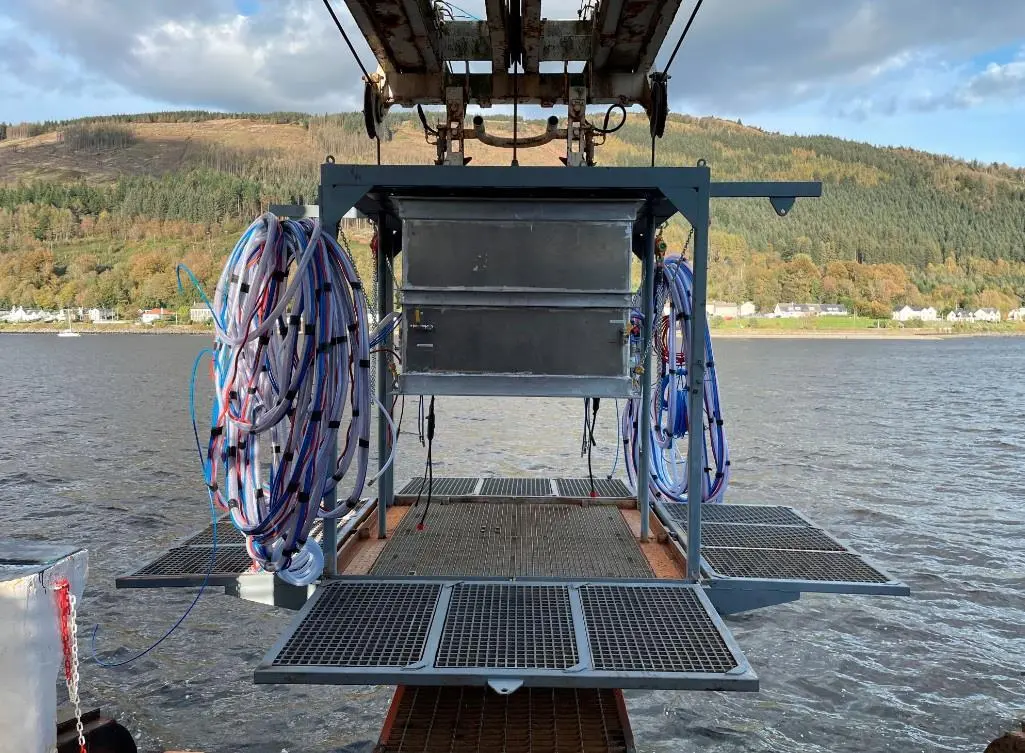
The solution involved the creation of an underwater ‘dry space’ for divers to work in, with environmental monitoring and CCTV surveillance to ensure optimal application conditions. The outcome, claims Shearwater, was a significant improvement in adhesion strength over conventional in-water applications, offering a new standard for underwater acoustic tiling.
The project faced several obstacles, including limited information on tiling application, restraining methods, environmental parameters, availability of testing facilities, and requisite training. The principal challenge was creating and maintaining an environment suitable for tile application that had never been attempted before. Testing parameters were challenging to define, but Shearwater’s in-house testing facility, dive tanks, 30m dive sites and training vessel enabled the exact testing conditions required on-site to be replicated.
After exploring various solutions, including industry-standard hydro boxes, Shearwater decided to construct a dry space for the diver to work in a controlled, dry environment. This dry space was equipped with an environmental monitor and CCTV, allowing certified trainers and supervisors to oversee the application process. The dry space was designed and built in-house using aluminium and CE-approved in the company’s execution-class workshop.
Initial tests were conducted on the surface with a qualified applicator before progressing to sea trials, where QinetiQ was used to ensure procedural compliance and data collection.
The results were nearly identical to those of dry dock application. In contrast, in-water trials not using the dry space showed significant loss in adhesion strength compared to surface application, highlighting the effectiveness of the dry space solution.
By creating a controlled dry space underwater, the company has not only overcome the limitations of traditional tiling methods but also demonstrated a potential model for other underwater engineering tasks.
Seawork stand: U7