![MaritimeJournal[Seawork]](https://www.maritimejournal.com/wp-content/uploads/2026/09/MaritimeJournalSeawork.svg)


Ecowende pioneers low-noise monopiles
Ecowende, in collaboration with CAPE Holland and GBM Works, is pioneering innovative installation techniques for XXL monopiles at the Ecowende offshore wind farm, aiming to significantly reduce underwater noise and minimise impacts on marine life.
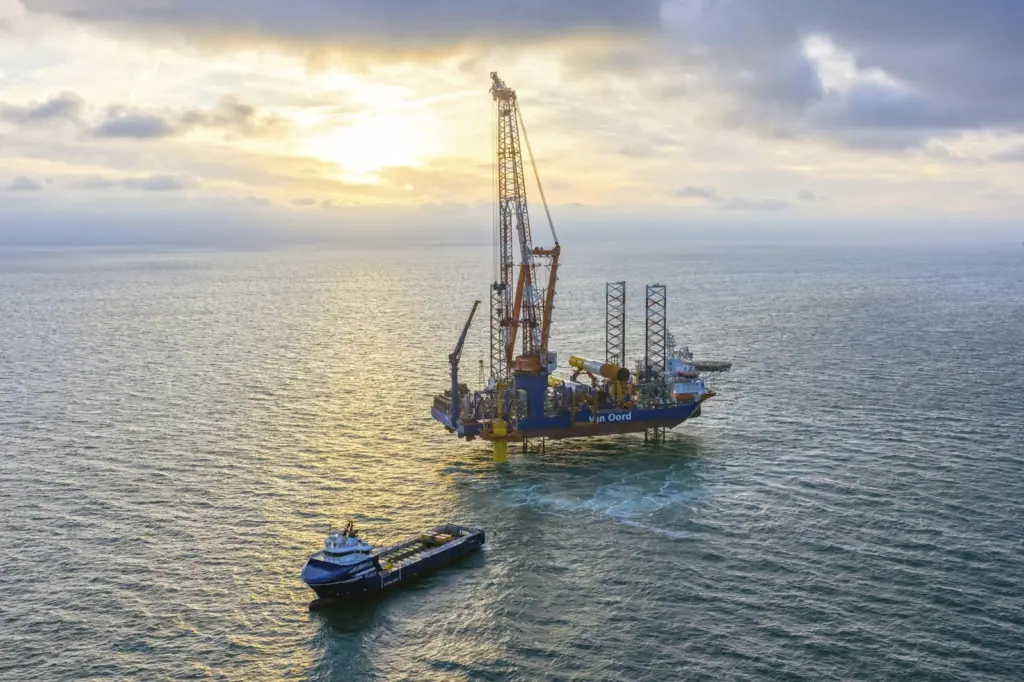
Foundations are typically installed using impact pile driving, a process that generates powerful underwater sound waves. Such noise can disturb marine mammals, including harbour porpoises, even when mitigation measures such as bubble curtains and resonator arrays are used.
To address this challenge, Ecowende and its partners are demonstrating alternative vibro-based installation methods at selected locations within the wind farm. The demonstrations coincide with construction activities that began on 3 December, when Van Oord’s offshore installation vessel Boreas started work at the site.
One of the techniques being tested is Vibro Technology from CAPE Holland. The CAPE VLT-640 Quad applies vertical vibrations that temporarily reduce soil resistance, allowing monopiles to sink under their own weight. “Vibro Technology has already demonstrated its capability and significant ecological benefits in commercial projects,” said Dick van Wijngaarden, business development manager at CAPE Holland.
“But we need to fully understand how the technology performs in dense to very dense soils to apply it reliably and effectively.”
At three test locations, the vibro method will be combined with VibroJet Technology from GBM Works. This approach uses controlled water jets inside the monopile to liquefy the soil and further lower resistance. “The innovative combination of Vibro Technology with VibroJet represents an important step toward reliably installing monopiles to full depth with minimal noise generation,” said Hein van Opstal, business development director at GBM Works.
Researchers will compare these methods with traditional impact hammer installations, analysing performance, pile stresses and underwater noise. The resulting data is expected to support wider adoption of low-noise installation techniques in offshore wind projects worldwide.
Related Articles
 OFFSHORE RENEWABLES
 OTHER NEWS
 OTHER NEWS