

Svitzer Reinforce Their Milford Haven Tug Fleet
Svitzer Marine Ltd has significantly reinforced their fleet of tanker handling tugs at Milford Haven with the arrival of the new Svitzer Milford . The tug, the first of a new series to be deployed to a British port, arrived during the first week of November and entered service after a few days of crew training.
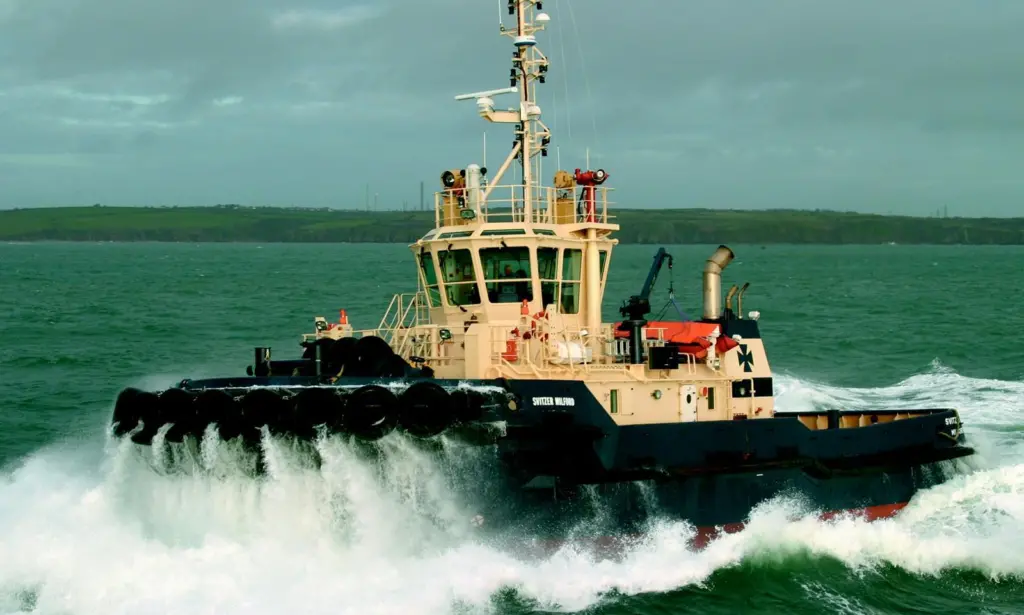
Known as the ‘M’ class, the tug is one of ten due to be completed at the Baltija Shipyard in Lithuania.
Earlier in the year a single ceremony was held at the yard to name three tugs nearing completion ( Maritime Journal – July 2004). Svitzer Milford was one of those vessels.
Svitzer Milford is an azimuthing stern-drive vessel 30.3m in length overall, with a breadth of 11.5m and maximum design draft of 4.8m.
All of the vessels in the series will be classed Lloyds Register +100 A1, TUG, FiFi1 (2400m 3)Waterspray, +LMC, UMS, IWS.
Building on this scale has enabled a high degree of commonality in equipment and fitting out, with presumably consequential economies of scale. At the naming ceremony earlier in the year an option for a further four tugs was announced but to date it is not clear whether that option will be taken up.
The vessel’s hull has a raised forecastle and the underwater configuration was tank tested and optimised to produce the required performance and excellent handling characteristics, particularly when going astern. A double skin hull configuration, unusual in tugs of this size, offers greater safety, increased bunker capacity and greater range. A total of 214m 3offuel can be accommodated, along with 23m 3of fresh water and 29m 3of foam compound.
Svitzer Milford is one of the first batch of four tugs powered by two medium speed MAK 6M25 main engines running at 750 rev/min (MCR) to produce a total of 4890bhp (3600kW). Power is transmitted to a pair of Rolls Royce US205 CP fully azimuthing propulsion units incorporating controllable pitch propellers of 2400mm diameter turning at 226 rev/min. This propulsion system produced a bollard pull on trials of 62 tonnes pulling ahead, 55 tonnes astern, and a maximum free running speed of 13.8 knots.
A Rolls Royce – Ulstein 45TU transverse bow thruster, powered by a 200kW electric motor, is also installed.
The remaining six vessels will have more powerful high-speed Caterpillar diesels delivering 5842bhp (4300kW) for a bollard pull of about 70 tonnes.
A well laid out engineroom also contains three Caterpillar powered electrical generating sets, two main alternators of 215kW and a small harbour set of 60kW.
The main engines drive a pair of ABS/Unitor SFP 250×350 pumps via Kumera – Norgear step-up gearboxes to provide a total water supply of 2400m 3. The fire fighting system complies with the requirements of FiFi 1 and includes two Unitor monitors located above the wheelhouse roof and self-protection dousing nozzles.
Towing equipment includes a combined towing winch and anchor windlass by Rolls Royce mounted on the foredeck and the principle means of shiphandling.
The winch is hydraulically powered and has a single ‘split drum’ with a line pull of 30 tonnes and maximum brake load of 160 tonnes. Each portion of the de-clutchable split drum carries a high performance, manmade fibre, towline of 120m in length. The towlines pass through a substantial fairlead incorporating two triangular shaped leads lined with polished stainless steel to reduce chafe.
If necessary the tug can tow over the stern from a single Mampaey quick release towhook with a safe working load of 65 tonnes.
A towing winch aft will be optional on this class of vessel.
Also located on the after deck is a capstan, from Rolls Royce, with a 5 tonnes capacity and a Heila HLM 10-25 hydraulic deck crane The wheelhouse aboard Svitzer Milford is located above a single storey superstructure and gives the tugmaster almost complete all round vision. All of the essential instruments and controls are located either on or above a centrally positioned console designed for ‘one-man’ operation. Each propulsion unit is controlled individually and the bow thruster, winch controls, radios and navigational instruments fall easily to hand.
The tug has accommodation for a maximum of six persons in three double cabins but under normal circumstances will work in port with a crew of three.
Delivery of further ‘M’ class vessels will proceed at roughly two month intervals, with most of the ten tugs destined for Svitzer fleets around the UK and in Europe. Mr Stuart McNiven, Managing Director of Svitzer Marine Ltd, described the fleet replacement exercise as one that is taking into account the whole fleet profile worldwide.
In Britain the intention is to upgrade fleets in premier ports and further new tugs are likely to be deployed eventually in the north-west and the Tees. The arrival of new tugs enables some of the existing tonnage to be redeployed to areas where they can be used to best effect. At Milford the tug fleet has been transformed at a stroke. In future most of the tanker handling services in the area will be provided by a three-tug fleet with a total bollard pull of over 190 tonnes – comprising Svitzer Milford and the two modern Damen ASD tugs Anglegarth and Millgarth . The Japanese built Dalegarth will be retained for use when a fourth vessel when required and a similar vessel, Thorngarth , has already been transferred to the Mersey.
Related Articles
 TUGS & SALVAGE
 EQUIPMENT
 MARINE CONSTRUCTION