

The world’s first composite lighthouse
Acciona Infrastructures in Spain, along with Huntsman Advanced Technology have been awarded recognition at the composites show JEC World for the first ever all composite lighthouse in Valencia.
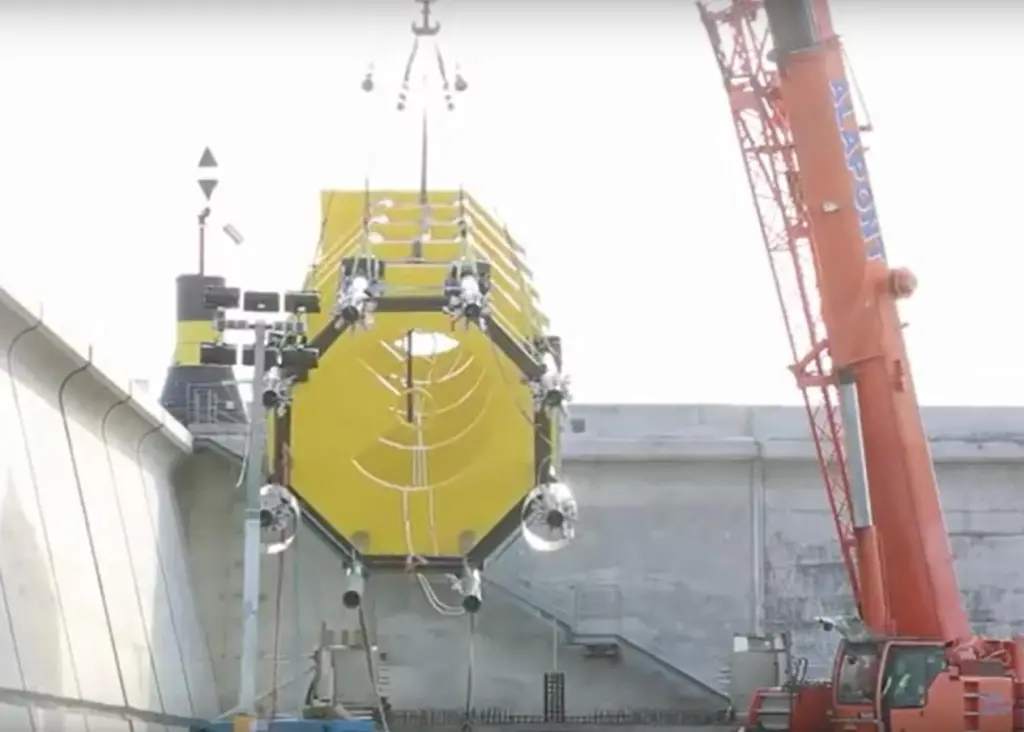
World leader in renewable energy, Acciona Infrastructures worked with close collaborators Aimplas, Dow, Saertex, Owens Corning and Autoridad Portuaria de Valencia, and in February 2016 completed the hoisting of the city’s new lighthouse, the first in the world made from composite materials.
The manoeuvre involved placing the new 32 metre lighthouse on its definitive site, the northern extension of the Port of Valencia. It is made from composites that provide higher resistance to exposure to the marine environment, reduce maintenance work and restrict the impact on the environment to a minimum.
The light weight of the composite materials, specifically developed by Acciona Infrastructures’ R&D centre, make the construction process of the lighthouse a pioneering one worldwide, with the structure being manufactured in Acciona’s Assembly Centre in Noblejas (Toledo province).
It was transported to Valencia by road, and once in the port was hoisted and anchored on its definitive site, reducing the time of the construction phase and, claims Acciona, avoiding around 20 per cent of the pollution associated with the construction of these infrastructures using traditional methods. The hoisting of the structure was successfully completed on Friday February 13th and took less than three hours, reducing interference with port operations to a minimum in the process.
Other work will continue following the hoisting of the structure, for example, placing the lamp, The installation is likely to be completed in April.
The new lighthouse is innovative in terms of its greater energy self-sufficiency, as it will have ten south-facing solar panels and a vertical axis wind generator that will reduce the energy consumption of the structure considerably. The lighthouse has also been equipped with LED technology, giving a range of 25 nautical miles with an electricity consumption of just 70 watts.
ADVANTAGES
- The use of composites in the construction of the lighthouse helps to make this kind of infrastructure more sustainable, both in environmental and economic terms.
- Quicker completion of construction work: the total manufacturing and installation time of the lighthouse is 40% lower than with the traditional process.
- Lower impact on port operations: apart from the fact that the total time of building the lighthouse is shorter, the time the port is affected is also much less because the assembly of the structure was done in the factory. This also means a smaller surface area and a shorter occupation time in the port, and less waste and noise in comparison with the work normally involved in the construction of a lighthouse.
- Longer working life of the lighthouse: one of the main advantage of using fibreglass or carbon fibre composites in harsh environmental conditions is that they are not affected by corrosion. This makes them very attractive for use in damp or marine environments; lighthouses built with traditional materials usually suffer considerable degradation, which leads to a shorter working life.
- Reduction in construction and maintenance costs: the use of composites is more efficient in economic terms because the construction process is faster and there is less need for the transport of materials. Furthermore, by resisting environmental conditions better, the lighthouse does not require investments in maintenance.
- A reduction of CO2 emissions in the construction process, due to fewer transfers of heavy materials and a lower level of extraction of aggregates. The environmental impact is believed to be 20% lower when using composites instead of traditional materials.
EFFECTIVE COLLABORATION
Huntsman Advanced Technology’s Head of European Technical Support, Philippe Christou said, “When companies work together hand-in-hand with shared research, technologies and ideas, successful innovation will be the outcome. Huntsman would like to congratulate all the companies who worked on our JEC global award-winning projects.”
In the Lighthouse project it was necessary to develop a low exothermic, low viscosity epoxy based infusion and RTM resin with long pot life and also a suitable epoxy based structural adhesive which was thixotropic and easy to apply on vertical surfaces.
The qualities of the resin were particularly important to meet the challenges encountered in moving from an open resin bath process to resin injection. Ultimately it was necessary to create a new resin system which offered low viscosity, low exothermic and long pot life.
Philippe Christou concludes. “JEC Innovation Awards are recognised throughout the composites industry and we are delighted to have shared in not just one but two this year. Even more important, though, is the fact that in both cases there have been direct and practical results which are providing end user benefits.”
By Jake Frith
Related Articles
 VESSELS
 MARINE CONSTRUCTION
 VESSELS