




Tug operations in ice
With recent deliveries to Svitzer and Alfons Håkans, Robert Allan Ltd (RAL) reflects on the detail of its TundRA class tug/icebreaker.
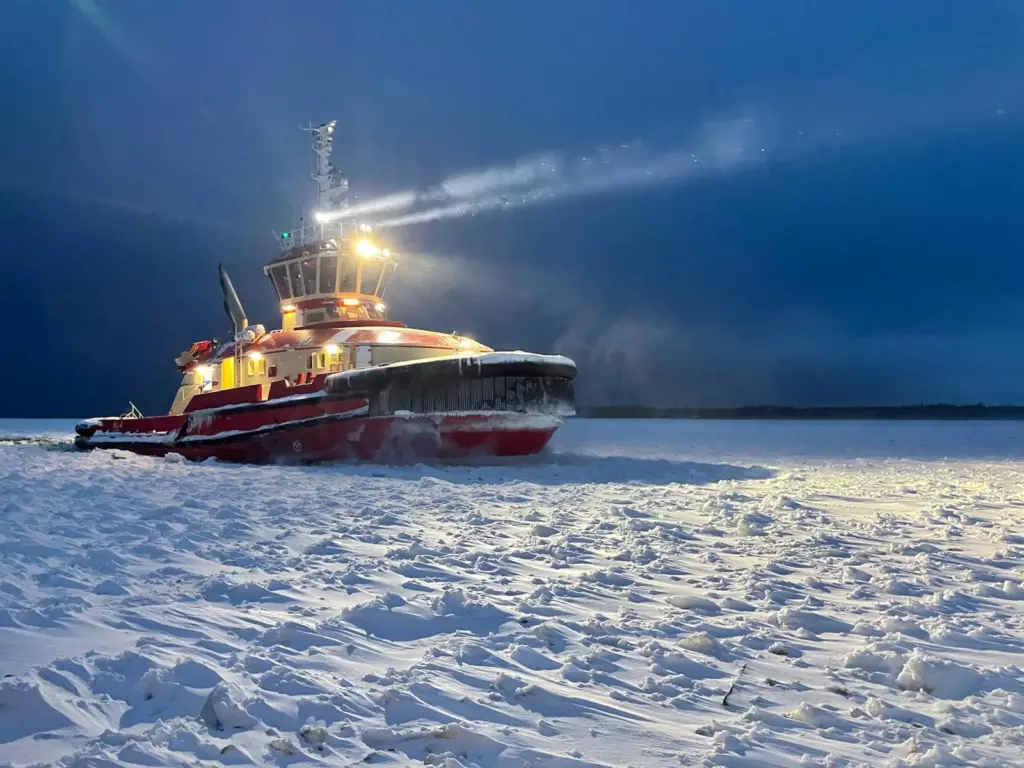
Shiphandling tug operators have a multitude of choices when it comes to selecting a suitable design to meet their requirements. As well as satisfying the obvious towing requirements some may need additional capabilities, for example pollution response, anchor-handling and navigation aid maintenance. A particular challenge for designers however is to produce a tug able to qualify as multipurpose but also to work in and manage ice conditions at ports affected by such and the TundRA is RAL’s answer.
In the northern Europe scenario, the TundRA hull structure meets Finnish-Swedish Ice Class Rules capable of continuously breaking ice up to 1m to 1.2m thickness at up to three knots. They are described as ‘multi-functional tools’ with open sea capabilities, also capable of escort duties and within a range of sizes including what is described as ‘compact designs.’
Such tugs break ice with their acceleration, weight, hull shape and power, their proven spoon-shape bow and round bilge hull form developed following extensive model testing. RAL explains further: “This hull shape merges into a modern ship-docking style bow, providing low fender contact pressures for shiphandling duties.” Ice-knives under the stern prevent large ice blocks contacting the propulsion units, the hull shape allowing dynamic clearing of a channel with a width twice the tug’s beam. More specifically the design has to be capable of ice breaking, ice management and channel clearing with covered foredeck winches and heated decks combating the elements.
The range varies from 19m to 36m in length with single-screw to Z-drive options and bollard pulls between 6t and 100t, RAL stating that the slightly less efficient open water performance resultant from a design optimised for the most onerous ice performance criteria can be minimised by using diesel mechanical electric hybrid power configurations designed to match the operational profile accompanied by the usual emissions and maintenance gains with such choices.
The recent deliveries of the TundRA marques mentioned above and reported in this column recently are the 65tbp Svitzer Edda and Svitzer Embla TundRA 3000 versions built by Eregli Gemi for Svitzer’s Scandinavian operations and the slightly larger Sanmar-built 3200 variants Selene and a second reportedly to carry the name Helios for Finland’s Alfons Håkans.
By Peter Barker
Related Articles
 TUGS & SALVAGE
 EQUIPMENT
 MARINE CONSTRUCTION